The AI Trade Melted Down Friday. Here's What Broke, and What Didn't
Nvidia -14%, Broadcom -12%, SanDisk -16%, IREN -18%, Nasdaq -5.3%. There was no single trigger: a flat Anthropic follow-through, a Reuters report on an SEC accounting probe at Nvidia, a Google TPU order shift, and a bearish NAND forecast all landed on one Friday. Who fell how much, and why the real damage is to the cost of capital for levered neoclouds, not to the GPU buildout itself.
Tom Pechulis, , 8 min read
Friday, November 20 was the worst day for the AI trade in a long time. The Nasdaq Composite fell 5.28% and went negative for 2026. The S&P 500 fell 3.7%, and both it and the Dow closed in correction territory, meaning 10% or more below their record closes (CNBC, Reuters via U.S. News).
Everyone wants one villain. Having read the coverage, I don't think there was one. Four separate pieces of news hit on the same day, on top of a market that was already nervous. My question for today: does any of it change how many GPUs, HBM stacks, and megawatts actually get built? Or does it mostly change what it costs to pay for them?
TL;DR
- What happened (fact): Nvidia closed -14.0%, AMD -13.2%, Broadcom -12.2%, Micron -13.9%, SanDisk -16.1%, CoreWeave -12.0%, Nebius -16.1%, IREN -18.0%. Anthropic, one day after its IPO, fell 8.5% (sources in the chart below).
- Why (fact, several triggers): (1) Anthropic's IPO didn't work as the "clearing event" bulls hoped for. (2) Reuters reported the SEC is looking at Nvidia's accounting. (3) Analyst Ming-Chi Kuo said Google is moving some 2027 TPU orders from Broadcom to MediaTek. (4) TrendForce said NAND flash prices start falling in Q1 2027. (5) Behind all of it, markets expect the Fed to raise rates in December.
- What it means (my opinion): A falling stock price doesn't cancel a GPU order. The hyperscalers pay for their builds out of their own cash flow. The neoclouds pay for theirs with borrowed money and new stock, so for them the share price is part of how the build gets funded. Friday made that money more expensive at exactly the moment Nvidia said it would be pickier about backstopping them.
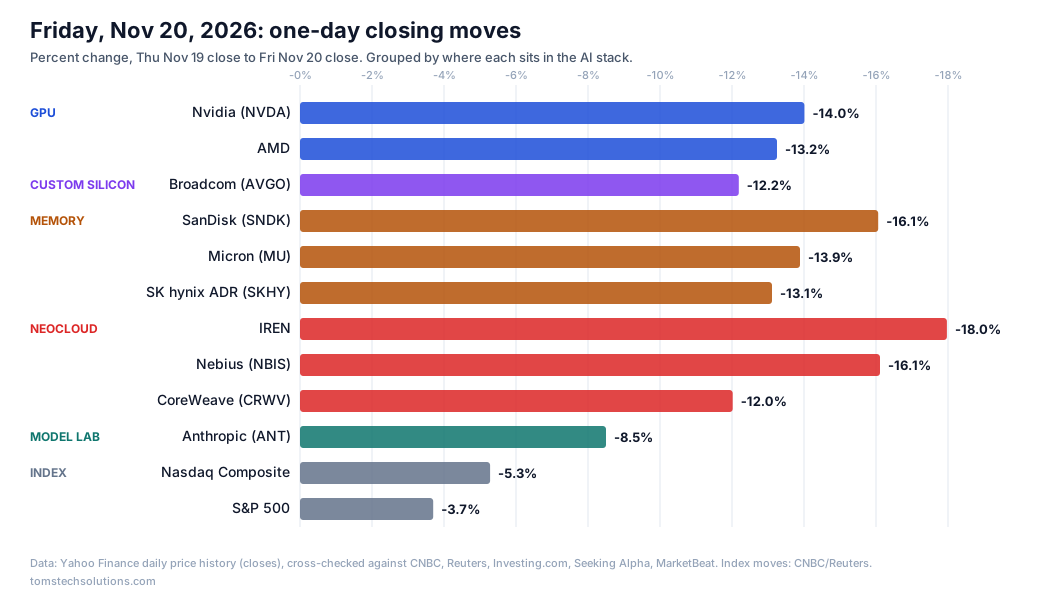
Chart data: one-day closes from Yahoo Finance price history for NVDA, AMD, AVGO, SNDK, MU, SKHY, IREN, NBIS, CRWV, ANT. I cross-checked them against Investing.com (NVDA -14.01%, AMD -13.25%, MU -13.89%, SNDK -16.06%, ANT -8.50%), Seeking Alpha (AVGO -12.19%), Reuters (CRWV -12.1%, NBIS -16.1%), and MarketBeat (IREN -18.1% midday).
Jargon decoder
| Term | Plain English | Everyday analogy |
|---|---|---|
| Correction / bear market | Down 10% / 20% from the peak | Your house's Zestimate dropping 10% vs. 20% |
| Neocloud | A company that rents out GPUs but isn't Amazon/Microsoft/Google (CoreWeave, Nebius, IREN) | An independent landlord vs. a giant REIT |
| Cost of capital | What it costs a company to raise money, through debt interest or by selling shares cheaply | The rate on your HELOC when you want to add a unit |
| NAND vs. HBM | NAND = flash storage (SSDs). HBM = the stacked high-speed memory sitting next to the GPU | The warehouse vs. the shelf right next to the cash register |
| Mix shift | A buyer keeps the order size but moves units to a different product or supplier | Same grocery bill, just a different store brand |
What actually triggered it: four headlines on one day
1. Anthropic's day two. Anthropic priced at $83, closed its first day Thursday up 17% at $97.17, then fell 8.5% on Friday (BBC, CNBC; Reuters printed -9.1%). "A lot of people, myself included, were looking to the Anthropic debut to some extent as a clearing event, and it wasn't," Horizon Investment Services CEO Chuck Carlson told Reuters. My math: the $88.91 close (Investing.com) is still about 7% above the $83 IPO price. I covered the IPO itself here.
2. The Nvidia accounting report. This was the big one for the GPU names. In the afternoon (7:13 PM UTC, about 2:13 PM ET), Reuters reported that SEC enforcement staff are "scrutinizing potential accounting issues" at Nvidia, citing two people briefed on the matter. Per Reuters, Nvidia was down more than 6% before the story and about 13% after it. The SEC declined to comment, and Reuters notes investigations "are not evidence of wrongdoing." One part of the story is about a geographic-revenue reporting change that took Singapore out of Nvidia's regional breakdown. Another is the broader worry about circular AI financing deals (Reuters). The BBC noted it had not confirmed the Reuters report itself (BBC). Nvidia closed -14.0%. Background on the CEO situation is in Nvidia After Jensen.
3. Google's TPU order shift (Broadcom). Ming-Chi Kuo of TF International said his industry survey shows Google trimming 2027 shipments of the Broadcom-designed TPU 8i by about 1M units (~20%), mostly the pricier 8i Max. Google would ship more of the MediaTek-designed TPU 8t instead. Kuo said the details aren't final, and neither company has commented (StockAnalysis). Broadcom finished at $304.41, -12.19% (Seeking Alpha). Treat this as one analyst's channel check, not confirmed by Google or Broadcom. I went through the 8i/8t split in this earlier post.
4. TrendForce turns on NAND. On Nov 19, TrendForce said NAND contract prices will start falling in Q1 2027, by 0% to 5% quarter on quarter. It expects NAND capex up 26.7% to $29.9B in 2027 and bit supply up 25–30%, while Chinese cloud providers cut 2027 enterprise SSD orders by more than U.S. clouds add (24/7 Wall St, StockAnalysis). SanDisk sells nothing but flash, so it closed -16.1%. That figure is measured against a split-adjusted prior close, because its 8-for-1 split took effect that same day (24/7 Wall St).
The backdrop. The selling started in Asia. Korea's Kospi and Japan's Nikkei closed down about 5% (BBC, StockAnalysis). Markets are pricing a near-certain 25 bp rate hike at the Fed's December meeting (Reuters). CNBC also lists the midterm results, "signs of moderation" in capex, and Jensen Huang's ouster as weights on the trade (CNBC). For the week, CNBC has the S&P -8.6% and the Nasdaq about -10% (CNBC).
Who fell how much, by layer
- GPUs: Nvidia -14.0%, AMD -13.2%. The accounting headline hit Nvidia directly, and AMD fell in sympathy.
- Custom silicon: Broadcom -12.2%, driven by its own news (Kuo). Marvell was down 9.2% intraday (StockAnalysis).
- Memory: SanDisk -16.1%, Micron -13.9%, SK hynix ADR -13.1%. Flash took the most damage, and HBM-heavy names took less. That matches TrendForce's call being about NAND, not HBM.
- Neoclouds: IREN -18.0%, Nebius -16.1%, CoreWeave -12.0%. This is the most leveraged layer and it fell the most.
- Power picks-and-shovels: Reuters said Caterpillar fell 5% "on worries over weakening demand for its power-generating and backup power equipment" (Reuters).
- Hyperscalers: Amazon -3.9%, Meta -5.9% (Reuters). Alphabet was flat as of 2 PM ET (StockAnalysis).
The infra read-through: does a selloff stop a single rack?
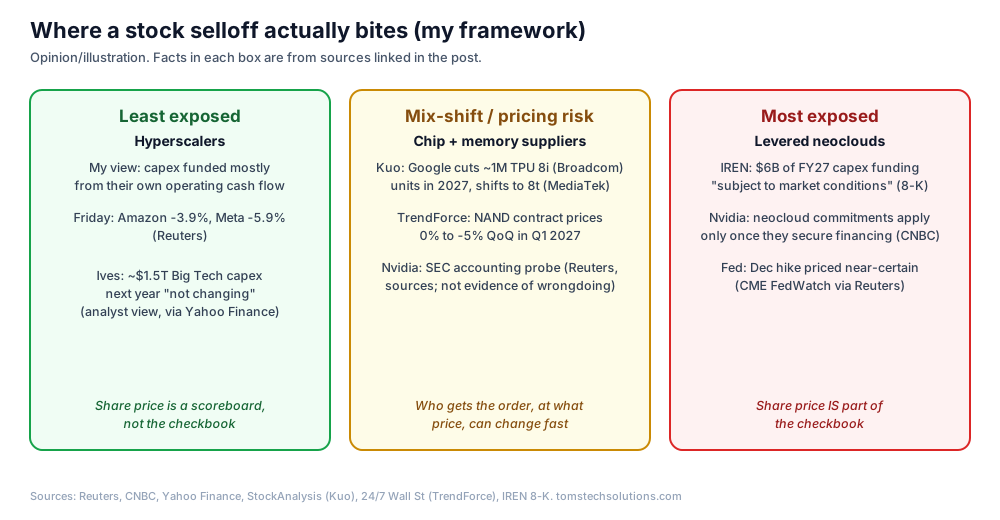
Everything in this section is my opinion unless it has a link.
For hyperscalers, a stock price is a scoreboard, not a checkbook. When Meta drops 6%, no data center loses its funding. Their capex comes mostly from operating cash flow, the same thing I walked through in the $730 billion question. Dan Ives' view is that Big Tech capex "in the $1.5 trillion range" next year "is not changing because of the panic" (Yahoo Finance). That's an analyst estimate, not company guidance. What would actually move capex is a guidance cut on an earnings call, and Friday didn't have one.
For suppliers, the risk is in the mix and the price, not the volume. The Google story is a mix shift: the same TPU program, with more units going to MediaTek. Kuo himself ties it to Google putting frontier-model compute first "amid a tight supply chain and data center power constraints" (StockAnalysis). That's bad for Broadcom's 2027 share of Google's spend. It doesn't say Google is buying less compute. Same with memory: TrendForce's call is a NAND price call. Micron still guided to $61.5B this quarter, up from $54.2B, and trades around 3.4x forward earnings per StockAnalysis's data (StockAnalysis). Nothing Friday said HBM demand is rolling over.
For neoclouds, the share price is part of the checkbook. That's the part that worries me. Look at what IREN wrote in its own Q1 FY27 release: of $15B remaining planned FY27 capex, $9B is cash and committed financing. The other $6B is "target GPU financing, prepayments, data center financing and other corporate level sources subject to market conditions." Friday, market conditions got worse: IREN closed at $11.82, down 18% (MarketBeat, Yahoo Finance). It was also down 18% intraday back on Nov 5 on a Bloomberg report about Microsoft's concerns over delays (Investing.com; my take on that here). When your stock is down that much, raising equity means selling a lot more of the company for the same dollars. And lenders pricing GPU-backed debt see the same screen you do.
And the backstop got weaker the same week. On Nvidia's earnings call, analysts flagged a new footnote: Nvidia's neocloud commitments take effect only if the neoclouds secure financing, and they may be reduced or eliminated if construction slips. Morgan Stanley's Lindsay Tyler cut her deployment estimate to 4 GW from 5 GW after disclosed neocloud commitments fell to $32B from $36B quarter over quarter (CNBC). Put that next to a Fed that markets expect to hike, and you get the circularity I wrote about in Nvidia, the Cosigner and GPU Debt, Decoded, now running the other way. Weaker equity leads to tighter financing, tighter financing slows builds, and slower builds lead to weaker equity.
One wrinkle: the 10-year Treasury yield actually fell, from 5.05% to 4.94% intraday (StockAnalysis), as money moved into safe bonds. The baseline "risk-free" rate went down. What went up is the extra premium investors want to fund risky AI builders. I don't have a sourced Friday number for that premium (credit spreads), so I won't make one up. Watch the next neocloud bond or convert deal for the real price.
Where I land (opinion): Friday repriced who gets to fund the buildout and at what rate. It didn't reprice whether the buildout happens. The GPUs and HBM going to hyperscalers and funded labs still get built. The marginal megawatt at a levered neocloud is the one that slips. (On Oracle's late-Friday "fully funded" statement, see yesterday's post. I won't rehash it.)
What would change my mind: a hyperscaler cutting capex guidance, the SEC probe turning into restated revenue at Nvidia, or HBM contract pricing (not NAND) rolling over. Any of those is a real demand signal. Friday was mostly a financing and sentiment signal. Bear in mind that "everything down 13%" days can also be forced selling, and those can reverse quickly. I'm not calling a bottom.
Next up
- Week of Nov 23: PCE inflation data, which Reuters describes as the next input on the Fed's December decision (Reuters).
- Wed, Dec 9: Broadcom fiscal Q4 results. This is the first chance for management to address Kuo's TPU report (StockAnalysis).
- Thu, Dec 17: Micron fiscal Q1 results, where it can respond to the TrendForce outlook (StockAnalysis).
- January 2027 (may slip to February): IREN's target date for its >$4B contracted ARR (IREN 8-K).
Not investment advice. Price moves are one-day closing changes from Yahoo Finance history, cross-checked against the reports linked above. Where sources differ slightly (e.g., Anthropic -8.5% vs. -9.1%), I note it. The SEC probe details come from unnamed sources via Reuters, and the Google TPU shift is one analyst's survey. Neither has been confirmed by the companies. "My math" marks numbers I derived from cited figures.