A $5.4B Lease on Monday, a Stalled Loan Sale on Thursday: Two Sides of the AI Data Center Money Machine
Applied Digital signed an 18-year, 150 MW lease with an unnamed investment-grade hyperscaler at higher pricing than its June deal. Four days earlier, ING couldn't clear a ~$500M auction of data center loans. Landlords are still signing; some lenders want out. What each side tells you about who carries AI build risk.
Tom Pechulis, , 7 min read
Two stories landed within a few days of each other, and I think they're best read together.
On Monday morning, Applied Digital (APLD), which builds AI data center campuses and leases them to big cloud companies, announced a new 18-year lease for 150 MW with a "tier-one investment-grade hyperscaler" it didn't name. Last Thursday, the Dutch bank ING tried to auction about $500 million of loans tied to a dozen data centers and didn't get enough bids at prices it would accept.
Same industry, opposite moods. The tenants still want space and are paying more for it. Some of the banks that lent the construction money would like to own less of it.
TL;DR
- The lease (fact): About $5.4B of contracted revenue over an 18-year base term, or about $12.7B if every renewal option is used (33 years total). Applied Digital says the pricing is higher than its earlier leases. Delivery is expected to start in the first half of 2028 (company release, Reuters).
- The loan sale (fact): ING's ~$500M package included a $25M piece of Project Jupiter in New Mexico, part of the OpenAI/Oracle/SoftBank Stargate effort. The formal bidding closed without enough interest, so ING is now selling the loans one by one (Bloomberg Law, Restructuring News).
- My take: Demand for powered AI buildings isn't the problem. The market is getting pickier about construction and power risk, meaning the stretch between "lease signed" and "rent starts." That's exactly the stretch Applied Digital is entering with this deal, since rent here doesn't start until 2028.
Quick jargon decoder
- Critical IT load (MW): the power available to the actual servers, not counting cooling and other overhead. 150 MW of IT load is the size of the "box" being rented.
- Hyperscaler: one of the giant cloud companies (Microsoft, Google, Amazon, Meta, Oracle and so on).
- Investment-grade: a credit rating that says the tenant is very likely to pay its bills. Lenders love these tenants.
- Base term vs. renewals: the base term is what the tenant is locked into. Renewals are options the tenant may use. Only the base term is a firm commitment.
- Project finance: a loan secured by one specific project and its contracted revenue (here, the lease), not by the whole company.
- Cents on the dollar: a loan trading at 85 cents means a buyer pays $0.85 for every $1.00 of loan, a 15% discount that reflects perceived risk.
- Force majeure: a contract clause that excuses delays caused by events outside a party's control.
The lease: more money per megawatt, but it starts in 2028
Here is what Applied Digital actually disclosed (release):
- 150 MW of critical IT hapacity, 18-year base term, ~$5.4B base-term revenue, ~$12.7B with all renewals over 33 years.
- Total contracted base-term lease revenue is now above $41B, or about $100B with every renewal.
- Portfolio: over 1.6 GW of contracted critical IT load and 2.2 GW of grid-connected peak load.
- About 75% of contracted base-term revenue comes from investment-grade tenants.
- Delivery "currently anticipated to begin in the first half of calendar 2028, subject to applicable development milestones, utility arrangements and regulatory approvals."
The company said the new lease has "higher pricing" than its earlier ones but didn't give a per-megawatt number. You can back into a rough one. Reuters notes that in June Applied Digital signed a 15-year, 210 MW lease worth about $5.2B at its Delta Forge 2 site.
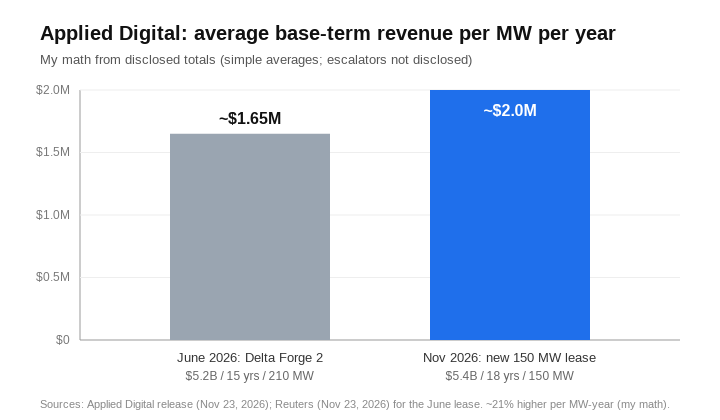
Chart: my math from disclosed totals. June lease: $5.2B / 15 years / 210 MW. New lease: $5.4B / 18 years / 150 MW. These are simple averages. The real contracts likely include annual rent increases (escalators), and neither disclosure says what is included in the rent, so treat this as a direction, not a precise price.
- New lease (my math): $5.4B / 18 / 150 MW ≈ $2.0M per MW per year.
- June lease (my math): $5.2B / 15 / 210 MW ≈ $1.65M per MW per year.
- That's roughly 21% more per megawatt per year (my math: 2.0 / 1.65), which fits the company's "higher pricing" claim.
One more number that caught my eye. Take the renewal value minus the base-term value: $12.7B - $5.4B = $7.3B over the 15 optional years. Divided by 150 MW, that's about $3.2M per MW per year (my math). That's far above the base-term average, which suggests the rent keeps climbing through the life of the deal. The release doesn't explain how renewal rent is set, so I'd treat that $12.7B as a ceiling, not a forecast.
In plain English: whoever this hyperscaler is, they're signing up for 18 years of rent on a building that won't start delivering for about two years, and they're paying more per megawatt than a tenant did five months ago. That's not what a cooling market looks like. Powered, permitted, liquid-cooled shells are still the scarce thing, and owners who have them can raise the price.
How the build gets paid for
This is where the two stories connect. Applied Digital's CFO laid out the funding plan (release):
- "First-in equity already funded from our balance sheet."
- Its $5B programmatic equity partnership with Macquarie Asset Management.
- Then project financing backed by the long-term lease with the investment-grade tenant.
It also said it expects to finish the remaining project financing for its Delta Forge 1 and Polaris Forge 3 campuses in the first calendar quarter of 2027, and Delta Forge 2 in the second quarter. Separately, it closed a $300M senior secured bridge loan for Delta Forge 1 in Louisiana (Investing.com). A bridge loan is short-term money to keep construction going until the long-term financing closes.
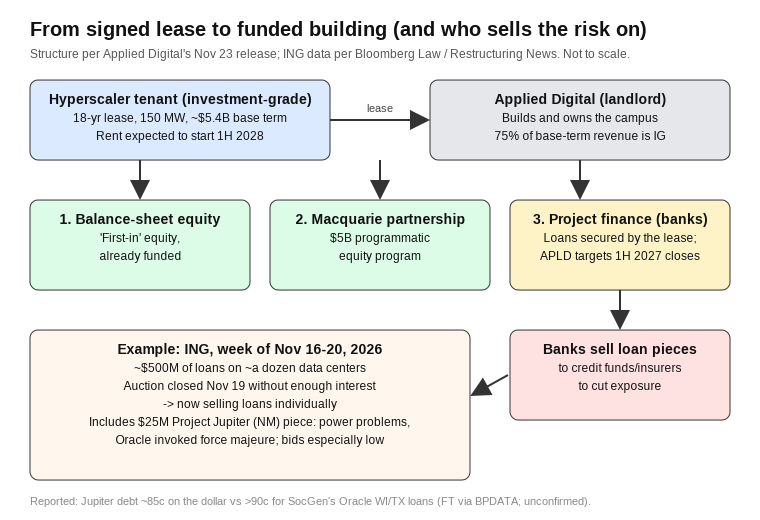
Diagram: structure from Applied Digital's Nov 23 release; ING figures from Bloomberg Law and Restructuring News; Jupiter pricing as reported by the FT via BPDATA. Not to scale.
Step 3 is the one that matters for today. Banks write the project loans, and then many of them sell pieces to other investors (credit funds, insurers) so they aren't stuck holding too much of one sector. If those buyers start asking for bigger discounts, the banks get choosier, and the cost of the next project loan goes up. That's what the ING sale is showing.
The loan sale: it's the power, not the tenant
What we know about ING's attempt:
- A roughly $500M auction of loans tied to about a dozen data centers, run as a "bids wanted in competition" (basically an auction among loan buyers). The window closed on Thursday, Nov 19 without the interest ING needed; some buyers are now negotiating directly with the bank (Bloomberg Law, Restructuring News).
- The package included loans tied to operators such as Vantage and CyrusOne, plus a $25M participation in Project Jupiter in New Mexico. Bids for the Jupiter piece were reportedly especially low. The project has had power problems, and Oracle previously invoked force majeure there (Restructuring News).
- Per the Financial Times, as summarized by BPDATA, Société Générale is also selling about $300M of Oracle project loans for Wisconsin and Texas, quoted at more than 90% of face value, while Jupiter-linked debt was expected around 85%. I couldn't open the FT piece itself, so treat those prices as reported, not confirmed.
Two caveats worth being fair about. First, Restructuring News points out that nothing reported says these loans are non-performing. Banks sell healthy loans all the time to free up capital, especially near year-end. Second, $25M is tiny next to the size of these projects. If you bought the Jupiter piece at 85 cents, the discount is about $3.75M (my math: $25M × 15%). The size isn't the point. The pattern is: the same buyers who will pay 90+ cents for a project with power sorted out want a real discount on one where power is still uncertain.
Why these belong in the same post
Put the two side by side and the market is drawing a clear line:
| Applied Digital's new lease | ING's Jupiter loan | |
|---|---|---|
| Tenant quality | Investment-grade hyperscaler | Oracle / Stargate |
| Power status | "Subject to ... utility arrangements" | Power problems, force majeure invoked |
| Rent starts | 1H 2028 (expected) | Delayed |
| What the market did | Paid more per MW (my math above); stock up ~13% Monday morning (Investing.com) | Bids too low for ING to accept |
The tenant isn't really the variable. Both have big, creditworthy names behind them. The variable is whether the electrons show up on time. A lease with a great tenant doesn't pay anything until the building is energized, and lenders are now pricing that gap.
So here's what I'm watching for Applied Digital specifically:
- The Q1 and Q2 2027 project financings. The company has given dates. If they close on time and at reasonable spreads, the "lenders are nervous" story mostly doesn't apply to it. If they slip, it does.
- The 2028 delivery language. "Subject to utility arrangements and regulatory approvals" is standard boilerplate, but after Jupiter it's the clause I'd read first in every update.
- The other 25%. About 75% of contracted base-term revenue is investment-grade, so roughly $10B is not (my math: 25% × $41B). That's the slice credit buyers will look at hardest.
The take, low-key: the AI data center trade isn't one trade anymore. "Power on, IG tenant, rent flowing" is getting more valuable. "Power pending" is getting marked down. If you're a GPU buyer, that means capacity arriving on schedule in 2027-28 will cost more, not less, because the landlords who can actually deliver it know exactly what they've got.
Sources opened for this post: Applied Digital release (Nov 23), Reuters via StreetInsider (Nov 23), Investing.com (Nov 23), Bloomberg Law (Nov 20), Restructuring News (Nov 22), BPDATA summary of FT reporting (Nov 18). Not investment advice.