879,868 AI Chips Approved for China, Zero Marked Shipped: Reading the BIS Paper Trail
Congress just published the Commerce Department's license ledger for Nvidia H200 and AMD MI325X sales to China. Here's what the documents actually show, who got what, the middlemen lawmakers are worried about, and why 'approved' is not the same as 'shipped' for Nvidia's and AMD's China revenue.
Tom Pechulis, , 9 min read
On Wednesday I broke down Nvidia's earnings (my breakdown), including the line that Nvidia is "no longer shipping" licensed Hopper chips to China. A day later, the House Foreign Affairs Committee did something it says has never been done at this level of detail: it published the Commerce Department's own license records for Nvidia H200 and AMD MI325X sales to Chinese companies (HFAC press release).
The headline everyone ran was "879,000 chips approved for China." That's true. But I read the actual tables, and the more interesting word is the one next to every approval: "not shipped."
TL;DR
- 3,444,160 chips requested, 879,868 approved across 21 licenses, as of May 11, 2026 (HFAC summary). That's about one in four (my math: 879,868 ÷ 3,444,160 = 25.5%).
- Every approved row reads "Approved, not shipped" in the BIS status table (BIS license table). It's a May snapshot released in November, not a shipping log.
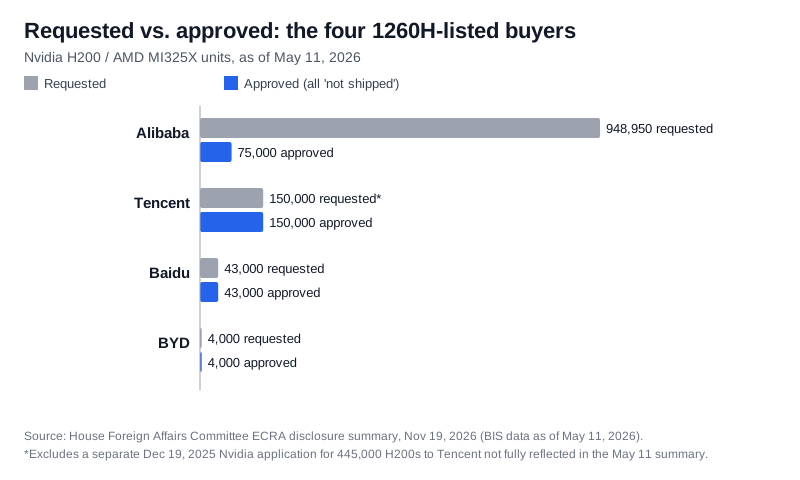
- Military-listed buyers got approvals: 75,000 for Alibaba, 150,000 for Tencent, 43,000 for Baidu, 4,000 for BYD, all companies on the Department of War's 1260H list of Chinese Military Companies (HFAC summary).
- The middlemen are the real story. Almost every Nvidia application named the same small set of installers, including two firms Chairman Mast called "fake companies" (CNBC).
- Money: Nvidia did book $2.4B of licensed Hopper sales to China last quarter, then stopped (Reuters). The China pipe is now closed from both ends, and this week's rules are squeezing the side doors too.
Quick jargon decoder
| Term | Plain English |
|---|---|
| BIS | The Bureau of Industry and Security, the part of the Commerce Department that decides who gets an export license. |
| ECRA | The Export Control Reform Act, the law behind BIS. It normally keeps license data secret, but lets Congress release it if withholding is "contrary to the national interest" (HFAC summary). |
| Export license | A government permission slip to sell a controlled item to a specific buyer. Think of a building permit: having one doesn't mean the house is built. |
| H200 / MI325X | Nvidia's Hopper-generation AI chip and AMD's comparable part. These are the two "covered integrated circuits" in the data (HFAC summary). |
| 1260H list | The Department of War's list of "Chinese Military Companies"; the latest version is from June 2026 (HFAC summary). |
| Entity List | A separate BIS blacklist that puts license requirements on named companies for activities against U.S. security or foreign-policy interests (BIS, 15 CFR 744). |
| RWA | "Returned without action": BIS sent the application back without approving or denying it, typically over deficiencies it couldn't resolve (15 CFR 750.4). |
| Diversion | Chips sold to an approved buyer that end up somewhere (or with someone) they weren't supposed to. |
What the documents actually say
There are two PDFs. One is a short committee summary. The other is the BIS status table itself, titled "H200 License and Equivalent Application Status as of May 11, 2026" (BIS license table).
I added up every row in the table myself. The totals tie out exactly to the committee's numbers: 3,444,160 requested and 879,868 approved across 21 approved rows. Here's how the 54 applications break down (all my math from the table):
- Approved: 879,868 chips, 21 applications. All "Approved, not shipped," all with China as the location.
- Returned without action (RWA): 1,888,950 chips, 9 applications. That includes a single Nvidia request for 610,000 chips for Alibaba Group, plus 1,118,500 chips bound for Malaysia, Indonesia and Thailand, for entities named Bytedance System, PT Byteplus, Alibaba Cloud and TikTok (System) Thailand.
- Still "Submitted": 600,342 chips, 23 applications.
- Rejected: 75,000 chips, one AMD application (UCloud).
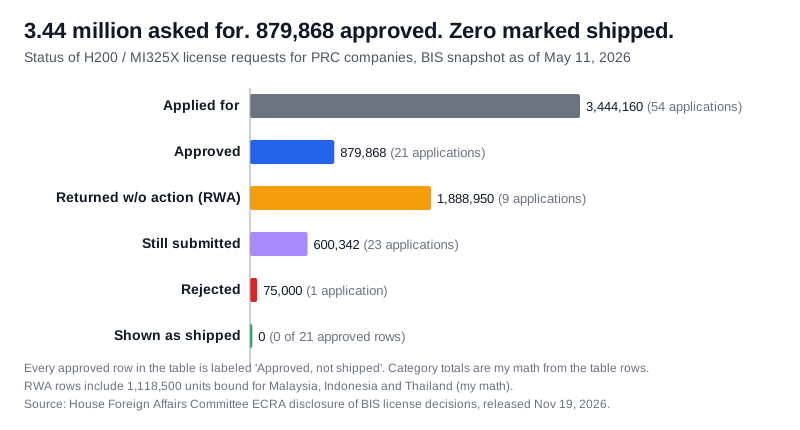
So the biggest bucket isn't "approved" or "denied." It's "sent back." That's a meaningful nuance the headlines skipped.
And the table isn't complete. The committee says it holds other applications not fully reflected in the May summary, including a Dec. 19, 2025 Nvidia request to export 445,000 H200s to Tencent (HFAC summary).
Who got what
Most big approvals were 75,000-unit blocks: Alibaba, ByteDance (one Nvidia and one AMD license), Tencent (one Nvidia, one AMD via a subsidiary), VNET, Kuaishou, DiDi and Linkwise, plus miHoYo (57,810), Baidu (43,000), JD (41,300) and small automaker licenses for Tesla Shanghai, BYD, Great Wall and Li Auto (BIS license table).
The part lawmakers jumped on is the 1260H overlap. Alibaba asked for 948,950 chips across its entities and got 75,000 approved (my math: about 8%). Tencent, Baidu and BYD got everything they asked for in the May summary (HFAC summary).
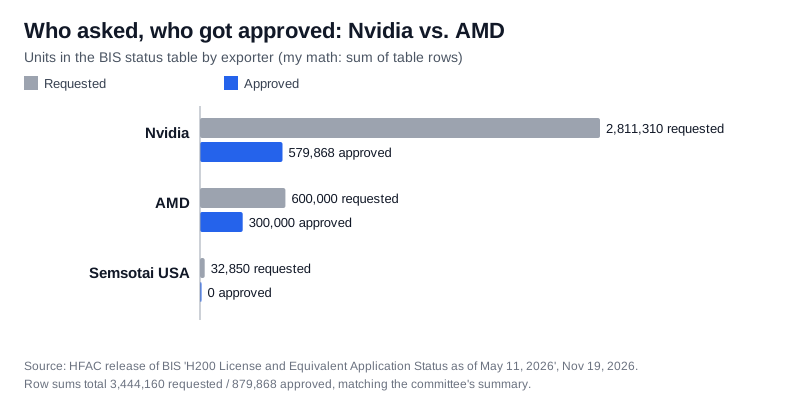
By vendor, Nvidia asked for far more and got a smaller share. My math from the table: Nvidia requested 2,811,310 and got 579,868 approved (about 21%). AMD requested 600,000 in eight 75,000-unit applications and got 300,000 approved (50%). The remaining 32,850 were pending applications from a U.S. exporter called Semsotai for Sharetronic Data Technology.
Bernstein's Stacy Rasgon read it the same way: "it sounds like they approved about one out of every four," and "It doesn't sound to me like they're approving everything they got willy nilly" (CNBC). Ranking Member Meeks read it differently, saying BIS "seemed to approve licenses for advanced chips to China with little scrutiny" while other license reviews were badly delayed (Meeks remarks). Both can be true: a 25% approval rate is selective, and approving 1260H-listed companies at all is a policy choice.
The middlemen
This is the section I'd read twice. Per the committee, all but two Nvidia applications list Maginfra, Beijing New Matrix Information Technologies, ZTE Kangxun Telecom and Lenovo (or subsidiaries) as entities that "may install the systems in the datacenter." Others named on multiple Nvidia applications include Aivres Systems, XFusion, Cloudnine and Changkuai Computing (SmoothCompute). Some of these also appear as ultimate consignees on AMD applications (HFAC summary).
Analogy: a permit to deliver 75,000 pianos is only as good as the movers named on it. If a mover has an empty office, the permit doesn't help much.
That's the allegation here. The committee cites public reports raising diversion questions about Maginfra, New Matrix and Aivres. Mast called Maginfra and New Matrix suspected "smuggling fronts" and said "Both are fake companies." CNBC notes the New York Times reported both had empty offices and ties to sanctioned companies; the two firms didn't respond (CNBC). These are allegations, not findings. Nothing released shows a chip actually being diverted.
The detail that will age worst: every Nvidia and AMD application rated the diversion risk as "low" (HFAC summary). Nvidia says it followed the regulations in effect at the time, and both companies say they comply with export law (CNBC).
Approved is not shipped (but some did ship)
The "879,868 chips went to China" framing is the version I'd push back on. The table says not shipped as of May 11. It doesn't tell us what happened next.
What we know from other reporting:
- Nvidia sold $2.4B of licensed Hopper data center products to China in the quarter ended Oct. 25, and interim CEO Colette Kress said "we are no longer shipping licenced Hopper data centre products to China" (Reuters). So at least some licensed chips shipped after May.
- Reuters reported earlier this month that about 600,000 H200s were sitting in Hong Kong awaiting shipment to the mainland after Beijing withheld approval for large-scale imports, and that several big Chinese internet companies had each obtained about 10,000 (Reuters). That's anonymous-source reporting, so treat it as directional.
- Nvidia's spokesperson to CNBC: "Despite receiving some licenses, we have since stopped shipping H200s to China" (CNBC).
So the bottleneck was never only Washington. Beijing was the other gate.
What it means for Nvidia's and AMD's China revenue
For Nvidia, the direct hit is already in the numbers. Kress said the guidance "does not have any licenced Hopper data centre products included" (Reuters); I covered the rest of the guide in Wednesday's post. CNBC puts China and Hong Kong customers at about 9.5% of Nvidia's total revenue last quarter, and notes H200 shipments to China were under 1% of data center revenue in the quarter that ended in July (CNBC). Rasgon's verdict on the licensed China business: "it's a rounding error. It's tiny" (CNBC).
So 879,868 approvals isn't a hidden pile of revenue waiting to show up. It's a ceiling Nvidia just walked away from, and the $2.4B quarter looks like a one-off, not a run rate (my read).
For AMD, I didn't find a sourced China MI325X revenue number, so I'm not going to guess one. What the table shows is 300,000 approved units, all "not shipped" as of May. AMD's statement was simply that it "complies with applicable U.S. export control laws" (CNBC).
The side doors are closing too
This is the GPU supply picture in one week:
- Remote access. Commerce issued a rule to close the loophole that let Chinese companies rent Nvidia compute in data centers in third countries (CNBC). It took effect Thursday, the day it was published, and shipments already in transit can proceed under the old terms until Dec. 21 (StockAnalysis, citing the FT).
- Foundries. TSMC told affected Chinese designers that orders at 16nm and below are halted unless they get U.S. licenses, generally limiting them to 28nm and 40nm without HBM or advanced packaging, per two people familiar (Reuters). The FT reported TSMC and Samsung paused some shipments to Chinese customers pending licenses (StockAnalysis, citing the FT). TSMC says it will comply with the new BIS rules and doesn't comment on rumors (Reuters).
- Neoclouds. Japan's Datasection cut its fiscal-year revenue forecast to ¥17.3B from ¥162.2B (-89.3%), mostly because a ¥79.86B AI infrastructure order was cancelled (Kabuto, summarizing the filing). The China link is reported, not confirmed: Barron's and the FT reported Datasection supplied Tencent through Nvidia servers in Southeast Asia, and the company has neither confirmed nor denied it (Investing.com).
- The military angle. The U.S.-China Economic and Security Review Commission's 2026 report says the PLA has been "actively soliciting" Nvidia's most advanced chips and that China "is seeking to evade U.S. export controls" (CNBC).
Put together: the front door (licensed H200s) is shut by Nvidia and throttled by Beijing, the rental window (offshore data centers) needs a license now, and the build-your-own route (TSMC/Samsung fabbing Chinese designs) just got much narrower. For the rest of the world, my read is that this frees up Hopper supply rather than tightening it. That's my inference, not something any source quantified.
My take
- The headline number oversells. 879,868 is a permission count, not a delivery count. Quote-tweeting "Commerce sent 880k GPUs to China" is ratio bait, not reading.
- The 1260H approvals are the policy question. Approving companies on a military-company list is what I expect lawmakers to press hardest.
- The middlemen are the risk question. One shared set of installers across nearly every Nvidia application, all rated "low" risk, is the thread I'd pull.
- I could be wrong about the shipped-vs-approved gap being large. Nvidia's $2.4B quarter proves some chips moved after May, and the released data can't tell us how many or to whom.
Next up
- Dec. 1: Jensen Huang's closed-door transcribed interview with House Foreign Affairs and two other committees. Dec. 2: Nvidia general counsel Tim Teter (CNBC).
- Dec. 21: the cutoff for in-transit shipments under the old terms of this week's Commerce rule (StockAnalysis, citing the FT).
- No date yet: Meeks wants public hearings with Commerce Secretary Howard Lutnick and BIS Undersecretary Jeffrey Kessler (Meeks remarks). I'll cover it if it gets scheduled.
Not investment advice. License figures are from BIS records dated May 11, 2026, as released by the House Foreign Affairs Committee on Nov. 19; they don't show what shipped after that date. "My math" labels mark numbers I derived from the published tables. Diversion claims about named companies are allegations from lawmakers and press reports, not findings.