Who Pays for the Vera Rubins? SpaceX's $44B Chip Lease vs. Oracle's 'Fully Funded' Plan
Two AI compute financings landed on the same Friday: Apollo and Goldman priced ~$44B of GPU-backed notes for SpaceX's Nvidia Vera Rubin buildout, and Oracle said its OpenAI contract is fully funded. Here's how each one pays for the GPUs, what the collateral and lease terms actually mean, and my math on what the money costs.
Tom Pechulis, , 11 min read
Every GPU in a data center gets paid for by somebody. Usually it isn't the company whose logo is on the building.
On Friday we got two clean examples of how this works at the top end. In the morning, Apollo and Goldman Sachs announced they had priced about $44 billion of notes to buy Nvidia Vera Rubin GPUs for SpaceX. They called it "the largest GPU financing executed to date." After the close, Oracle put out a statement saying it "has secured all the funding we need to fulfill our contract with OpenAI."
Both deals buy the same chips. They pay for them in very different ways. I covered the general plumbing (SPVs, spreads, swaps) in GPU Debt, Decoded, so today I'm focusing on these two deals and what they tell us about who is actually carrying the risk.
TL;DR
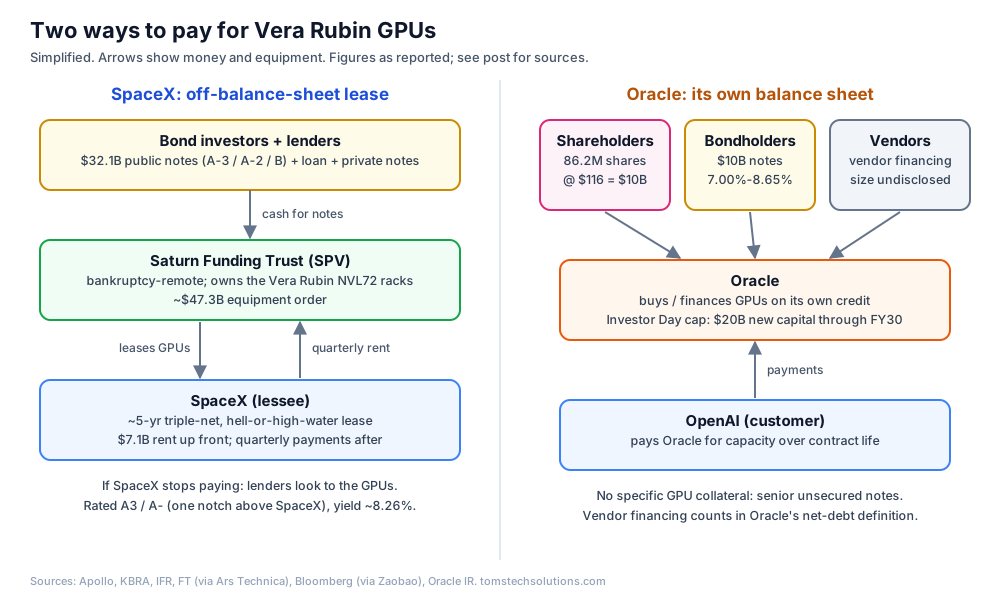
- SpaceX (debt, off the balance sheet): An Apollo-owned trust sold $32.1B of chip-backed bonds. It will buy Vera Rubin NVL72 racks and lease them to SpaceX for about five years (IFR). The whole package is ~$44B, oversubscribed and upsized (Apollo, Reuters).
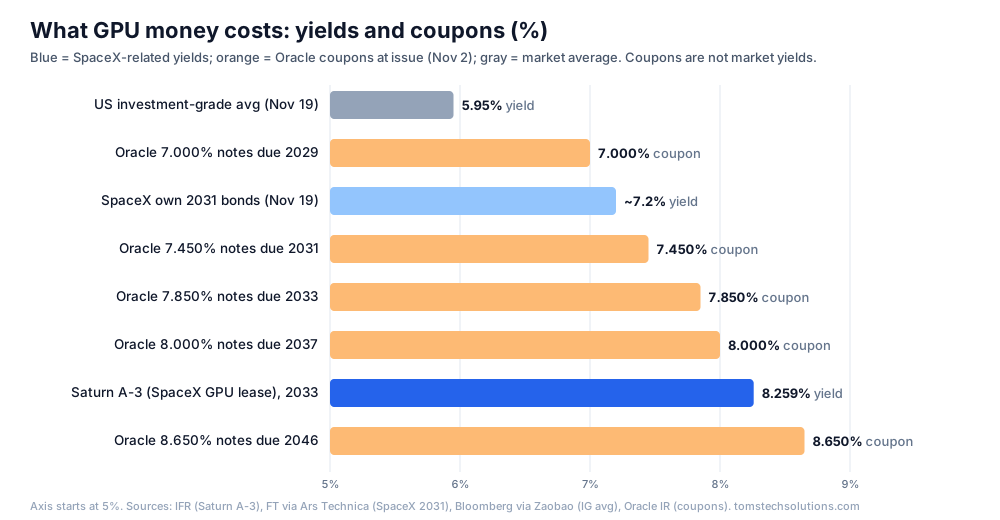
- Rated higher than SpaceX, but it pays more: The big $25.2B tranche is rated A3, one notch above SpaceX's own rating, yet it yields ~8.3%. SpaceX's own 2031 bonds yield ~7.2% (FT via Ars Technica). My math: that gap is roughly $270M a year of extra interest on that one tranche.
- The space clause: Lenders tried to stop Musk from launching their collateral into orbit. It's unclear whether that made the final documents (FT via Ars Technica).
- Oracle (equity + its own debt + vendors): Oracle raised $20B this month, $10B in stock at $116/share and $10B of notes at 7.000%–8.650% coupons (Oracle IR). Friday, it said that raise plus vendor financing means the OpenAI contract is fully funded (Oracle).
- The common thread: Neither company is paying cash up front for most of its GPUs. Lenders, shareholders, and chip vendors are paying first. Everyone is betting the GPU revenue shows up before the hardware is obsolete.
Jargon decoder
| Term | Plain English | Everyday analogy |
|---|---|---|
| SPV / trust | A separate legal entity set up just to own the assets and issue the debt. Here it's Saturn Funding Trust (KBRA). | A holding company that owns one rental building |
| Bankruptcy-remote | Built so that if the parent goes bust, the SPV's assets don't get pulled into the parent's bankruptcy. | A safe-deposit box that stays shut even if the bank's owner goes broke |
| ABS (asset-backed security) | A bond repaid from a specific pool of cash flows and backed by specific assets, not just a company's general promise. | A car loan where the car is the collateral |
| Collateral | What lenders can seize and sell if the borrower stops paying. Here: the GPU racks. | The house behind a mortgage |
| Senior vs. subordinated | Seniors get paid first from collateral proceeds. Subordinated ("sub") gets paid after, so it earns more for taking more risk. | First in line vs. back of the line at the buffet |
| Oversubscribed / upsized | Investors asked for more bonds than were on offer, so the deal got bigger. | A concert so popular they add a second show |
| Hell-or-high-water | The tenant has to keep paying rent no matter what, even if the equipment breaks. | A car lease where you still owe the payment after you wreck the car |
| Triple-net lease | The tenant also pays for maintenance, insurance, and taxes. | Renting a house where you also pay the property tax and fix the roof |
| Spread (bp) | Extra yield over US Treasuries. 345 bp = 3.45 percentage points. | Your credit-score markup over the base rate |
| Take-or-pay | A buyer commits to pay for capacity whether or not it uses it. Same idea as hell-or-high-water, seen from the customer's side. | A gym membership you pay for even if you never go |
| Vendor financing | The supplier lets you pay for hardware over time instead of up front. | Store-credit financing on a new fridge |
Deal 1: SpaceX's "Project Saturn"
How the money flows
Here's the structure, pieced together from the rating agency and deal reporting:
- Saturn Funding Trust is a new bankruptcy-remote entity. It's an indirect subsidiary of WHCO Intermediate Holdings, an asset-backed lender that KBRA calls "unaffiliated" with SpaceX (KBRA). IFR describes the trust as Apollo-owned (IFR).
- The trust buys Vera Rubin NVL72 equipment. WHCO leases it to SpaceX under an "approximately five-year triple-net, hell-or-high-water finance lease," with quarterly payments intended to fully pay off the debt (KBRA).
- The point of the structure is to keep the debt off SpaceX's balance sheet and protect its investment-grade rating (FT via Ars Technica).
- Leases start when the equipment is delivered, expected in 1H 2027 (Apollo). Bloomberg reported deliveries starting in January (Zaobao, citing Bloomberg).
- Anchor investors were funds run or advised by BlackRock, Goldman Sachs Asset Management, and KKR. Goldman was sole structuring agent (Apollo). Pimco committed $4B ahead of launch (FT via Ars Technica).
The capital stack
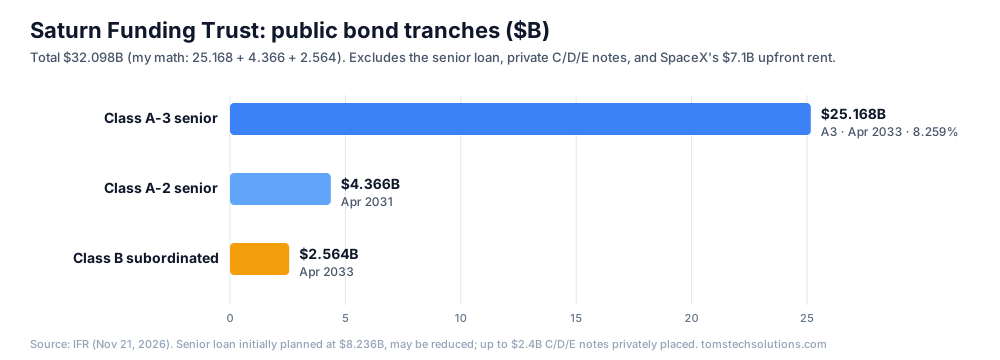
The headline numbers don't match exactly. Apollo says "approximately $44 billion" (Apollo), the FT says $43B (Ars Technica), and last month SpaceX described about $40B of total principal payments (Reuters). The different totals come from which pieces each source counts. IFR has the most detailed breakdown (IFR):
| Piece | Size | Terms |
|---|---|---|
| Class A-3 senior secured notes | $25.168B | A3 (Moody's), due April 2033, T+345 bp, 8.259% yield |
| Class A-2 senior secured notes | $4.366B | due April 2031 |
| Class B subordinated secured notes | $2.564B | due April 2033 |
| Senior secured loan | initially planned at $8.236B | "could be reduced" after the bonds were upsized |
| Class C, D, E notes | up to $2.4B | privately placed |
| SpaceX upfront rent | $7.1B | paid by SpaceX |
All three public tranches are expected to be paid off more than a year before their legal maturity (IFR). The FT reported that investors get their principal back in under four years (Ars Technica). That's the key risk control. The faster the debt is paid down, the less it matters what a three-year-old Rubin rack sells for.
My math:
- The three public tranches add up to $25.168B + $4.366B + $2.564B = $32.098B. That matches IFR's $32.1B.
- The order is for about $47.3B of GPU equipment (Zaobao, citing Bloomberg). IFR says $47B.
- SpaceX's $7.1B upfront rent is $7.1B ÷ $47.3B ≈ 15% of the equipment cost. Think of it as a down payment that sits ahead of the bondholders.
The pricing paradox: rated higher, priced wider
This is the part I find most interesting.
- Moody's rated the notes A3, "one notch above SpaceX's own credit rating." KBRA rated them A-minus (FT via Ars Technica).
- Both agencies credited the hell-or-high-water clause, meaning SpaceX can't walk away from the lease (same source).
- But the big tranche yields ~8.3%, and SpaceX's own unsecured 2031 bonds traded around 7.2% the same day (same source). The average US investment-grade bond yielded 5.95% on Thursday (Zaobao, citing Bloomberg).
So investors got a higher rating and more yield than SpaceX's plain bonds pay. Why would SpaceX accept that? Off-balance-sheet treatment and the size of the deal. And the market is still charging a novelty premium for GPU collateral. KBRA's warning is blunt: "GPUs are rapidly depreciating assets," and their value in a default "is inherently uncertain" (IFR, quoting KBRA).
My math (annual interest on the A-3 tranche only, ignoring amortization):
- $25.168B × 8.259% ≈ $2.08B/year at full balance.
- Premium over the IG average: (8.259% − 5.95%) × $25.168B ≈ $581M/year.
- Premium over SpaceX's own 2031 bonds: (8.259% − ~7.2%) × $25.168B ≈ $267M/year. The "~7.2%" is approximate, so this is a rough figure.
- Since principal is repaid in under four years, the real dollar totals are lower. These numbers just show the scale of what the structure costs.
Not everyone bought it. One portfolio manager told IFR: "This is really SpaceX-secured equipment, dressed as an ABS." His firm passed, citing Tesla-merger talk and Musk-complex governance risk (IFR). I think that's the right way to read it. If SpaceX pays, you're fine. If it doesn't, you're in a fire sale of used Rubin racks.
The "don't launch our collateral" clause
According to the FT, lenders tried to bar SpaceX from shooting the financed chips into space for Musk's orbital data center plans, because chips in orbit can't be seized and resold after a default. The FT said it is "uncertain whether the provision was included in the finalized documents" (FT via Ars Technica). So treat it as reported negotiating, not a confirmed term.
What is documented: SpaceX says these chips are for Earth. Moody's says they'll sit in US data centers majority-owned, controlled, and operated by SpaceX (same source). Apollo's release calls it SpaceX's "terrestrial compute buildout" (Apollo). Musk has said the first Starmind satellites could launch in Q3 2027, months after the leases begin (Yahoo Finance).
The legal question is real and new. Repossessing collateral works when a truck can drive up to the data hall. It doesn't work in low Earth orbit.
Who actually uses the compute?
IFR reports that SpaceX has "pivoted" toward renting out large chunks of its chip capacity, and calls Anthropic "a major SpaceX customer and one of the likely end customers for these chips" (IFR). "Likely" is IFR's word. No end customer is named in the deal documents I could see. If it's true, the payment chain is AI lab → SpaceX → lease trust → bondholders. So the bondholders' real exposure is SpaceX's credit plus whether its renters keep paying.
Deal 2: Oracle says it's "fully funded"
Oracle took the opposite route. It used its own balance sheet, plus vendors.
- The plan (Oct 28 Investor Day): Oracle capped additional capital-markets raises through FY30 at $20B, $10B equity and $10B gross debt, excluding refinancing. That's on top of a $20B at-the-market equity raise completed in fiscal Q1 2027. "Vendor financing, customer-provided hardware and customer prepayments" are supposed to cover the rest of the upfront cash (Oracle IR).
- The raise (Nov 2, closed Nov 4): 86,206,897 shares at $116.00, plus five note tranches: $2.0B at 7.000% due 2029, $1.75B at 7.450% due 2031, $2.25B at 7.850% due 2033, $2.5B at 8.000% due 2037, and $1.5B at 8.650% due 2046 (Oracle IR, 8-K).
- Friday's statement: "The financing we outlined at Oracle Investor Day, including vendor financing, is in place. Any further private discussions with vendors are just additional options." Oracle also said Vera Rubin rack handover at its Shackelford campus is "on track for the coming weeks" (Oracle). Shares rose as much as 3.3% after hours (Reuters).
My math:
- Equity: 86,206,897 × $116 = $10.0B gross.
- Notes: the weighted-average coupon is (2.0×7.000 + 1.75×7.450 + 2.25×7.850 + 2.5×8.000 + 1.5×8.650) ÷ 10 = 7.77%. That's about $777M/year in interest on the $10B.
So Oracle, an investment-grade hyperscaler issuing in its own name, is paying 7%–8.65% coupons. That's the same neighborhood as SpaceX's off-balance-sheet chip paper. GPU money isn't cheap for anyone right now.
Two things I'd flag:
- "Fully funded" leans on vendor financing. Oracle hasn't disclosed the size or rate of that financing. Oracle's own net-debt definition includes vendor financing (Oracle IR, footnote 1). So it doesn't count toward the $20B cap, but it does count as debt. The statement's line that media reports saying otherwise "are incorrect and wrong" (Oracle) reads like a pre-emptive denial. I haven't seen the reporting it's responding to, so I'm not going to speculate about it.
- Cash flow is still negative. Oracle reported fiscal Q1 free cash flow of negative $5B against $664B of remaining performance obligations (FactsDesk, summarizing Oracle's Q1 release). It's targeting positive FCF in 2H FY28 and $30B+ in FY29 (Oracle). "Fully funded" means funded on the plan. It doesn't mean the plan can absorb a slip with no consequences.
SpaceX vs. Oracle, side by side
| SpaceX / Saturn | Oracle | |
|---|---|---|
| Who writes the check first | Bondholders and lenders to an SPV | Oracle shareholders, Oracle bondholders, vendors |
| On SpaceX's / Oracle's balance sheet? | Designed to stay off (FT via Ars) | Yes: stock and senior notes |
| Collateral | The GPU racks | None specific; senior unsecured notes |
| Biggest piece yields / coupons | 8.259% (A-3) | 7.000%–8.650% coupons |
| Who repays | SpaceX quarterly lease payments, hell-or-high-water | Oracle's cash flow, and eventually OpenAI's payments |
| Key risk | GPU resale value if SpaceX stops paying | OpenAI concentration; vendor financing terms undisclosed |
My take
- GPU ABS is now a real asset class. One $32B bond print, oversubscribed, with BlackRock, KKR-advised accounts, and Pimco in the book. A fund CIO told the FT it "could prove a harbinger of future issuances" (Ars Technica). I agree. Expect copycats from anyone with a strong-enough lessee.
- The rating comes from the tenant, not the hardware. KBRA says upgrades or downgrades will be "primarily driven by the corporate anchor," meaning SpaceX (KBRA). The GPUs are a backstop, not the main source of repayment.
- Fast amortization is what makes it work. Paying the debt off in under four years against a roughly five-year lease means lenders mostly get repaid before the next GPU generation crushes Rubin resale prices.
- Oracle's "fully funded" is only as solid as the vendor terms. Since those terms aren't public, I'd treat it as fully planned until the next 10-Q shows the liabilities.
- I could be wrong about the novelty premium. The extra yield over SpaceX's own bonds could instead reflect Musk-complex governance risk, which is what at least one PM told IFR. If that's right, the next GPU ABS deal with a blue-chip lessee should price much tighter.
Next up
- Oracle fiscal Q2 earnings: date not announced as of Nov 12. Last year's Q2 came out Dec 10, 2025, and Oracle usually announces the date 7–9 days ahead (FactsDesk). I'll be looking for vendor-financing liabilities and the capex line.
- Saturn lease start: leases begin on delivery in 1H 2027 (Apollo), with deliveries reported to start in January (Zaobao, citing Bloomberg).
- Starmind: Musk's target for first orbital-compute satellites is Q3 2027 (Yahoo Finance). That's when the "space clause" question stops being theoretical.
Not investment advice. Deal terms are from the Apollo press release, KBRA's preliminary rating release, and press reports (FT, Reuters, IFR, Bloomberg via Zaobao); final documents weren't public as of this writing, and headline totals differ by source. The reported orbital-collateral restriction is unconfirmed. "My math" labels mark numbers I derived from the cited figures; interest estimates ignore amortization and fees.