Why Liquid Cooling Is No Longer Optional at AI Densities
The average data center rack still pulls about 9 kW. A GB200 NVL72 pulls 120+. Here's the physics, the facility changes, and the money behind direct-to-chip liquid cooling.
The discourse still treats liquid cooling like a premium option, something you pick when you're feeling fancy. At AI densities it isn't an option. It's the only thing that physically works. And the gap between what most facilities were built for and what AI racks need is way bigger than people think.
TL;DR
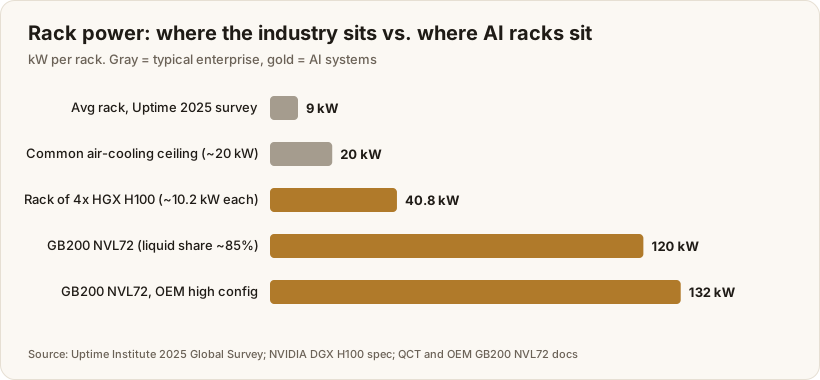
- The average rack in the industry is about 9 kW (Uptime Institute 2025 Global Data Center Survey). A GB200 NVL72 is ~120–132 kW. That's more than 13x the average.
- Moving 130 kW with air takes around 15,000+ CFM through a single rack. Water does it with ~190 L/min. That's the whole argument in one number.
- The money case is mostly about PUE and stranded power: every MW you don't spend on fans and chillers becomes a MW of GPUs you can bill for.
Where the industry actually is
Uptime's 2025 survey puts the average modal rack density near 9 kW, up from 8.3 kW the year before. Leave out facilities with racks above 30 kW and it drops to 7.5 kW (Uptime 2025). In Uptime's separate 2025 cooling survey, only 22% of operators reported using any direct liquid cooling (DLC), basically flat from 2024, and perimeter air still led at ~75%. High rack density was the top reason operators gave for adopting DLC (Uptime: DLC adoption remains slow and steady). Around 20 kW per rack is the commonly cited point where air stops being workable.
Now compare that to AI hardware:
| System | Approx. power | Cooling |
|---|---|---|
| DGX H100 (8 GPUs) | ~10.2 kW per node | Air |
| Rack of 4x HGX H100 nodes | ~41 kW | Air, and very loud |
| GB200 NVL72 | ~120–132 kW per rack | ~85% liquid, rest air |
NVIDIA's own framing is helpful here. Going from Hopper to Blackwell, per-GPU TDP rose about 75%, but growing the NVLink domain to 72 GPUs pushed rack power density up 3.4x (NVIDIA Technical Blog). The density comes from the architecture, not just from hotter chips. NVLink runs over copper, copper only reaches so far, so the GPUs have to sit physically close together.
The physics: air just can't carry it
Heat removal is basically one equation: Q = flow × heat capacity × ΔT.
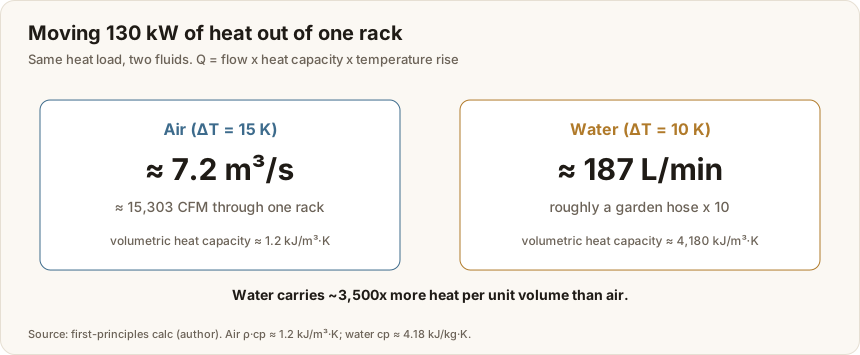
- Air holds about 1.2 kJ/m³·K. If you want to pull 130 kW out with a 15 K rise across the rack, you need about 7.2 m³/s, roughly 15,000 CFM, through one cabinet. You can't push that through a 600 mm rack without hurricane-level velocity, huge fan power, and acoustic levels that hurt the people working in the hall.
- Water holds about 4,180 kJ/m³·K, around 3,500x more per unit volume. The same 130 kW at a 10 K rise needs about 190 L/min. That lines up with OEM specs: QCT's GB200 NVL72 cooling rack lists roughly 130 L/min at a ~12.8 K rise for ~115 kW of liquid-side heat (QCT QoolRack).
That's why NVL72 is designed around direct-to-chip cold plates. About 85% of the heat goes into the liquid. The remaining ~15% (power shelves, NICs, drives) still goes to air, which is a detail that bites people later (see below).
What actually changes in the facility
Direct-to-chip isn't just swapping a part. It adds a second thermal system that has its own failure modes.
- CDUs (coolant distribution units). These sit between the facility water loop and the technology cooling loop (TCS). You size them for flow, approach temperature, and redundancy. In-row CDUs at ~1 MW+ are common now, and rack-integrated units exist for retrofits.
- Facility water temperature. Warm-water designs (supply temperatures in the 30s °C and higher) let you reject heat through dry coolers for most or all of the year, with much less chiller time. That's where the PUE gains come from.
- The residual air load doesn't go away. 15% of 130 kW is still ~20 kW of air per rack, which is about what a whole enterprise rack used to be. You still need rear-door heat exchangers or decent CRAH capacity.
- Leak detection, quick disconnects, and water chemistry become operational disciplines you need to own. Filtration and coolant monitoring belong in your runbooks, not somewhere in a vendor manual.
- Commissioning gets longer. Flushing, pressure testing, and flow balancing loops is real schedule time. Plan for it.
The money: PUE and stranded power
Here's the part that gets underrated. At a fixed utility interconnect, cooling overhead takes away from GPU capacity.
Using a simple site-power model (IT power = site power ÷ PUE) on a 100 MW site:
| Air-heavy (PUE 1.5) | Liquid-heavy (PUE 1.25) | |
|---|---|---|
| IT power | 66.7 MW | 80.0 MW |
| Difference | +13.3 MW of IT | |
| ≈ NVL72 racks at 130 kW | ~100 more racks (~7,400 GPUs) |
As an illustration, price those extra 7,400 GPUs at the H100 one-year contract rate SemiAnalysis tracked in March 2026 (**$2.35/GPU-hr**, SemiAnalysis). That's about $150M a year of rentable capacity, and it's conservative because Blackwell rents for more than Hopper. Same grid connection, same substation. The extra capacity is just power you stopped burning on air handling.
The supply chain is pricing this in too. Vertiv posted Q1 2026 net sales of $2.65B, up 30% YoY, and raised full-year guidance (Vertiv Q1 2026). Thermal management is one of the clearest picks-and-shovels trades in the whole buildout.
Where people get cooked
- Planning for liquid and forgetting about air. That ~15% residual is still a real HVAC load.
- Retrofitting raised floors without checking weight. Liquid-cooled racks full of coolant and copper are heavy. Get the structural engineer involved early.
- Treating the TCS like an IT asset. It's a mechanical system. Facilities and IT need a shared runbook for leaks, pump failures, and CDU failover, because a pump trip is now a compute outage.
- Underestimating lead times. CDUs, manifolds, and quick disconnects have had real backlogs. Order them along with the GPUs, not after.
Bottom line
Air cooling topped out somewhere in the tens of kW per rack. AI racks are past 100 kW now and heading higher. Liquid is how you turn a fixed grid connection into the most GPUs possible. If a site plan for Blackwell-class or newer hardware still says "air-cooled," it isn't a plan yet. W for the facilities teams who already made the switch.