800 VDC and the 200 kW Rack: Rethinking Power Delivery for Vera Rubin
Vera Rubin NVL72 pulls up to 227 kW per rack, and Kyber is headed further. At 54 V that's more than 4,000 amps of busbar. Why the industry is moving to 800 VDC, what changes in the facility, and the economics behind it.
We spent 2025 getting used to 130 kW racks. Vera Rubin roughly doubles the target, and NVIDIA's roadmap is already talking about megawatt racks. At that point the problem isn't the GPUs anymore. It's getting electrons into the rack without melting copper or wasting 10% of your power on conversions. That's the case for 800 VDC.
TL;DR
- Vera Rubin NVL72: 72 Rubin GPUs, 20.7 TB HBM4, and rack power of 227 kW at MaxP, 187 kW at MaxQ, 156 kW with NVIDIA's MaxLPS power-optimized mode, all liquid-cooled at 45 °C inlet (NVIDIA Vera Rubin datasheet).
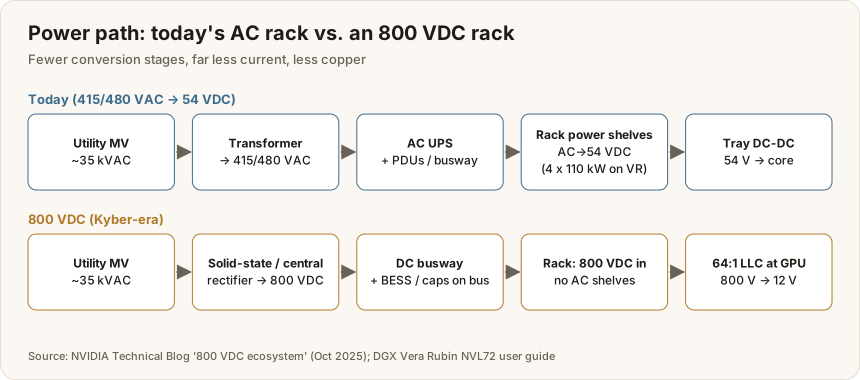
- Today's rack still converts AC to 54 VDC in-rack across four 110 kW power shelves (DGX VR NVL72 guide). At 227 kW, 54 V means ~4,200 A on the busbar.
- 800 VDC moves AC→DC conversion out to the facility. NVIDIA says the same wire gauge carries 157% more power than 415 VAC, and Kyber's 64:1 converter steps 800 V down to 12 V right next to the GPU (NVIDIA Technical Blog).
Where rack power is going
| Platform | Rack power | Notes |
|---|---|---|
| 4x HGX H100 per rack | ~41 kW | Air-cooled era |
| GB200 NVL72 | ~120–132 kW | DLC, ~85% to liquid |
| Vera Rubin NVL72 | 156 / 187 / 227 kW | MaxLPS / MaxQ / MaxP, 45 °C liquid |
| Kyber (Rubin Ultra, 2027) | Much higher; NVIDIA designing for >1 MW racks | 576 GPUs, 800 VDC native (NVIDIA) |
NVIDIA's own sizing is ~40K Rubin GPUs per 100 MW AI factory in its MaxLPS configuration (datasheet). That's about 555 racks, so roughly 180 kW of facility power per rack once you include cooling, networking, and storage.
Why 54 V runs out of room
The DGX Vera Rubin NVL72 still uses the familiar design: AC whips from a remote power panel feed 4 power shelves, each 3U and rated at 110 kW, with six 18.3 kW PSUs, fed by two 100 A whips at 415–480 VAC. The shelves output 54 VDC to a liquid-cooled busbar (DGX VR guide). The busbar is liquid-cooled for a reason.
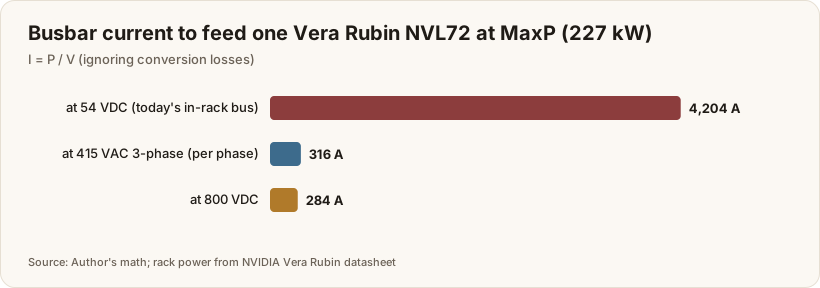
Ohm's law is the whole argument. At 227 kW:
- 54 VDC → ~4,200 A. Resistive loss scales with I², so the copper gets very thick and still runs hot.
- 800 VDC → ~284 A. About 15x less current, so roughly 200x less I²R loss for the same conductor.
Then add the rack space. Four 3U power shelves is 12U of PSUs in a rack that would rather hold compute. At Kyber densities that layout just doesn't scale.
What the 800 VDC architecture changes
From NVIDIA's whitepaper and blog (NVIDIA):
- Centralized rectification. Medium-voltage AC (e.g., ~35 kV) gets converted straight to 800 VDC by large facility-level converters (eventually solid-state transformers). That removes layers of LV switchgear, transformers, AC UPS, and PDUs.
- Less copper. Same wire gauge carries 157% more power than 415 VAC. A three-wire DC setup (POS, RTN, PE) replaces four-wire AC.
- Fewer conversions. NVIDIA says traditional AC chains can be below 90% efficient end to end, and a native DC path removes several of those stages.
- Point-of-load conversion. Kyber uses a 64:1 LLC converter to go from 800 V to 12 V next to the GPU, in 26% less area than multi-stage approaches.
- Storage on the bus. This is the underrated part. Synchronized training makes rack power swing between ~30% and 100% in milliseconds. NVIDIA proposes supercapacitors near the racks for fast transients and facility BESS for seconds-to-minutes swings, both easier to attach to a DC bus. Vera Rubin already ships rack-level "Intelligent Power Smoothing" capacitors (datasheet).
The ecosystem is real. NVIDIA lists partners from silicon (Infineon, TI, Navitas, onsemi, ST, and others) to power systems (ABB, Eaton, GE Vernova, Hitachi Energy, Schneider, Siemens, Vertiv).
The economics
Why do operators care? Because at a fixed grid interconnect, every point of power-chain efficiency becomes billable GPUs.
- On a 100 MW site, recovering even 3–5 points of conversion efficiency is 3–5 MW. At Rubin's ~180 kW per rack all-in, that's about 17–28 more racks, or ~1,200–2,000 GPUs.
- Less copper and fewer AC components cut both capex and install labor. Electrical labor has been a real bottleneck.
- Taking power shelves out of the rack frees up compute space, and the 45 °C inlet spec allows dry-cooler-only heat rejection in most climates, which lowers PUE again.
The costs are real too. 800 VDC needs new safety practices, arc-flash procedures, connectors, protection gear, and electrician training. Standards bodies and OCP are still aligning voltage ranges and interfaces. Early adopters pay that learning-curve cost.
How I'd plan for it
- Vera Rubin (2026–27): AC to the rack still works. Size for 227 kW MaxP per rack even if you plan to run MaxQ or MaxLPS, because the breakers and busway have to handle peak.
- Design new halls to be 800 VDC-ready. Leave room for centralized rectifiers and DC busway, and pick switchgear vendors with a DC roadmap.
- Plan energy storage for power quality, not just for backup. Your utility will ask about load oscillations.
- Treat cooling and power as one system. 45 °C warm water, liquid-cooled busbars, and liquid-cooled CPO switches all point the same way: the whole hall runs on liquid now (see Why Liquid Cooling).
Bottom line
Vera Rubin is the last generation where 54 V in-rack distribution is reasonable, and even there it takes a liquid-cooled busbar to work. Kyber and anything after it needs 800 VDC. If you're breaking ground on a facility now, design for DC. Otherwise you'll be redoing the electrical room in two years.