Hyperscaler Capex: The $730 Billion Question
Amazon, Alphabet, Microsoft, and Meta guided to roughly $720–745B of 2026 capex. Capex now exceeds operating cash flow at two of them. A look at the numbers, the accounting quirks, and what to watch going into Q3 prints.
Every AI infra conversation eventually comes back to one question: who's paying for all of this, and can they keep paying? Going into Q3 earnings, the answer is four companies spending about three-quarters of a trillion dollars this year, with cash flow at two of them no longer covering it.
TL;DR
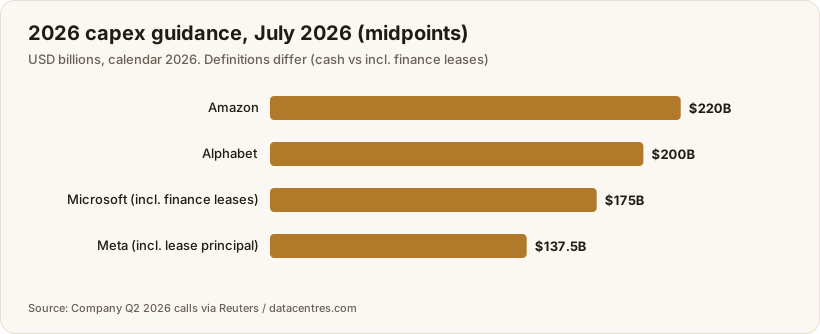
- 2026 capex guides (July): Amazon ~$220B, Alphabet $195–205B, Microsoft ~$175B (incl. finance leases), Meta $130–145B. Total: ~$720–745B, against roughly $410B in 2025 (datacentres.com; NMSC).
- Cash is the constraint now. In 2Q26, cash capex was 119% of operating cash flow at Amazon, 115% at Alphabet, 95% at Meta, and 65% at Microsoft (NMSC).
- To hit the guidance midpoints, H2 spend has to run ~44% above H1. Watch whether they actually deliver it.
The numbers, one company at a time
Amazon (~$220B, cash capex). On the July 30 call, Andy Jassy raised the 2026 number from ~$200B to ~$220B and blamed higher memory costs. He also said AWS still lacked enough compute to serve demand (Reuters). 2Q cash capex was $53.1B (datacentres.com). That's a direct read-through to HBM and DRAM pricing.
Alphabet ($195–205B). Raised from $180–190B in July, because capacity is landing faster. 2Q capex was $44.9B, and management guided to another significant increase in 2027. Alphabet also said it would rent third-party capacity as a bridge, which pressures Cloud margins near term (Closing Print).
Microsoft (~$175B, calendar, incl. finance leases). This one is an accounting story. The April figure was ~$190B. Microsoft then extended data center useful lives from 15 to 25 years, which moves more future leases from finance leases (inside capex) to operating leases (outside capex). The CFO said the build plan didn't change. So don't read the lower number as a pullback. Microsoft guided to >$50B in the September quarter (datacentres.com).
Meta ($130–145B, incl. finance-lease principal). The low end went up from $125B. 2Q free cash flow fell to $784M from $8.55B a year earlier (Reuters). And the capex line understates it: Meta disclosed ~$279B of data center leases signed but not yet started as of June 30, up from $183B a quarter earlier (eMarketer), with another ~$68B signed in July (Closing Print).
The cash-flow problem
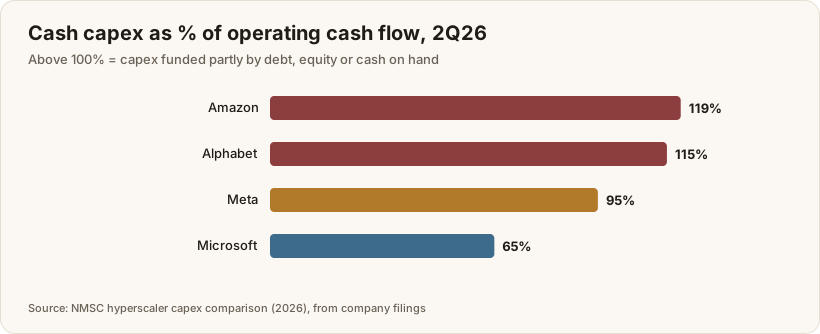
This is the chart that changed the discourse in 2026. For a decade, hyperscaler capex was easily covered by operating cash flow. In 2Q26:
| Company | Cash capex / OCF (2Q26) |
|---|---|
| Amazon | 119% |
| Alphabet | 115% |
| Meta | 95% |
| Microsoft | 65% |
Source: NMSC, from company filings. The gap is being filled with balance sheet. Long-term debt at Alphabet and Amazon has roughly doubled since December 2025, and Alphabet raised $49.6B of equity and convertible preferred in June.
The four spent $165.1B on PP&E in 2Q26, almost double the $88.2B in 2Q25.
The H2 math
| $B | 2026 midpoint | H1 actual | Implied H2 |
|---|---|---|---|
| Microsoft | 175.0 | 72.9 | 102.1 |
| Alphabet | 200.0 | 80.6 | 119.4 |
| Amazon | 220.0 | 96.3 | 123.7 |
| Meta | 137.5 | 50.9 | 86.6 |
| Total | 732.5 | 300.7 | 431.8 |
Source: NMSC. H1 definitions vary by company.
Hitting the midpoints requires H2 to be ~44% above H1. That's possible, since data center capex is lumpy and back-half loaded when GPUs and power arrive. But it depends on equipment deliveries (memory, power gear) and financing conditions, not just demand.
The split: builders vs borrowers
The market has already sorted the trade. Through mid-October, cash-rich hyperscalers held up while the debt-funded builders sold off hard: Oracle about −55% over a year and CoreWeave about −43%, per the Closing Print. The trigger was a report that put OpenAI's annualized revenue near $50B, below the $68–70B some investors had assumed. The report wasn't confirmed by OpenAI, but it raised questions about the multi-hundred-billion-dollar contracts underpinning neocloud and Oracle backlogs.
That's the core risk in a capex cycle financed by long-term contracts. The lessors' credit depends on the tenants' revenue growth. (I worked through the unit economics in GPU Cloud Economics.)
Who gets the money
Follow the $730B down the supply chain:
- Accelerators and networking: the biggest slice, through NVIDIA, custom ASIC programs, and switch vendors. AI back-end switch sales passed front-end for the first time in 2Q26 (Dell'Oro).
- Memory: SK hynix's 76% operating margin and Micron's take-or-pay contracts are the clearest signs of pricing power in the chain.
- Power and cooling: switchgear, transformers, CDUs, turbines. Long lead times, real backlogs.
- Land, shells, and leases: Meta's $279B lease book shows how much is shifting to developers and lessors off the capex line.
What to watch in the Q3 prints
- Did H2 run-rate show up? Microsoft >$50B, Alphabet and Amazon tracking toward ~$120B+ halves.
- 2027 commentary. Alphabet already flagged a significant increase. Does anyone flinch?
- Cloud revenue growth vs capex growth. If Azure, GCP, and AWS growth keeps accelerating, the spend is justified in the market's eyes. If it slows while capex rises, it gets ugly.
- Free cash flow and financing. Another quarter of negative FCF at Alphabet or Amazon means more debt and more scrutiny.
- Accounting changes. Useful lives, lease classification. Normalize before comparing.
Bottom line
$730B a year is about more than demand. It's a financing story now. The hyperscalers can fund it, though two of them are using their balance sheets to do it. The weaker point is the lessors and neoclouds, whose economics depend on tenant revenue showing up on schedule. For infra folks, it means a supply chain sold out into 2027, with spending discipline tied to cash flow more than to slide decks.