Nebius Got Its Customers to Prepay the Build-Out. The Buildings Are Running Late
Nebius beat on Q3 revenue and says new deals now come with prepayments that cover more than 100% of their capex. But third-party data centers slipped, 2026 revenue goes to the low end, and capex jumps to $27 billion this year and $40-45 billion next. Here's the quarter in plain English.
Tom Pechulis, , 9 min read
Yesterday I said Nebius reports Thursday, and that we'd see whether CoreWeave's pricing strength and funding pressure show up there too. It reported before the open this morning. Short version: the pricing strength showed up. So did a new problem. This time it's not the cost of money. It's the calendar.
TL;DR
- The headline beat. Revenue was $980.8 million, up 571% from a year ago, versus $907.5 million expected (LSEG, per CNBC). But about $325 million of that was a one-time item (StockTitan, citing the shareholder letter).
- The guide disappointed. 2026 revenue now lands at the low end of $3.0-3.4 billion, because some data centers that other companies are building for Nebius slipped into the first half of 2027 (Reuters via StreetInsider).
- Spending went way up. 2026 capex is now about $27 billion (was $20-25 billion), and 2027 is $40-45 billion, against 2027 revenue guidance of $12-13 billion (CNBC).
- The funding answer is customers. Prepayments on deals signed in Q3 covered more than 100% of the related capex, up from 50-60% in Q2. Nebius expects prepayments plus contract-backed loans to cover 75-85% of 2027 capex (Blockspace).
- The stock didn't love it. Shares fell as much as 16% in pre-market trading Thursday, per CNBC.
- My take: Nebius has a better funding story than CoreWeave and a worse timing story. Customers are paying up front, so demand is real. The risk now is construction: buildings and power showing up on time.
Quick jargon decoder
| Term | Plain English |
|---|---|
| Neocloud | A newer cloud company that mainly rents out AI chips (GPUs), like Nebius or CoreWeave, as opposed to Amazon, Microsoft or Google. |
| Capex | Capital expenditure: money spent on long-lived stuff like chips, servers and buildings, rather than day-to-day costs. |
| Prepayment | The customer pays part of a multi-year contract up front. For Nebius it's like the customer lending it money for free to build their capacity. |
| ARR (annualized run-rate revenue) | One month's revenue × 12. A speedometer reading, not a forecast. |
| RPO (remaining performance obligations) | Revenue customers have signed for but Nebius hasn't earned yet. Basically the order book. |
| Colocation / third-party capacity | Data-center space Nebius rents from someone else's building, instead of building it itself. |
| Asset-light | Partners pay for the data center and hardware, and Nebius supplies its design and cloud software. |
| Convertible notes | Bonds that can turn into shares later. Low interest, but they can dilute shareholders. |
The quarter, in one picture
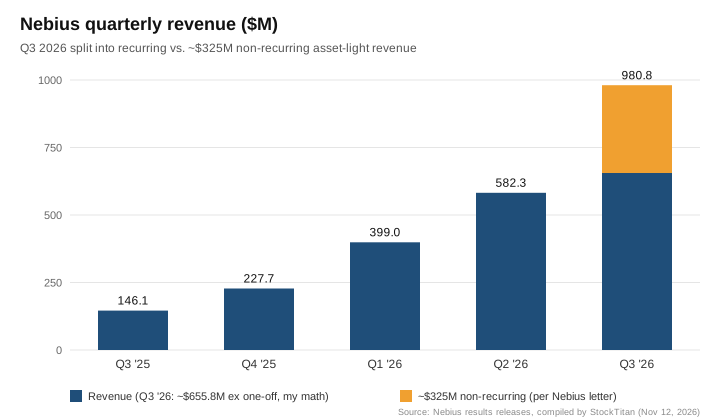
From the Q3 release:
- Revenue: $980.8 million, versus $146.1 million a year ago. Nine-month revenue: $1,962.1 million.
- Operating income: $50.4 million, versus a $130.2 million operating loss a year ago.
- Adjusted EBITDA: $465.8 million, about a 47.5% margin (my math: 465.8 ÷ 980.8).
- Interest expense: $112.5 million, more than double the operating profit. Add a $49.5 million charge for converting old convertible bonds into shares, and the net loss from continuing operations was $37.5 million, or 13 cents a share.
Now the footnote that matters. About $325 million of revenue was non-recurring. It came from the first phase of Nebius's asset-light model, where partners fund the data center and run Nebius's design and cloud software on it (StockTitan; WebProNews). Strip that out and Q3 revenue was about $656 million, up roughly 13% from Q2's $582.3 million (my math). That's still growth, but it's not the 68% quarter-on-quarter jump the headline implies. It also means the operating profit leaned heavily on the one-off.
Nebius says it expects this kind of revenue to become "a more regular part of our business," per StockTitan's read of the letter. Fair enough, but I'd treat it as lumpy until it shows up two quarters in a row.
What slipped, and why
The delay isn't about demand. It's about buildings Nebius doesn't own.
- "Where we rely on third parties, there have been delays," CEO Arkady Volozh wrote. Nebius's own sites "are on time or ahead of schedule" (Blockspace).
- The big one is the New Jersey colocation site serving Microsoft. Nebius now expects to deliver more than half of the Microsoft capacity there by year-end, with the rest pushed to Q2 2027. The site operator, DataOne, started retiring temporary generators ahead of a switch to permanent power from Bloom Energy fuel cells, and that reset the schedule (WebProNews).
- Reuters says the contracts behind the delayed capacity "were still in place." The cost is timing: Nebius now expects to pass a $7 billion ARR in February instead of December, "a shift of about two months" (Reuters via StreetInsider; StockTitan). ARR was $6.4 billion at the end of September.
Why this matters: a GPU sitting in a warehouse waiting for power earns nothing, but the money to buy it is already spent. StockTitan points out that Nebius's Microsoft contract filing lets Microsoft drop a block of capacity if it misses its delivery date after a grace period and Nebius can't offer an alternative. I'm not saying that happens. It's why "two months late" isn't a rounding error.
The guidance math (all my math):
- To hit the $3.0 billion low end, Q4 needs about $1.04 billion of revenue (3,000 − 1,962.1). That's a bit above Q3's reported total, and about 58% above Q3 excluding the one-off.
- A $7 billion ARR in February means about $583 million of AI-cloud revenue that month (7,000 ÷ 12).
Pricing: same story as CoreWeave
This is the part that rhymes with Tuesday. Volozh: "Our customers committed to longer deals, at higher prices, with more up front" (WebProNews).
- Annual contract value topped $25 million per megawatt on Q3 deals, up from more than $20 million in Q2. (A megawatt here is a slice of data-center power. Think of it as renting a room of servers priced by how much electricity it pulls.)
- Price per GPU-hour rose more than 20% on average.
- Customers committed more than $12 billion of contract value since the start of Q3, including first multi-year deals with Databricks, Datadog and Snowflake (Blockspace).
- Payback on comparable one-to-three-year deals fell to 1 year 7 months from 1 year 10 months, per StockTitan. That figure excludes prepayments and assumes servers last five years.
CoreWeave's $20-25 million per megawatt on its new long-term deals and Nebius's $25 million+ are in the same neighborhood. Two companies, same message: AI compute is still scarce, and buyers are paying up for it.
The spending, and who pays for it
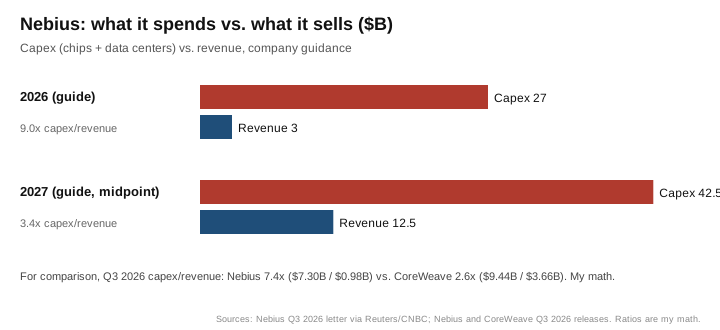
Here's the scale. Nebius spent $7.30 billion on equipment and buildings in Q3 alone, versus $955.5 million a year earlier (release). That's about 7.4x its quarterly revenue. CoreWeave was about 2.6x (my math: $9.44 billion ÷ $3.66 billion). Nebius is building much further ahead of its sales than CoreWeave.
The 2026 capex guide of ~$27 billion compares with $22 billion analysts expected (LSEG, per Reuters). The 2027 guide of $40-45 billion compares with FactSet's $28.77 billion (CNBC). Nebius says 2027 spending is sized for more than 1 GW of new capacity, mostly at its own sites: Missouri (now 1.1 GW under contract), Alabama, Lappeenranta and a second Mäntsälä site in Finland, which together total more than 3 GW at scale (Blockspace).
So who pays? Three sources:
- Customers, up front. Prepayments on Q3 deals covered more than 100% of the related capex, versus 50-60% in Q2. Nebius expects $10 billion of prepayments in 2026 and $17-20 billion in 2027. You can see this in the balance sheet: deferred revenue (cash received for service not yet delivered) is about $9.4 billion, up from $1.6 billion at the end of 2025 (my math: $1,445.5M current + $7,963.7M non-current, versus $275.5M + $1,302.0M) (release).
- Loans against contracts with investment-grade customers. "We expect prepayments and financing against existing contracts with investment-grade customers to cover 75%-85% of our 2027 capex," Volozh wrote (Blockspace).
- Capital markets. Since June: $5.75 billion of convertible notes in August, a $775 million secured loan, a $3.5 billion 364-day Citi facility in October, and about $1.0 billion of net proceeds from selling shares in Q3. The share count rose about 8% in the quarter (StockTitan).
If 75-85% of $40-45 billion is covered, the remaining 15-25% is roughly $6-11 billion that has to come from cash on hand, cash flow, or new equity and debt (my math). Nebius ended September with $7.4 billion of cash and about $14.2 billion of debt (my math: $187.5M current + $14,003.3M non-current).
A few things worth a footnote
- The prepayment cash isn't all in yet. Deferred revenue rose $3.43 billion in Q3, but receivables rose $3.76 billion. Operating cash flow was negative $273 million (Blockspace; release). My read: a lot of the prepayment has been billed but not collected yet. Accounts receivable went from $720 million at year-end to $4.04 billion. I'd watch for that to turn into cash next quarter.
- Depreciation got friendlier this year. Nebius moved servers and network gear to a five-year useful life from four years in 2026, which lowers the annual charge. The Q4 2027 pre-tax breakeven target assumes that five-year life (StockTitan). It's a reasonable assumption if old GPUs keep renting at higher prices, as both Nebius and CoreWeave say they are. It's not a free lunch if they don't.
- The order book is smaller than CoreWeave's. RPO was $38.7 billion, up from $37.5 billion in June (Blockspace). CoreWeave reported a $132.5 billion backlog, but the two companies count differently, so don't compare them directly.
- Nebius is retiring ARR as a target. From 2027 it will guide on revenue, pre-tax earnings and capacity instead. That's a healthier metric set, frankly. ARR built on one month of revenue was always going to get noisy with lumpy deals.
What I think
- Bull case: Demand and pricing are clearly real. Price per GPU-hour is up 20%+, contract value per megawatt is up, blue-chip software companies are signing multi-year deals, and customers are prepaying more than the cost of the build. If you can get customers to fund your capex, the classic neocloud risk (borrow a fortune, hope the tenants show up) mostly goes away. Its own sites are on schedule, and those carry most of 2027.
- Bear case: The beat leaned on a $325 million one-off. Ex that, revenue grew ~13% sequentially while capex ran 7x+ revenue. The delays are a reminder that power, not chips, sets the pace, and Nebius doesn't control third-party sites. 2027 needs $40-45 billion of spending to deliver $12-13 billion of revenue, which still leaves a funding gap. And the share count keeps climbing.
- My take: Compared with CoreWeave, Nebius has the better balance-sheet position: about $14.2 billion of debt versus CoreWeave's roughly $47 billion, $7.4 billion of cash, and customers paying it up front. It has the harder execution problem: it's growing from a smaller base, betting on a much bigger build next year, and it just missed a delivery window. A pre-market drop of as much as 16% on a two-month slip tells you how little room for error the market is giving neoclouds right now. I'd want to see Q4 revenue clear the ~$1.04 billion bar without a one-off, and the receivables turn into cash.
What I'm watching
- Q4 revenue vs. ~$1.04 billion, the number Nebius needs to hit the low end of its 2026 guide.
- Microsoft's New Jersey capacity: more than half delivered by year-end, the rest in Q2 2027.
- Collections. Does the $4 billion of receivables turn into cash, so operating cash flow flips positive?
- Meta's $12 billion dedicated-capacity deal, which StockTitan says is scheduled to start in early 2027.
- Anthropic's Nasdaq debut next week (CNBC), which should tell us a lot more about what the AI labs, the end buyers of all this capacity, can actually afford.