CoreWeave's Business Is Working. Its Interest Bill Is Still Bigger Than Its Profit
CoreWeave beat on revenue, raised guidance and grew its backlog to $132.5 billion. But it paid $846 million in interest against $207 million of operating income, and it carries about $47 billion of debt. Here's how its plan to fund 2027 works, in plain English, and what I'm watching.
Tom Pechulis, , 9 min read
Yesterday I said CoreWeave's Q3 print was the one to watch, because funding costs and delivery dates still drive this market. It reported after the close on Tuesday. The short version: the business is doing better than expected, and the balance sheet is still the whole debate.
TL;DR
- The quarter was strong. Revenue was $3.66 billion, up 168% from a year earlier and ahead of the $3.55 billion analysts expected (CoreWeave release; Reuters via U.S. News). It raised full-year guidance to $13.0-13.3 billion.
- Contracted future revenue (backlog) hit $132.5 billion, up from $104 billion in June (CNBC).
- But interest ate the profit. CoreWeave made $207 million of operating income and paid $846 million of interest, so it lost $709 million. Next quarter's interest bill is guided to $1.05-1.15 billion.
- The funding plan changed. The CFO said that at today's rates CoreWeave won't sell any more unsecured parent-company bonds through 2027. Instead it will lean on customer prepayments (about $9 billion coming in the next three months), loans tied to specific contracts, and hardware-vendor financing (earnings call transcript).
- My take: demand isn't the problem. The cost of money is. Watch whether next quarter's operating profit grows faster than that $1.1 billion interest bill.
Quick jargon decoder
| Term | Plain English |
|---|---|
| Neocloud | A newer cloud company that mostly rents out AI chips (GPUs), like CoreWeave or Nebius, as opposed to Amazon, Microsoft or Google. |
| Backlog | Revenue customers have signed up for but CoreWeave hasn't earned yet, because the servers aren't delivered or the contract hasn't run yet. It's the company's own count. |
| ARR (annualized run-rate revenue) | Last month's revenue × 12. A snapshot of the current pace, not a forecast. |
| Adjusted EBITDA | Profit before interest, taxes, depreciation (the cost of chips wearing out) and stock pay. It flatters capital-heavy companies, because depreciation is their biggest cost. |
| Recourse vs. non-recourse debt | With recourse debt, lenders can go after the company's other assets if it doesn't pay. With non-recourse debt, they can only seize the specific collateral. |
| Unsecured debt | A loan or bond with no specific collateral behind it, so it costs more. |
| DDTL (delayed-draw term loan) | A loan you can draw down in pieces as you buy equipment. CoreWeave ties each one to a specific customer contract. |
| Prepayment | The customer pays part of the contract up front. For CoreWeave it's like a free loan from the customer. |
| Basis points / SOFR | 100 basis points = 1 percentage point. SOFR is the benchmark short-term interest rate that many loans are priced on top of. |
The quarter, in one picture
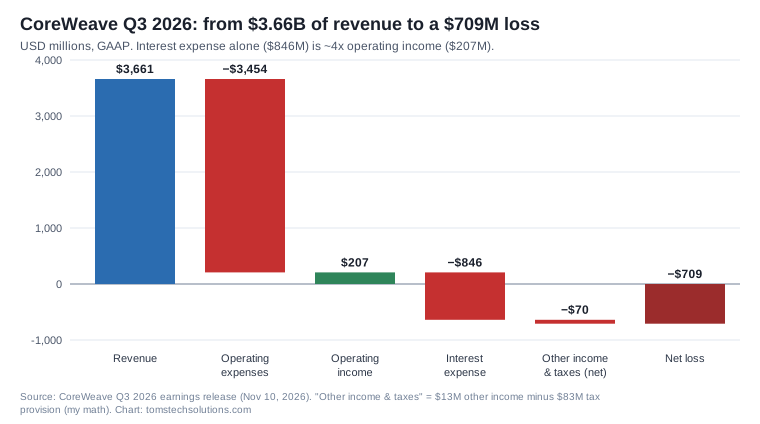
From CoreWeave's release:
- Revenue: $3,661 million, versus $1,365 million a year ago. Nine-month revenue is $8,314 million.
- Operating income: $207 million (a 6% margin). On CoreWeave's adjusted basis it was $379 million, or 10%, well above its own $200-260 million guide (call transcript).
- Interest expense: $846 million, up from $310 million. That's about 23 cents of every revenue dollar (my math: 846 ÷ 3,661).
- Net loss: $709 million, versus $110 million a year ago.
- Adjusted EBITDA: $2,256 million, a 62% margin. The gap between that and the net loss is mostly $1,889 million of depreciation plus the interest bill. That's the neocloud model in one line: the chips earn a lot of cash, but they wear out fast and were bought with borrowed money.
The margin trend is the bull's best chart. CEO Mike Intrator said adjusted operating margin was "approximately 1% in Q1, 5% in Q2, and exceeded 10% in Q3" (transcript). CFO Nitin Agrawal put it plainly: adjusted operating income "nearly tripled from the second quarter, while interest expense rose about a third. That is the path to earnings."
The catch: Q4 interest is guided to $1.05-1.15 billion, up from $846 million. Operating profit has to keep outrunning that.
Why the revenue jumped: pricing, not just more chips
This was the most interesting part of the call to me. GPU rental prices are going up, not down:
- In July CoreWeave raised prices "across SKUs by approximately 25%," then another 10% later in the quarter, and "pricing has continued to move higher in Q4" (Intrator, transcript).
- Older chips are getting more valuable. Pricing for Nvidia's Ampere and Hopper generations "increased 30%-50% quarter over quarter," at prices above their original contracts.
- New 4-5 year contracts are pricing at $20-25 million per megawatt per year. Short-term deals go for more than $40 million per megawatt. (A megawatt here is a slice of data-center power capacity. Think of it as renting out a fully loaded room of servers by how much electricity it draws.)
- More than 130,000 GPUs come off contract in 2027 and about 170,000 in 2028. Intrator said re-renting the 2027 batch at current prices would add "approaching $4 billion" of annualized revenue with no new capex, and "nearly $10 billion" including 2028. Those are management projections, outside the backlog.
Why does that matter? The big bear argument on GPU clouds has been that chips lose value fast, so old fleets end up worth little. CoreWeave is saying the opposite is happening right now: because new data centers are slow to build, old chips stay scarce. Intrator went further: "If data center construction across the sector were to slow, installed compute becomes scarcer… GPU pricing may stay higher for longer" (CNBC). That's the reverse of the usual neocloud risk, and the reason last week's local votes against data centers aren't purely bad news for a company that already has its sites permitted.
Physically, CoreWeave added more than 200 MW in the quarter to reach over 1.7 GW of active power, and has 4.6 GW contracted. It still expects more than 1.85 GW active at year-end (release). It also brought its first multi-rack Vera Rubin NVL72 systems online, with Cognition as the first production customer.
The guidance math
- Full-year revenue guide of $13.0-13.3 billion minus $8.31 billion already booked implies Q4 revenue of roughly $4.7-5.0 billion (my math). That would be another sequential jump of about $1.0-1.3 billion.
- Exit ARR guide of $20-21 billion implies December revenue of roughly $1.67-1.75 billion (my math: ÷ 12).
- Backlog grew $28.5 billion in one quarter, about 27% (my math: 132.5 − 104). The CFO said more than 50% of it is tied to contracts where delivery should start by year-end.
- 2026 capex guide is now $37-39 billion, with the low end raised because deliveries are running early. Q3 capex alone was $14.5 billion, above guidance (CFO, transcript).
The balance sheet: the part the stock actually trades on
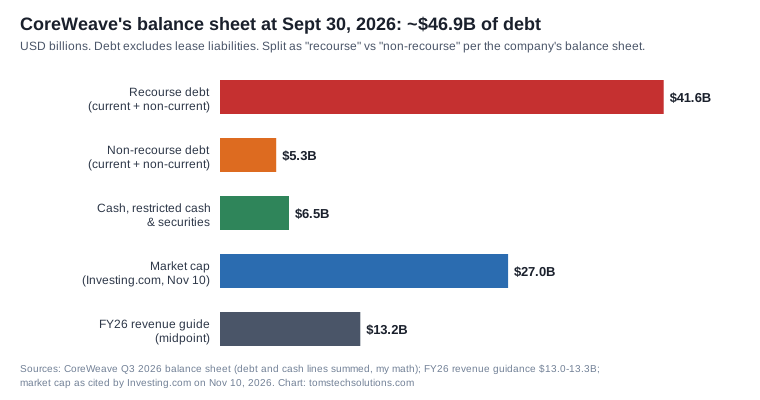
From the Sept. 30 balance sheet:
- Recourse debt: $41.6 billion ($9.18 billion current + $32.42 billion non-current). Non-recourse debt: $5.27 billion. Total about $46.9 billion (my math), which matches CNBC's "almost $47 billion." That's before about $18.7 billion of operating lease liabilities for data-center space.
- Cash, restricted cash and securities: about $6.5 billion, plus nearly $5 billion of undrawn loan capacity (CFO).
- Operating cash flow: $1.98 billion in Q3. Cash spent on equipment: $9.44 billion. So about $7.5 billion went out the door that had to be borrowed or prepaid (my math: 1,975 − 9,441).
- Investing.com put the market value at about $27 billion (source). That means the debt is roughly 1.7x what the stock market thinks the whole company is worth (my math).
Now the funding market. CNBC reports that "some CoreWeave bond yields recently topped 16%" and that the stock lost more than 40% of its value in the past month (CNBC). A bond trading at a 16% yield is the market saying "I'm not sure I get paid back." Yet management says the company's average cost of debt is 7.9%, down 250 basis points from a year ago (transcript).
How can both be true? Two kinds of debt:
- Contract-backed loans (DDTLs). These are tied to a specific customer contract, often an investment-grade one. The customer's payments service the loan, and lenders can see that cash. Agrawal said these loans "continu[e] to trade around par value," meaning lenders aren't worried. The next one, due "in the coming weeks," should price at about a 7-7.5% yield and fund more than 90% of the associated capex.
- Parent-company unsecured bonds. No specific collateral, so they bear the full "will CoreWeave make it" risk. That's where the 16% yields are.
So the plan: stop using the expensive kind. "At current yields, we do not intend to issue additional parent-level unsecured debt through 2027," Agrawal said. CoreWeave expects to raise less than $5 billion of new parent-level capital through 2027. The rest is meant to come from:
- ~$9 billion of prepayments and deposits in the next three months. More than $3 billion of that is for existing, already-paid-off infrastructure being re-rented, which needs no new capex. CoreWeave says it has collected prepayments on 70% of its deals this year.
- Contract-backed loans, where more than 75% of 2027 committed capex is tied to investment-grade and enterprise customers.
- Vendor (OEM) financing, which Implicator describes as coming from hardware partners such as Nvidia.
- Its own cash flow: management expects EBITDA minus interest to "more than double in 2027."
There's also an off-ramp. If money stays expensive, CoreWeave can build only what's already contracted. In that case, Agrawal said, 2027 capex would stay "in line with our 2026 capex investment, while revenue and EBITDA grow significantly" (CNBC). Management guides to an adjusted net profit in the first half of 2028.
I explained how this kind of GPU-backed lending works in GPU Debt, Decoded. This quarter is that model under real stress: the secured side is holding, and the unsecured side is where the market is pricing fear.
A few things that deserve a footnote
- Prepayments flatter cash flow. Deferred revenue rose $2.1 billion in Q3's cash flow statement. That's real cash, but it's cash for service CoreWeave still owes. Total deferred revenue is now about $10.0 billion, up from $8.2 billion at year-end (my math from the balance sheet).
- Receivables jumped. Accounts receivable used $1.74 billion of cash in Q3. Customers owe CoreWeave $4.28 billion, up from $3.17 billion at year-end. Worth watching, though a fast-growing quarter naturally ends with more unpaid bills.
- Backlog is CoreWeave's own number, and only counts if it delivers the capacity on time (release footnote).
- The adjusted EPS number varies by source. CNBC reported 95 cents adjusted loss vs. $1.16 expected (LSEG). Investing.com used a different consensus. I'd stick with the GAAP $1.27 loss per share from the release.
What I think
- Bull case: Revenue is compounding, margins are expanding a quarter ahead of plan, and pricing is rising, even on old chips. The re-contracting math ($3 billion+ in prepayments for paid-off GPUs) is the cleanest evidence yet that GPUs can earn well past their first contract. And the company has a credible plan to fund 2027 without touching the bond market that's charging 16%.
- Bear case: It's still losing money, and interest is still growing. Q4 interest of ~$1.1 billion is about $4.4 billion annualized (my math). Debt is roughly 1.7x the market value. The plan leans on customers paying up front, and that only works while compute is scarce. If supply catches up, prepayments and pricing are the first things to go.
- My take: This was the quarter CoreWeave needed: proof that demand and pricing are real, plus a funding plan that avoids the most expensive money. But the stock is a bet on the timing of two curves: operating profit going up faster than interest. The Q3 gap was $207 million vs. $846 million. I want to see that gap close in Q4, not just hear that it will. Shares rose about 5.7% after hours to $51.51 (Investing.com). That's a relief rally, not a verdict.
What I'm watching
- The next contract-backed loan "in the coming weeks": does it really price at a 7-7.5% yield with an investment-grade rating?
- Nebius reports Thursday (CNBC). Same business, so we'll see whether pricing strength and the funding pressure show up there too.
- Anthropic's Nasdaq debut next week. It's a key CoreWeave customer, per CNBC, and a public Anthropic means much more visibility into what the AI labs can actually pay for.
- Q4 operating profit vs. ~$1.1 billion of interest. That's the number.