GPU Debt, Decoded: Swaps, Spreads, and Why Neocloud Money Got Expensive
A plain-English deep dive on how GPUs get financed: delayed-draw loans, SPVs, swaps, junk bonds, converts, and vendor money. What actually got more expensive for CoreWeave and the neoclouds in 2026, plus my break-even math on what each point of interest costs per GPU-hour.
Tom Pechulis, , 18 min read
Yesterday I said the market cares more about who can pay for the buildout than about who spends the most. Today I'm going one layer down, into the plumbing. A neocloud is a GPU-rental company like CoreWeave, Nebius, IREN, or Lambda. When one of them buys $5 billion of GPUs, almost none of it is paid for in cash. It's borrowed. And this year, the price of that borrowing moved a lot.
TL;DR
- Two different "swaps" got more expensive, and people mix them up. (1) Locking in a fixed interest rate costs more now. The 5-year SOFR swap rate went from 3.22% on Feb 27 to ~4.56% on Oct 28, while the floating rate itself barely moved, 3.68% → 3.94% (AST/RCA, FRED). (2) Insurance against a CoreWeave default exploded. Its 5-year CDS hit a record 1,194.5 bp intraday on Oct 15 (Investing.com/ICE), up from 421 bp a year ago (Benzinga/S&P Global MI).
- The base rate and the lender's markup both went up, and they stack. CoreWeave's GPU-loan spreads fell from SOFR + 9.62% (2023) to SOFR + 2.25% (March 2026). Then they turned back up: +4.50% in May, +5.50% in August (10-Q, 8-K). Its unsecured bonds now yield ~15% (CNBC).
- The market has split into tiers. Debt backed by investment-grade customers still prices at ~6–7%: Lambda at 6.78% fixed, IREN–Microsoft at 5.96%. Weaker-credit paper is 9%+, and CoreWeave's own unsecured paper is ~15%.
- My math: for a GB300-class cluster, every +100 bp of debt cost adds about $0.09 per GPU-hour to break-even. At ~10% all-in, a 5-year contract at IREN–Microsoft pricing only breaks even if the GPUs still have resale value at the end.
- Amazon (last night): AWS grew 39% and capex held at ~$220B. Jassy also said neocloud capacity runs about 3,500 bp worse in operating margin than capacity Amazon owns or long-leases. That's not what the neocloud bulls wanted to hear.
Jargon decoder
Skim this first, or come back to it when a term shows up.
| Term | Plain English | Everyday analogy |
|---|---|---|
| SOFR | The Secured Overnight Financing Rate. It's the benchmark floating rate most US loans reset off. It was 3.94% on Oct 29 (FRED). | The "prime rate" your adjustable mortgage tracks |
| Spread / margin | The extra % a lender charges on top of SOFR for your risk. "SOFR + 5.50%" means today's SOFR plus 5.5 points. | Your credit score's markup on top of the base rate |
| bp (basis point) | 1/100th of a percent. 100 bp = 1%. | Cents vs. dollars |
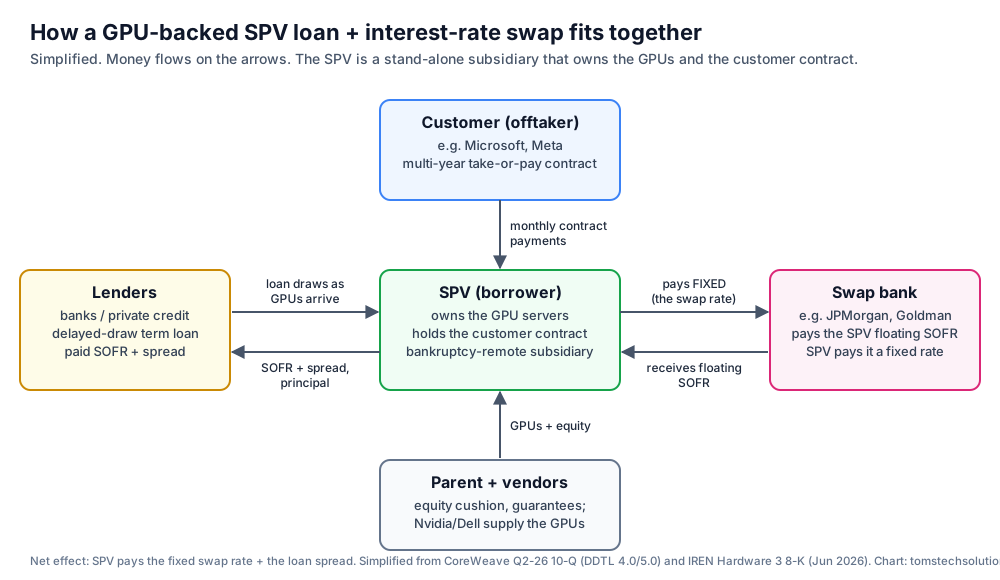
| Interest-rate swap | A side contract that turns a floating loan payment into a fixed one. You pay a bank a fixed rate, the bank pays you SOFR, and the SOFR legs cancel out. | Switching from an adjustable-rate mortgage to a locked rate |
| Swap rate | The fixed rate the bank asks for that trade, for a given term (5-year, 10-year). It's the market's guess of average SOFR over that term. | Today's quote for a 5-year rate lock |
| CDS (credit default swap) | Insurance on a company's debt. The "spread" is the yearly premium: 1,000 bp = $1M a year to insure $10M. | Life insurance on someone else's loan |
| Delayed-draw term loan (DDTL) | A loan committed up front but drawn in chunks as the GPUs actually arrive. You pay a small fee on the undrawn part. | A construction loan that releases money as each floor gets built |
| SPV | Special purpose vehicle: a stand-alone subsidiary that owns just the GPUs and the customer contract and does the borrowing. If the parent blows up, the SPV is (mostly) walled off. | Putting a rental property in its own LLC |
| Collateral | What the lender can seize if you don't pay. Here that's the GPUs, the SPV's shares, and the customer contract. | The house behind a mortgage |
| Recourse / non-recourse | Recourse means the parent guarantees the loan. Non-recourse means the lender can only go after the SPV's assets. | Co-signing a loan vs. not |
| Unsecured bond (high-yield/junk) | A loan to the whole company with no specific collateral, sold to bond investors at a fixed coupon. "Yield" is the return implied by today's price. | An unsecured personal loan |
| Convertible bond | A low-coupon bond the holder can swap for stock if the share price rises past a set level. | A loan where the lender gets a stock option as a sweetener |
| Vendor financing | The supplier lets you pay later, or helps fund the purchase. | 0% financing at the furniture store |
| DSCR | Debt service coverage ratio: cash available ÷ debt payments due. 1.05x means $1.05 of cash for every $1 owed. | Your rent-to-income ratio |
How a GPU actually gets financed
The workhorse: a delayed-draw loan inside an SPV
CoreWeave's 10-Q is basically a textbook for this (Q2-26 10-Q). Each big loan sits in its own subsidiary ("CoreWeave Compute Acquisition Co. VIII" and so on).
How much the SPV can borrow is capped by what it paid for the GPUs. The 10-Q says borrowing is "constrained by the purchase price of assets... based upon the depreciable cost of graphics processing unit servers."
The lender gets first-priority claims on the SPV's shares and "substantially all of the assets." The loan pays itself down from the customer contract's cash flows. The same filing confirms CoreWeave was in compliance with all DDTL covenants at June 30.
The cleanest public example is IREN's Microsoft financing (8-K, Jun 2026):
- ~$3.6B total. A $1.5B DDTL at Term SOFR + 2.25%, plus $2.1B of 5.96% fixed notes due Dec 31, 2031.
- Secured by the GPUs, the SPV's equity, and the Microsoft contract.
- Guardrails. The SPV must keep DSCR ≥ 1.05x. It must prepay if DSCR stays under 1.10x for six months, or if loan-to-cost tops 65%.
- Hedging is mandatory. Interest-rate hedges must cover 85–105% of the expected loan balance, with JPMorgan and J. Aron (Goldman), plus power-price hedges. Those hedges are "temporarily guaranteed by the Parent" until they move into the secured structure. That detail tells you swap banks care about who is on the other side.
Think of it like a rental property: the tenant's lease (the Microsoft contract) is what the bank is really underwriting. The house (the GPUs) is the backstop.
Why the customer's credit is everything
CoreWeave's 2024 DDTL 2.0 priced at SOFR + 6.00% for draws backed by investment-grade customer contracts, and up to SOFR + 13.00% for non-IG customers (American Compute tracker, citing the filings). Same company, same GPUs. The only difference was who was renting them.
Swaps: turning a floating loan into a fixed one
Private-credit lenders like floating-rate loans. GPU operators want fixed costs, because their customer contracts are fixed-price. The swap bridges the gap.
The SPV pays the bank a fixed swap rate and receives SOFR, which it passes through to the lender. Its all-in cost becomes swap rate + loan spread.
There's no upfront premium on a swap. But swaps are secured derivatives, so the bank cares about your credit, and it's often hard to place one away from your relationship lender (AST/RCA).
Lenders increasingly require swaps:
- DDTL 3.0 (Jul 2025): swaps on ≥75% of expected floating loans within 45 days (10-K)
- DDTL 4.0 (Mar 2026): hedges on ≥95% after the draw period, plus power-cost hedging (10-Q)
- DDTL 5.0 (May 2026): swaps on ≥95% "until the maturity date" (10-Q)
DDTL 4.0 even makes CoreWeave hold restricted cash sized to three months of interest, principal, opex, and "periodic swap settlements."
This is happening at macro scale, too. The Dallas Fed estimated pay-fixed swaps tied to AI private-credit loans may have totaled as much as $50B in 10-year equivalents in Q4 2025 alone. That kind of swap demand "ought to pressure swap yields higher" (Dallas Fed). In other words, the AI buildout is itself helping push up the price of the hedges it needs.
The rest of the toolkit
- Unsecured high-yield bonds. CoreWeave has $2.0B of 9.25% notes due 2030, $1.75B of 9.00% and $2.75B of 9.75% notes due 2031, $1.25B of 9.625% notes due 2032, and €2.0B of 8.50% notes due 2032 (10-Q).
- Convertibles. In September, CoreWeave priced $3.7B (plus a $500M option) of 2.875% converts due 2033. They convert at ~$97.85 a share, a 22.5% premium to the $79.88 stock price at the time (CoreWeave IR). Its earlier 2031 and 2032 converts carry 1.75%. So in five months the convert coupon went up 112.5 bp, and the conversion price is lower.
- Vendor financing. CoreWeave carries $5.1B of OEM/software financing: $4.22B recourse at an 11% effective rate and $0.88B non-recourse at 9% (10-Q). Dell lets IREN pay for its $5.8B of Microsoft-contract gear within 30 days of each shipment (IREN Q1 FY26 call).
- Nvidia. It's the biggest supplier and also a backer. It bought $2B of CoreWeave stock at $87.20 in January (CNBC). It also has a $6.3B order to buy any unsold CoreWeave capacity through Apr 13, 2032 (8-K). That's support, but it's also the "circular financing" critics keep pointing at.
What actually got more expensive
Here's the premise check. "Swaps got more expensive" is true, but in two separate ways. There's also one way it's not true.
1. The base you lock in went up. These are SOFR swap rates on Feb 27 vs. Oct 28, per AST/RCA:
| Tenor | Feb 27, 2026 | Oct 28, 2026 | Change |
|---|---|---|---|
| 2-year | 3.21% | ~4.60% | +139 bp |
| 5-year | 3.22% | ~4.56% | +134 bp |
| 10-year | 3.52% | ~4.60% | +108 bp |
Over the same stretch, overnight SOFR only went from 3.68% to 3.94% (FRED). The 5-year Treasury went from 3.51% to 4.85% (FRED).
The Fed hiked to a 4.00% upper bound effective Sep 17 and held there through today (FRED). Before Wednesday's meeting, futures priced ~90% odds of another hike in December. AST frames the whole move as "since the onset of the US-Iran war," with Brent near $115 (AST/RCA).
So the floating rate on today's loans barely moved. What changed is the expected path. Anyone drawing a new loan with a 95% hedge requirement now locks in a fixed rate ~1.3 points higher than in February.
My math: a swap at 4.56% while SOFR sits at 3.94% means the borrower pays a net ~62 bp a year to the bank right now. That's about $6.2M a year per $1B hedged, and it only pays off if SOFR actually rises.
2. The lender's markup went up. CoreWeave's DDTL spreads had been falling for two years. Then they reversed:
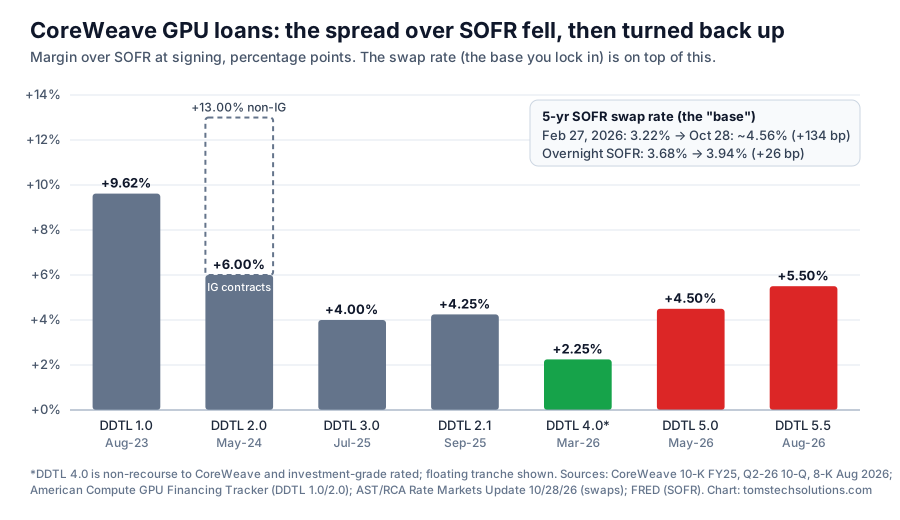
Stack the two moves and the hedged cost of a new loan went from roughly 3.22% + 4.50% = 7.72% to 4.56% + 5.50% = 10.06% (my math, using the DDTL 5.0 and 5.5 margins). The August DDTL 5.5 priced before October's selloff.
3. Insurance on the borrower went parabolic. CoreWeave's 5-year CDS:
- 421 bp a year ago and 835 bp a month ago. It peaked at 1,167 bp on Oct 22 and printed 1,148 bp on Oct 26 in S&P Global data. On a 40% recovery assumption, that implies ~62% odds of default within five years (Benzinga).
- ICE data showed an intraday record of 1,194.5 bp on Oct 15 (Investing.com).
- The 9.625% 2032 notes yielded 14.9% on Oct 19 (CNBC). Axios says CoreWeave's unsecured yields hit highs "around 16%" (Axios).
CDS doesn't change what CoreWeave pays on existing debt. It tells you what new money would cost.
4. Where the premise breaks. A swap that's already on the books got more valuable this year, not less. If you locked in a fixed rate early, rising rates mean you're paying less than the market now charges. At Jun 30, CoreWeave had $4.661B of interest-rate swap notional, up from $319M at year-end (10-Q).
The bigger issue is how much isn't hedged. The 10-Q says "the majority of the debt under our Credit Facilities bears interest at variable rates, the majority of which is unhedged." It puts the sensitivity at ~$30M of extra quarterly interest per +100 bp.
My math: the floating DDTL balances at Jun 30 add up to about $12.2B: DDTL 1.0 $1.30B, 2.0 $3.19B, 2.1 $3.00B, 3.0 $2.215B, 5.0 $1.10B, and the 4.0 floating tranche $1.4B. Against $4.661B of swaps, that's ~38% hedged. That matches the $30M per quarter sensitivity ($120M a year ÷ 1% ≈ $12B floating).
So the honest version is this. Higher rates hit CoreWeave mainly through new borrowing and the unhedged floating debt, not through the swaps themselves.
The bill is showing up
From CoreWeave's 10-Q and Q2 outlook deck:
- Q2 revenue was $2,575M. Operating loss was $(49)M. Net interest expense was $(640)M, ~25% of revenue (my math).
- The Q3 guide is $860–940M of interest against $200–260M of adjusted operating income. 2026 capex guidance is $35–39B.
- Total indebtedness was $35.6B at Jun 30, with $4.41B of principal due in the rest of 2026 and $6.18B in 2027. Since then CoreWeave has added the $3.7B convert, $1.2B of DDTL 5.5 draws, and a $1.2B revolver draw. Media tallies including leases run ~$52B (Investing.com).
Effective interest rates by instrument, as reported:
| Instrument | Balance (Jun 30) | Effective rate |
|---|---|---|
| DDTL 1.0 (2023) | $1.30B | 15% |
| DDTL 2.0 (2024) | $3.19B | 11% |
| DDTL 2.1 / 3.0 / 5.0 | $3.00B / $2.22B / $1.10B | 9% |
| DDTL 4.0 (non-recourse, IG-rated) | $2.84B | 7% |
| Unsecured notes (USD) | $7.75B | 10% |
| Converts | $6.59B | 2% |
| OEM financing (recourse) | $4.22B | 11% |
Funding needs are big and the window is narrow. Baird estimates ~$30B of new capital in 2027. FactSet consensus has Q3 free cash flow at about −$10.1B. CNBC's credit-desk sources say high-yield issuance is "effectively on hold until after the midterm elections" (CNBC). Yesterday Morgan Stanley cut its target to $70 from $99, citing financing uncertainty (Investing.com).
It's not just CoreWeave: the market is tiering
Recent GPU and neocloud deals, all checked against the primary release:
| Deal | Date | Structure | Price | What's backing it |
|---|---|---|---|---|
| IREN Hardware 3 | Jun 2026 | $1.5B DDTL + $2.1B notes | SOFR + 2.25% / 5.96% fixed | Microsoft contract (8-K) |
| CoreWeave DDTL 5.5 | Aug 2026 | $2.6B DDTL | SOFR + 5.50% | CoreWeave guarantee (8-K) |
| Lambda | Oct 1 | $1.008B delayed-draw, Baa1 / A(low) | 6.78% fixed, to May 2033 | Two IG hyperscale offtakers (Lambda) |
| Nebius | Oct 22 | $3.5B senior secured, 364-day | SOFR + 2.75%, stepping up to 3.50% max | Citi; Nebius cites >$40B of IG contracts (Nebius) |
| HIVE / BUZZ HPC | Oct 27 | ~$129M, 3-yr amortizing, 80% loan-to-cost | 9.0% fixed | 2,303 GB200s for a $225M Cohere contract (8-K) |
| IREN / Wingspire | Oct 28 | $363M equipment refinancing of deployed GPUs | not disclosed | Multi-year contracts (TSN) |
| NexGen Cloud | Oct 29 | $106M 4-yr senior secured | not disclosed | 1,728 B300s, take-or-pay (PR Newswire) |
The pattern: ring-fenced debt backed by an investment-grade customer still clears at ~6–7%. Smaller or weaker-credit deals are 9%+. CoreWeave's own unsecured paper trades at ~15%. Deals are still getting done this week, mostly as secured, contract-backed facilities. Nebius took a one-year bridge, which buys time to term out later.
Barclays put it well: "The market has moved from trading AI as a theme to pricing issuers differently." Citi's HY desk warned that data-center bonds "can reprice quickly" on tenant risk (Axios).
It's spilling into data-center real estate too. Senior AAA data-center CMBS widened 21 bp in one week to T+182 for fixed-rate deals, and 24 bp to SOFR+199 for floaters. Since year-end they're +60 bp (fixed) and +32 bp (floating), versus +1 and +7 for other single-asset deals. Every underlying loan is still current (Trepp).
That's a repricing of the sector, not a wave of defaults. J.P. Morgan's wealth strategists make the same point: it costs roughly 10x as much to insure the weakest AI borrowers as the strongest (Benzinga).
My math: what a point of interest costs per GPU-hour
This is the part I care about as an infra person. In my GPU-hour cost breakdown, capital was the biggest line. Here's how sensitive it is to the interest rate.
Inputs (sourced from the IREN–Microsoft GB300 deal):
- GPU + system capex: $5.8B for 76,000 GB300s, covering servers, InfiniBand, cabling, software, and deployment (IREN PR; GPU count from the Q1 FY26 call). That works out to $76.3k per GPU. Cross-check: HIVE's fresh deal is $165M for 2,303 GB200s, or $71.6k per GPU (8-K).
- Data center: IREN estimates $14–16M per MW of IT load all-in, across 200 MW (IREN deck). 200 MW ÷ 76,000 = 2.63 kW per GPU, so at the $15M midpoint that's $39.5k per GPU.
- Revenue: $1.94B ARR ÷ 76,000 GPUs ÷ 8,760 hours = $2.91 per GPU-hour contract-implied (IREN deck).
- Opex (power, staff, maintenance, insurance): IREN guides an 85% project EBITDA margin, so opex is 15% of revenue, or $0.44 per GPU-hour.
Assumptions (mine):
- GPU gear is paid off over 5 years (the contract term). As a variant, I use the 6-year life CoreWeave depreciates over (10-K).
- The building is paid off over 15 years. The Dallas Fed notes physical infrastructure is depreciated over 10–15+ years.
- 100% debt-funded at rate r. That's a simplification: real deals mix in equity, prepayments, and cheaper tranches.
- 100% utilization for the contracted case and 80% for a merchant cluster with no anchor customer.
Formula:
CRF(r, n)       = r / (1 − (1 + r)^−n)        # capital recovery factor: level payment per $1 borrowed
Break-even $/hr = [ CRF(r,5) × $76.3k  +  CRF(r,15) × $39.5k ] / 8,760  +  $0.44
                  ÷ utilization
20% residual:   replace $76.3k with ($76.3k − 0.2 × $76.3k / (1+r)^5)
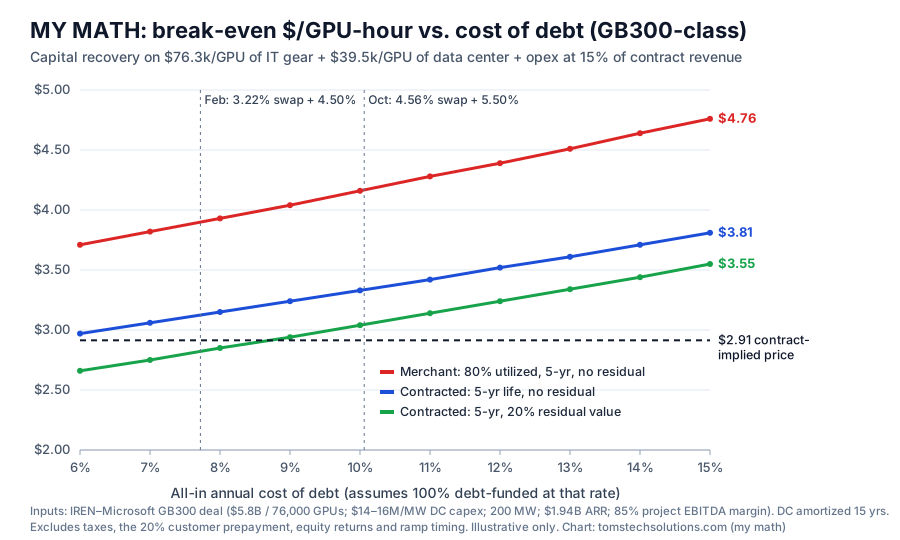
| All-in cost of debt | What it looks like | Break-even, 5-yr, no residual | 5-yr, 20% residual | 6-yr life | Merchant, 80% util. |
|---|---|---|---|---|---|
| 7% | ~IG SPV (Lambda 6.78%) | $3.06 | $2.75 | $2.76 | $3.82 |
| 8% | Feb swap + May margin (~7.7%) | $3.15 | $2.85 | $2.85 | $3.93 |
| 10% | Oct swap + Aug margin (~10.1%) | $3.33 | $3.04 | $3.03 | $4.16 |
| 12% | $3.52 | $3.24 | $3.22 | $4.39 | |
| 15% | ~CoreWeave unsecured yield | $3.81 | $3.55 | $3.51 | $4.76 |
How to read it:
- Each +100 bp adds ~$0.09 per GPU-hour. That's ~3% of a $2.91 contract, or roughly $820 per GPU per year. Across 76,000 GPUs, it's ~$62M a year.
- The Feb→Oct move cost ~$0.21 per GPU-hour. The swap move (+134 bp) plus the spread step-up (+100 bp) took a new hedged loan from ~7.7% to ~10.1%, which moves break-even from $3.12 to $3.33.
- The resale value of the GPUs decides who wins. With zero residual value, the $2.91 contract doesn't fully pay back the gear plus building at any rate above ~5.4%. Assume 20% residual value, or a sixth year of life, and break-even falls below $2.91 up to ~8.7% debt cost. That's why IG-backed deals at 6–7% work and 10%+ money gets tight. It's also why lenders obsess over what a five-year-old GPU is worth.
- Merchant capacity needs ~$3.70+ per hour even at 6% money. For context, the H100 rental index settled at $2.92 yesterday (Ornn OCPI-H100). That's a different, older chip, so take it as a mood check, not a direct comparison.
- HIVE's deal shows the math at short tenors. $165M of capex at 9% over 3 years is ~$3.23 per GPU-hour of capital, against ~$3.72 of contract revenue ($225M ÷ 2,303 GPUs ÷ 3 years). Capital takes ~87% before any opex (my math). That only works because HIVE keeps the GPUs after year 3.
Caveats: this is one contract, pre-tax, with no equity return. It ignores IREN's 20% customer prepayment, which lowers how much has to be borrowed, and the ramp timing. The contract revenue also includes some services. Directionally, though, the conclusion holds: for a neocloud, the financing spread is most of the margin.
Amazon's print, through a financing lens
Yesterday's post said to watch Amazon after the close. Here's what matters for this topic:
- AWS revenue was $46.0B, up 39%, with $17.8B of operating income. Backlog is $578B (Amazon release, call).
- Cash capex was $75.9B in Q3, per the CFO on the call. CNBC reports capital expenditures of $77.3B vs a ~$58.7B FactSet estimate, so the definitions differ slightly (CNBC). Amazon held its ~$220B 2026 guide and expects to spend "meaningfully more in 2027."
- Trailing-12-month free cash flow was −$42.4B. The stock fell more than 6% after hours (CNBC).
- The neocloud read-through is the line to underline. Jassy said AWS is "a different model than primarily hosting GPUs or renting short-term data center capacity." When analysts asked about cloud margins, he said: "Neoclouds are about 3,500 basis points worse in operating margin than if you long lease them," and noted most of Amazon's capacity is owned or long-leased (transcript).
My take: Microsoft's print said neocloud deliveries slipped. Amazon's says the biggest cloud views neocloud capacity as structurally expensive and isn't leaning on it. Neither is a demand problem; Amazon is still "gobbling up" capacity as fast as it installs it. But a neocloud's best credit support is a long contract with a hyperscaler. If one of the biggest potential customers says renting from neoclouds is a 35-point margin hit, that customer is less likely to sign one.
Bull vs. bear, honestly
Bear
- Refinancing needs are huge: $6.18B of principal due in 2027 at CoreWeave, plus ~$30B of new capital (Baird) and $35–39B of 2026 capex.
- The HY window is shut until after Nov 3.
- Rates may go higher again in December.
- Most floating debt is unhedged, and every new hedge locks in at the higher swap curve.
- Musk posted that the 200+ neoclouds face "guppy-level death and consolidation" (Benzinga). Opinion, not data, but it's moving sentiment.
Bull
- The SPV structure works: IG-backed GPU debt still prices at 6–7% this month (Lambda, IREN), and deals closed this week.
- CoreWeave has $103.7B of remaining contracted revenue, 41% of it due within 24 months (10-Q).
- Nvidia's $6.3B capacity backstop runs through 2032.
- Goldman upgraded to Buy, arguing "not all neoclouds are created equal" (CNBC).
- Jensen Huang says CoreWeave's "cost of capital is actually decreasing" (Investing.com). The market data above says otherwise for new unsecured money, but it's roughly true for IG-backed SPV paper versus 2023.
What I'm watching
- Nov 3 midterms. Does HY issuance reopen?
- IREN's FY27 Q1 print, reported for Nov 5 (TSN): the rate and terms on the Wingspire refinancing.
- CoreWeave Q3 on Nov 10, 2:00 PM PT (CoreWeave IR):
- Swap notional and how much is hedged vs. floating
- Pricing on any new DDTL: wider than SOFR + 5.50%?
- A funding plan for 2027
- The December FOMC and the 5-year swap. Every 25 bp is about $0.02 per GPU-hour on my model.
Bottom line
GPU debt isn't one market anymore. If you have an investment-grade customer, a walled-off SPV, and a hedge, money still costs ~6–7%. If you're borrowing on your own name, it's ~15% today, with the base rate up 134 bp and the lender's spread up 100 bp since spring.
My break-even math says that gap is roughly the difference between a 5-year GPU contract that pays for itself and one that only works if the chips are still worth something in 2031. That's why the bond market, not the GPU order book, is the thing to watch into CoreWeave's print.