Nvidia Without Jensen: What We Know, What's Rumor, and What It Means for GPU Buyers
Jensen Huang is out as Nvidia CEO. Here's a plain-English timeline of why, what's confirmed versus only reported, the export-control fight in Washington, and what it could change for GPU buyers, suppliers, and China and Southeast Asia.
Tom Pechulis, , 10 min read
Nvidia is the company the whole AI buildout leans on, and this week its founder-CEO of 33 years left in the middle of a scandal. I said yesterday I'd come back once there were more facts. There are more now. I'm going to be strict about what is confirmed, what is "reported by people familiar," and what is just opinion. This is a story with real people's personal lives in it, so I'm sticking to what matters for business and policy.
TL;DR
- Confirmed: Jensen Huang resigned as CEO, president and board member, effective immediately. CFO Colette Kress is interim CEO (and stays CFO). Harvey Jones is the first-ever board chair. A permanent CEO search is on, internal and external candidates.
- Why, as far as it's public: Nvidia's statement gives no reason. But Huang had admitted an affair days earlier, with an executive of a Nvidia customer that US authorities suspect of spying for Beijing (Reuters). The board hired an outside law firm to investigate.
- Washington: Both parties want tougher chip controls, and Huang is expected to be called to testify.
- The business risk: Analysts told CNBC the company leaned heavily on Huang personally. How much that matters is the open question, and Nvidia reports earnings Tuesday, Nov 17.
- My take: The CEO swap probably doesn't change Nvidia's product roadmap next quarter. It could change how allocations and deals get decided over the next couple of years. Watch that, not the headlines.
Timeline: the week it happened
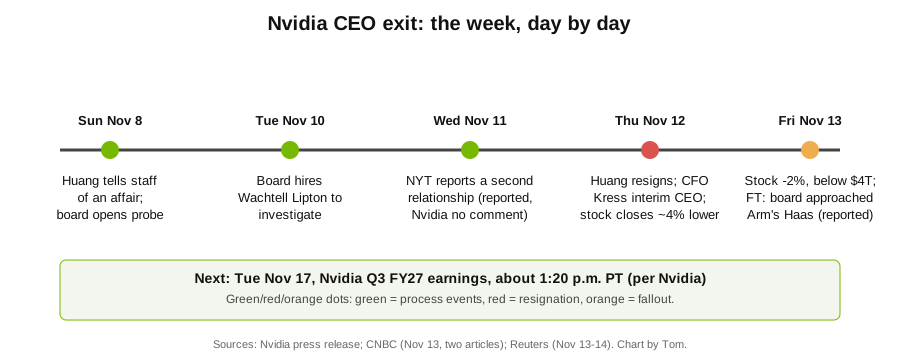
All times and days below come from CNBC, CNBC and Reuters:
- Sunday, Nov 8: Huang told employees in a note that he'd had an affair. The board announced an investigation. Huang also apologized for being unfaithful to his wife and for disappointing the company, without naming anyone.
- Tuesday, Nov 10: The independent board members said they hired Wachtell, Lipton, Rosen & Katz for an independent investigation, after the New York Times and Wall Street Journal reported on the relationship and on US suspicions about the woman involved. Beijing has denied she is a spy, and Reuters says it has not independently verified whether she worked for the Chinese government.
- Wednesday, Nov 11 / Thursday, Nov 12: Nvidia's 8-K filing says the board accepted Huang's resignation on Nov 11. It was announced Thursday, Nov 12, and that's when the stock reacted. Huang resigned. Nvidia's stock fell sharply that morning and closed about 4% lower (CNBC).
- Friday, Nov 13: The stock fell another 2.01%, closing below a $4 trillion market value for the first time since July 2025. It was down 12.75% on the week, its sixth straight weekly decline, the longest streak since 2012 (CNBC). Reuters says the stock is down more than 30% from its Oct 6 closing high, erasing over $1.8 trillion of market value.
Why did he leave? Confirmed vs. reported vs. opinion
Confirmed (on the record):
- The resignation, the interim CEO, and the new chair (Nvidia). Nvidia's release doesn't state a reason, and, per Reuters, it did not address Huang's actions.
- Huang's own admission of an extramarital affair, and the board's outside investigation (CNBC).
- The board says it is selecting a search firm and has "not formally engaged any potential candidates." It calls speculation about individuals "premature."
Reported by media, from anonymous sources (treat as credible but not proven):
- Reuters says Huang misled general counsel Tim Teter and the chief marketing officer about the relationship, describing it in October as normal customer dealings. Reuters says it reviewed internal messages and Nvidia and Huang's representative declined to comment.
- The New York Times and Reuters each reported additional relationships with Nvidia employees (CNBC). Nvidia didn't immediately respond to CNBC. I'm not naming anyone here.
- The Financial Times reported (via CNBC) that the board approached Arm CEO Rene Haas about the job. I haven't seen Nvidia or Arm confirm this, and the board says candidate speculation is premature. Treat it as a rumor.
Opinion, not fact:
- TechCrunch argues that Nvidia's potential corporate liability for export-control violations "likely factored into" the decision.
- SemiAnalysis, in its own post-mortem, says it believes there is more at play than the personal conduct, tying it to large-scale GPU smuggling, and that it believes the US intelligence community is a big part of the push. It frames these as its beliefs, not as established facts.
One more guardrail, straight from Reuters: there has been no public finding that Huang violated export-control laws, and the company Alice Huang was associated with, Megaspeed, has denied illegally diverting chips to China. (Jensen and Alice Huang share a last name but are not related.)
Washington: the export-control fight just got louder
Plain-English background first. "Export controls" are US rules about which chips can be sold to which countries. The US has been restricting Nvidia's top AI chips since 2022. Huang was a loud advocate for loosening them.
What's happening now, per CNBC:
- House Foreign Affairs Chair Brian Mast says Huang has agreed to appear in the coming weeks, likely under oath, and wants it before Thanksgiving. If he doesn't show, Mast says he'll subpoena him. Details are still being worked out.
- Senate Banking Chair Tim Scott summoned Huang and Commerce Secretary Howard Lutnick to testify in December. Commerce says Lutnick agreed to appear voluntarily.
- The New York Times reported that Nvidia's general counsel told Commerce investigators he'd been in touch with the head of the Bureau of Industry and Security (BIS), the agency that enforces export controls. The Commerce probe of Megaspeed was then moved to the Justice Department. Some members of Congress want BIS itself investigated.
- Democrats take control of both chambers in January, per CNBC, so this doesn't fade after the lame-duck session.
And the bills. Reuters lists the ones that could be attached to the annual defense bill:
| Bill | What it does, in plain English | Why Nvidia cares |
|---|---|---|
| Chip Security Act | Chipmakers must track where advanced AI chips are and report suspected diversion. | New compliance cost and paperwork. |
| AI Overwatch Act | Gives Congress a bigger say in loosening chip export rules. | Harder for any future administration to relax limits. |
| MATCH Act | Pushes allies (Netherlands, Japan) to restrict chipmaking tools sold to China. | Doesn't hit Nvidia directly. Aims at China's own chip industry. |
| Remote Access Security Act (RASA) | Lets Commerce regulate renting overseas GPUs by Chinese firms. Passed the House in January, awaiting the Senate. | Nvidia said in July it could have "a material impact on our business." |
The last one matters most for the GPU rental business, and it's the one where the Reuters explainer notes Chinese AI companies are already rushing to lock in Nvidia-powered capacity outside China.
China and Southeast Asia: the chips that "aren't there"
Here's the odd part. Nvidia says its China data-center business is basically zero. Huang said last year its China share went from 95% to zero, and the August filing said Nvidia is effectively excluded from that market. But:
- A Reuters review of more than 150 Chinese procurement notices and contracts found projects worth over 23 billion yuan (about $3.2 billion) built around restricted Nvidia H100, H200 and H800 chips. That total includes buildings and power gear, not just chips, and includes plans and contracts, not only finished installs. The projects haven't been linked to Megaspeed or to the allegations about Huang (Reuters).
- An IDC report cited by Reuters estimated Nvidia was still 34% of Chinese AI-accelerator shipments in H1 2026. Reuters is careful to say that figure and Nvidia's measure "measure different things" and don't show how any restricted hardware got there.
- TechCrunch, citing analysis by Will DePue of Unemployment Labs, says the weights of leading Chinese open models (including Moonshot's Kimi K3 and DeepSeek's V4) show "fingerprints" of training on Blackwell chips. That's one research group's claim. TechCrunch itself notes it doesn't mean the models were trained entirely on those chips, or that laws were broken, since the chips could sit in an offshore data center.
- That offshore route is the Southeast Asia story. Epoch AI estimates 275,000 Nvidia accelerators were imported to Malaysia in 2024 and 2025 (per TechCrunch), and Chinese firms often rent compute abroad rather than buy chips.
- Also reported by TechCrunch: about 600,000 H200 chips are reportedly stockpiled in Hong Kong awaiting shipment into China, and observers disagree on why they haven't been cleared. According to TechCrunch, the US allows H200 exports under a routing arrangement that lets the government collect a 25% tariff.
If you're a buyer or operator in Malaysia, Singapore or Hong Kong, the practical read is that who ends up using the compute is becoming the question regulators ask, not just who bought the box. That's the point of the Remote Access Security Act.
What it means for the GPU supply chain
First, what SemiAnalysis says. Their post is marked as a paid article, so I'm only summarizing the opening, which I'd treat as the public part, in my own words. They say the conduct issue is "real," but that they believe there's more behind a resignation after only four days, and that it is tied to GPU smuggling. They say they believe the US intelligence community is a large part of the push, and that RASA (the remote-access bill above) or similar legislation will likely move forward now that Huang, the biggest defender of selling to China, is gone. They'd prefer MATCH-style rules to RASA. All of that is their stated belief. I can't verify it. Go read the original and subscribe if you want the rest.
Now the part I can source. Analysts told CNBC before the resignation that losing Huang could cost Nvidia as much as 20% of its market value, given how central he's been. Stephane Houri of ODDO BHF said the architecture of the AI industry "really depended on the vision" of Huang. Nvidia's own line is that operations, customer commitments and the product roadmap will continue without interruption.
Here's my interpretation (labeled as mine, not sourced fact):
- Buyers: Allocation and deal terms have often come down to relationships. A new CEO means every big customer will quietly check whether the handshake deals still hold. If you're a smaller GPU buyer or a neocloud (a newer GPU-rental company), keep your contracts and delivery dates in writing.
- Suppliers: Nvidia is the biggest customer for memory and advanced chip packaging. A CEO change doesn't cancel orders, but suppliers will watch whether the new leadership keeps the same commitments. I don't have a source on any supplier changing behavior, so this is a watch item.
- Rivals: Nvidia's biggest customers are building their own chips. A distracted Nvidia is an opening for them. Again, my read.
- Open models: Nvidia has promoted open-source AI models and has worked with developers worldwide. Whether that continues under new leadership is unknown.
Here's an analogy. Think of Nvidia as a giant restaurant where the head chef also personally negotiates with every farmer and every VIP customer. The kitchen still works the day he leaves. The question is whether the farmers keep giving you the best produce and whether your VIPs keep believing the handshake deals.
One correction to a story I saw floating around: Malaysia is not running a probe. CNBC reports Malaysia's trade minister said his ministry hadn't been shown evidence that Megaspeed's Malaysian unit, Speedmatrix, broke Malaysian law and hadn't opened an investigation. Singapore police opened one in October 2025, and the US is looking at Megaspeed too. Megaspeed denies illegally sending chips to China.
Jargon decoder
| Term | Plain English |
|---|---|
| Export controls | US rules limiting which advanced chips can be sold abroad, and to whom. |
| Neocloud | A newer company that rents out GPUs (like CoreWeave or Nebius), as opposed to the big clouds. |
| Remote access | Renting chips in someone else's data center instead of owning them. |
| Interim CEO | A temporary boss while the permanent one is found. |
What I think
- Don't confuse the gossip with the risk. The scandal is the trigger. The business risk is export-control exposure, an open succession question, and how much of Nvidia's customer relationships ran through Huang personally. Those are the things I'd track.
- Near term is mostly noise, long term is policy. Nvidia says operations, customer commitments and the product roadmap continue without interruption. I believe that for the next few quarters. Whether the next CEO gets the same personal access in Seoul, Taipei and Washington is a different bet.
- Policy is moving faster than the facts. Washington is about to legislate on a story whose investigations haven't finished. That's how you end up with rules like the Remote Access Security Act, which could hit Southeast Asian data-center operators hard. If you rely on offshore GPU capacity, plan for that.
- I could be wrong on the rate of change here. A lot of this rests on anonymous sourcing, and I'd rather say that than pretend otherwise.
What I'm watching next
- Tuesday, Nov 17: Nvidia's Q3 FY27 earnings (about 1:20 p.m. PT, call at 2 p.m. PT, per Nvidia). First numbers and first commentary from Kress as interim CEO.
- The CEO search: a search firm name, and any real candidate, not rumor. I'm not treating the Haas report as news until someone on the record confirms it.
- Huang's testimony and the Senate Banking hearing in December, and what Lutnick says.
- Whether the Remote Access Security Act and Chip Security Act ride on the defense bill.
- Anthropic's Nasdaq IPO: CNBC reports a $70 to $78 price range, with pricing planned for Nov 18 and trading Nov 19, according to people familiar. Nvidia's biggest customers are the AI labs, so how that goes will say something about the demand side.