Cerebras Has the Chips. It's Waiting on the Buildings
Cerebras beat on Q3, guided Q4 well above Wall Street, and named Microsoft as its third hyperscaler customer. But its cloud is capped by data centers that aren't finished, and part of its OpenAI contract is running late. Here's the quarter in plain English.
Tom Pechulis, , 9 min read
Yesterday was a strange day to be an AI chip company. Nvidia announced that Jensen Huang had resigned as CEO, with CFO Colette Kress stepping in as interim CEO (8-K). A few hours later, after the close, Cerebras, the best-known startup trying to beat Nvidia at serving AI answers fast, reported its third quarter as a public company. The stock jumped about 17% after hours (CNBC).
The Cerebras story turns out to rhyme with yesterday's Nebius post. Demand isn't the problem, and neither are chips. The problem is buildings.
TL;DR
- Beat and raise. Core revenue (Cerebras' adjusted number) was $230.9 million, up 70% from a year ago, versus $214.7 million expected. Q4 guidance of $310-330 million compares with $271 million expected (LSEG, per CNBC).
- It's a cloud company now. Cloud and services revenue was $141.9 million on a GAAP basis, up 265%, and is now about two-thirds of revenue. Hardware sales fell (release).
- Microsoft signed. That makes three hyperscalers (AWS, Oracle, Microsoft). No size or terms yet. Revenue is expected to start in early 2027 (CNBC; call transcript).
- The catch. Cerebras is "running behind schedule" on the first data-center tranches of its big OpenAI contract, and Q4 cloud revenue is guided flat because the new data centers aren't ready yet (transcript).
- GAAP vs. "core" is a big gap. The GAAP operating loss was $224 million. The core operating loss was $33 million. Most of the difference is stock compensation.
- My take: Good quarter. The technology and the customer list are getting real. But the 2027 "triple revenue" plan depends on 700 MW of data centers showing up on time, and nobody's data centers are showing up on time right now.
Quick jargon decoder
| Term | Plain English |
|---|---|
| Inference | Running a trained AI model to answer questions. Training builds the model. Inference is using it. |
| Wafer-scale chip | Cerebras makes one giant chip out of a whole silicon wafer (roughly dinner-plate size) instead of cutting it into hundreds of small chips. Memory sits on the chip, so it's very fast at producing answers. |
| HBM | High-bandwidth memory, the expensive, scarce memory stacked next to Nvidia and AMD GPUs. Cerebras doesn't use it. |
| Core (non-GAAP) numbers | Cerebras' own adjusted figures. They leave out stock pay, a non-cash charge tied to warrants given to customers, and some data-center costs it just passes on to customers. |
| Customer warrants | Rights to buy Cerebras stock, given to big customers as a sweetener. Accounting rules count their cost as a reduction in revenue. |
| RPO | Remaining performance obligations: revenue customers have signed for but that hasn't been earned yet. The order book. |
| Take-or-pay | The customer pays for the committed capacity whether it uses it or not. |
| Land, power, shell | Industry shorthand for the three things a data center needs before any chips go in: a site, a grid connection, and a finished building. |
| Disaggregated inference | Splitting one AI request across two kinds of chips. One reads your prompt and the other writes the answer, each doing what it's best at. |
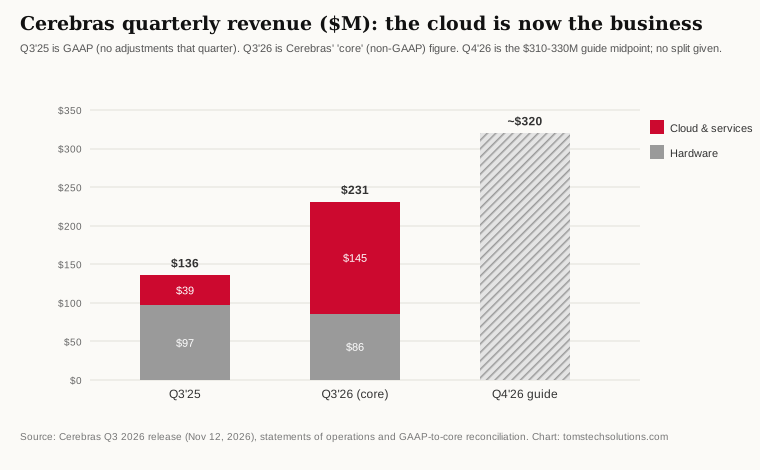
The quarter, in one picture
From the Q3 release:
- GAAP revenue: $210.8 million, up 55%. Hardware was $68.9 million (down from $96.8 million). Cloud and services were $141.9 million (up from $38.9 million).
- Cloud share: about 67% of GAAP revenue, versus about 29% a year ago (my math: 141.9 ÷ 210.8 and 38.9 ÷ 135.7).
- Core revenue: $230.9 million. Core cloud revenue: $144.9 million, up 272%.
- Core gross margin: 41%. Core cloud gross margin improved to 46.9%, up 510 basis points from Q2, because new business is coming in at higher prices, per CFO Bob Komin on the call.
- Core net income: $29.8 million, the first positive one as a public company. Analysts expected an adjusted loss of $38.4 million (LSEG, per Reuters).
Two things worth noticing. Growth is slowing: core revenue grew 70% versus 103% in Q2 (CNBC). And hardware gross margin fell to 31%, which Komin said was the last shipments under an old, cheaply priced hardware deal. Newer orders ship "at significantly higher current prices" starting in Q4.
GAAP vs. core: read both
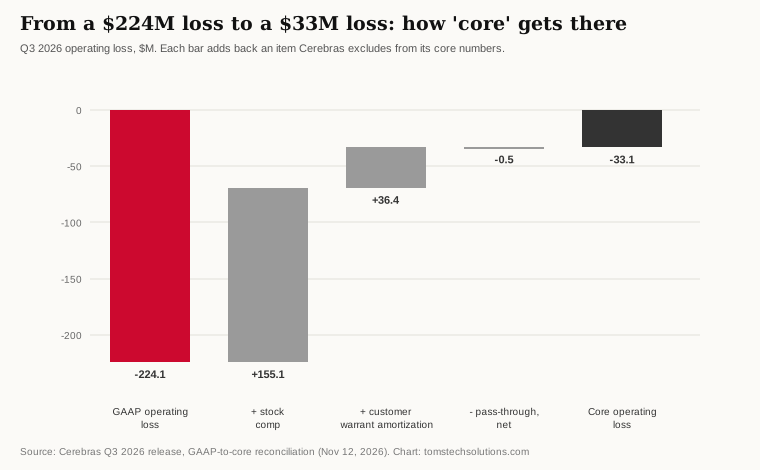
The headline numbers you'll see are "core." The audited-style GAAP numbers look very different:
- GAAP operating loss: $224.1 million (a -106% operating margin). Core operating loss: $33.1 million (-14%).
- The biggest add-back is $155.1 million of stock-based compensation. That's about 74% of GAAP revenue in a single quarter (my math: 155.1 ÷ 210.8). Much of it is tied to the May IPO, but it's real dilution for shareholders.
- $36.4 million is the non-cash cost of warrants given to customers. Under GAAP that comes out of revenue, which is why core revenue is higher than GAAP revenue.
I don't think "core" is unreasonable here. Post-IPO stock comp is lumpy, and the warrant charge isn't cash. But when someone says Cerebras is "profitable," that's only true on its own definition. GAAP net loss was $161.2 million (release).
The guidance: Q4 is a big step, 2027 is in line
- Q4 core revenue: $310-330 million, about 18% above the $271 million consensus at the midpoint (my math: 320 ÷ 271). Core gross margin of 47-49% compares with 42.1% expected (CNBC). The core operating margin is guided to roughly breakeven.
- Full-year 2026 core revenue: $940-960 million, up from $880-890 million before (Reuters).
- 2027: management "continue[s] to see revenue tripling." CNBC works that out to about $2.85 billion, slightly below the $2.92 billion analysts had. So the near term is a beat, and the long term is a reiteration.
Here's the important detail. The Q4 jump comes from hardware, not cloud. Komin said Q4 cloud revenue will be "flattish" sequentially, and that "our ramp in cloud revenue is limited entirely by our data center capacity." New capacity starts ramping in December, "too late to affect Q4." Hardware should be closer to 50% of the mix in Q4 and Q1 (transcript).
In plain English, Cerebras can't sell more cloud until its new buildings are finished. In the meantime, it's selling boxes to customers who have their own buildings ready.
The OpenAI contract is running late
This was the part investors were nervous about, and Cerebras addressed it head-on. From the call:
- OpenAI's contract is a take-or-pay deal for 750 MW of capacity. It makes up "the majority" of the $26.1 billion RPO.
- If Cerebras is late delivering capacity, OpenAI gets delay credits against future purchases. Cerebras has already deducted its estimate of those credits from RPO, and calls it a "very conservative" worst case.
- If a delay runs 90 days or more, either side can cancel that tranche only. Cerebras estimates that less than 5% of the committed megawatts could be subject to cancellation this year. Feldman confirmed that nothing has been canceled so far.
- The cause, in Feldman's words: "Our delays right now are exclusively land, power, shell. We have capacity. We have all materials." Komin said the company now projects it will be back on schedule in the second half of 2027.
- OpenAI also has an option on another 1.25 GW starting in 2029. Komin said they haven't even begun discussing it.
Feldman also said OpenAI grew as a customer from Q2 to Q3, but that Cerebras "didn't have sufficient capacity" to support a broad rollout of OpenAI's faster "Ultrafast" tier (Reuters). That's a nice problem to have, but it's still a problem: you can't bill for tokens you can't serve.
Where the capacity is coming from
- 700 gross MW contracted for delivery by end-2027 (release). "Gross" means total facility power, not all of which reaches the chips.
- More than 75% of the capacity coming online in 2027 is outside the U.S.: Canada, France, Norway, Finland, and a Sao Paulo site that's in final contracting. Feldman said "the evolving U.S. policy landscape could create greater challenges for data center development in the U.S." (transcript).
- On chips, Feldman said TSMC "has committed sufficient capacity" of wafers for 2027, and not needing HBM is "hugely beneficial" given how tight memory supply is.
That last point is the real structural edge. Everyone fighting over GPUs is also fighting over HBM. Cerebras keeps its memory on the wafer, so it skips that queue entirely. Its queue is the same one Nebius and CoreWeave are in: power and concrete.
The money
From the balance sheet and cash-flow statement in the release:
- $7.8 billion of cash, restricted cash and investments, mostly from the May IPO ($6.23 billion net proceeds).
- Debt: about $829 million, the working-capital loan from OpenAI (my math: $706.5M current + $122.6M non-current). There's also an unused $850 million credit line.
- Nine-month operating cash flow: -$389 million. Capex: $1.05 billion.
Compared with the neoclouds, this is a clean balance sheet. CoreWeave pays more in interest than it makes in operating profit (my Tuesday post). Cerebras has barely any debt. Komin's pitch is that because Cerebras builds its own systems, it pays its bill-of-materials cost instead of "a third party 70% gross margins," so each megawatt costs less to fill. That's plausible, but they gave no per-MW figure, so I can't check it. Feldman also told CNBC the company is "evaluating its financing options," so expect it to raise more money for the 2027 build-out.
What I think
- Bull case: The pitch, that fast inference is worth paying for, is winning. Three hyperscalers in six months, Oracle buying hardware for its own data centers, Q4 guidance way above the Street, margins inflecting, and a balance sheet with almost no debt. Plus, no HBM means it isn't stuck in the industry's tightest supply chain.
- Bear case: One customer (OpenAI) is most of the order book, and that contract is behind schedule. GAAP losses are huge because of stock comp. The 2027 "triple" target only matches consensus. The cloud can't grow until the buildings arrive, and Feldman himself says "data centers are late across the board and across the world." The IPO lockup also fully expired on November 9, so more insider shares can now be sold.
- My take: I like this quarter more than Nebius's. The beat came from the core business, not a one-off, and the balance sheet is far healthier. But the lesson from this week's earnings (CoreWeave, Nebius, now Cerebras) is the same: AI compute is sold out, and growth is limited by how fast someone can energize a building. The Microsoft deal is a great logo. Until we see the dollar figure next year, though, OpenAI's 750 MW still drives the story.
A word on Nvidia
I'm not going to wade into the circumstances of Huang's exit here. The facts that matter for infrastructure: Nvidia's board accepted his resignation on November 11, Kress is interim CEO while also staying CFO, and the board is searching for a permanent CEO among internal and external candidates. Harvey Jones, a director since 1993, became the first-ever board chair (Nvidia; 8-K). The stock closed down about 4% Thursday (AP). In my view, Huang was the face of a lot of Nvidia's biggest customer relationships (I wrote about Nvidia acting as a cosigner). Whether those relationships hold up without him is the real infrastructure question, and I'll come back to it once there's more than one day of facts.
What I'm watching
- Q4 core revenue vs. $310-330 million, and whether hardware really lands near 50% of the mix.
- Microsoft deal size, promised for the first half of 2027.
- OpenAI tranches: any cancellations, and whether the "back on schedule in 2H27" date holds.
- First capacity in Canada, France and Norway, which Feldman said comes online "in the next several months."
- Anthropic's Nasdaq debut next week (CNBC), the next read on what the AI labs, the end buyers of all this capacity, can actually afford.