Nvidia, Co-Signer: Why the Chip King Wants to Backstop Nscale's Anthropic Data Center
Nvidia is reportedly in talks to guarantee billions of debt for Nscale's West Virginia campus, where Anthropic signed for up to $44.6B of compute. Here's what a residual value guarantee is, what Nscale's S-1 says about the deal, how much credit support Nvidia has already put on its own balance sheet, and why it matters for the neocloud debt squeeze.
Tom Pechulis, , 10 min read
On Friday I wrote about what GPU debt costs and why neocloud money got expensive. The next chapter of that story broke the same week: Nvidia is in talks to co-sign the construction debt for one of its customers' data centers. That customer is Nscale, a UK neocloud (a GPU-rental company without a big cash-generating business behind it), and the building is for Anthropic.
TL;DR
- The news: Nvidia is in talks to give Nscale "billions of dollars in credit guarantees" to back debt for the power infrastructure and construction of its West Virginia campus, which Anthropic plans to use. First reported by The Information on Oct 29 and confirmed by Bloomberg. It's not signed, and terms could change (Reuters via CNA, TechCrunch, TNW).
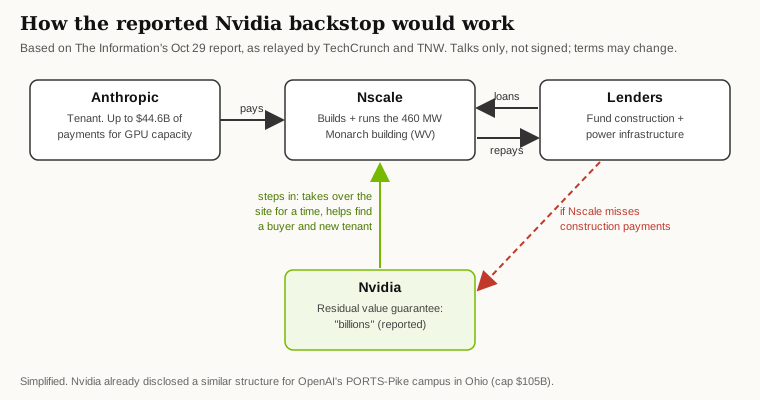
- The structure: a residual value guarantee. If Nscale misses its construction payments, Nvidia would step in, temporarily take over the facility, and help find a buyer and a new tenant (TechCrunch).
- Why it's needed: Nscale's own S-1 says Anthropic's contracts are worth up to ~$44.6B, but as of that filing Nscale said it had not obtained binding commitments for any of the financings needed to deliver them. Anthropic can cancel any tranche that shows up late.
- The bigger picture: this wouldn't be Nvidia's first rodeo. Its latest 10-Q already shows $108.5B of maximum guarantee exposure, mostly a $105B cap backing OpenAI's leases at the PORTS-Pike campus in Ohio (Nvidia 10-Q). Nvidia is becoming the AI buildout's lender of last resort.
Quick jargon decoder
| Term | Plain English |
|---|---|
| Neocloud | A company that rents out GPUs by the hour or by the contract (CoreWeave, Nebius, Nscale). Unlike Amazon or Microsoft, there's no giant profitable business behind it. |
| Credit guarantee / backstop | A promise by a stronger company to cover a weaker company's debts if it can't pay. Basically co-signing a loan. |
| Residual value guarantee | A specific kind of backstop: if things go wrong, the guarantor stands behind the value of the asset (here, the building). They take it over and resell or re-lease it, instead of just writing a check for the whole loan. |
| TCV (total contract value) | The total dollars a customer has agreed to pay over the whole life of a contract. Not annual revenue. |
| Tranche | One slice of a bigger deal. Anthropic's deal is split into four, each with its own delivery date. |
| Land, power, and shell | The empty data center: the land, the grid connection, and the building, before any GPUs go in. |
| Junk / below investment grade | A credit rating that says "riskier borrower." Junk borrowers pay much higher interest. |
As a landlord, the way I think about it: it's like the tenant's rich parent co-signing the lease. Except here, the parent is also the company that sold the tenant the furniture.
What was reported this week
The facts, with the caveat that this is a report on private talks, not a signed deal:
- Who and what: Nvidia is in talks to give Nscale credit guarantees to support debt funding for a West Virginia data center earmarked for Anthropic. The money would cover power infrastructure and construction. Nvidia is already an investor in Nscale. Nvidia, Nscale, and Anthropic didn't respond to Reuters (Reuters via CNA).
- Confirmation: Bloomberg's Brody Ford confirmed the talks, citing a person familiar with the matter. Nscale declined to comment to Bloomberg (TNW).
- The asset: the guarantee would cover the value of the 460 MW building that Anthropic's contract covers (TNW, TechCrunch).
- What's new about it: Nvidia's earlier support for cloud providers has mostly covered leases and chip purchases, not construction (TechCrunch).
- Why Nvidia cares: one investor told The Information that Anthropic's involvement likely explains Nvidia's interest in keeping the project on track (TNW).
- A second deal is in the works: Nscale and Anthropic are also discussing another roughly $45B deal for another building (TechCrunch, Reuters via CNA).
What Nscale's S-1 says about the Anthropic deal
The best primary source here is Nscale's IPO filing, the S-1 filed Sep 18. The key lines:
- The contract: signed Aug 25, 2026. Four separate agreements to provide Anthropic with dedicated GPU infrastructure at Nscale's Monarch Compute Campus, running Nvidia Vera Rubin NVL72 systems, for aggregate payments of "up to approximately $44.6 billion," subject to Nscale hitting delivery and uptime requirements.
- The financing gap: Nscale has to use "best efforts" to line up financing for the GPUs and the data center within a set period. As of the filing, it had "not obtained binding commitments for any of the financings required" for the Anthropic deal. The FT reported that Anthropic can walk away if the financing isn't in place by a deadline (TNW).
- Tough terms: if Nscale delivers a tranche too late, Anthropic can terminate that tranche "without liability." Supply-chain delays are only excused if they're industry-wide and Nscale placed binding orders on time. Anthropic can also terminate if monthly uptime stays below set thresholds. The S-1 calls these service levels "more stringent" than its other customer agreements.
- The site: Monarch is a ~2,250-acre campus in Mason County, West Virginia. Nscale expects 2 GW of gross power (1.37 GW of IT load) online by the first half of 2028, scaling to about 8 GW by 2031.
- Nvidia is already in: Nvidia is set to buy $1.0B of convertible notes or non-voting shares in Nscale, closing on or around Nov 16, 2026.
Now put yourself in a lender's shoes. You'd be lending billions to build a building whose only big customer can walk if construction slips. The tenant (Anthropic) is strong. The builder (Nscale) has a short track record. That gap is exactly what a guarantee from Nvidia fills.
Nscale by the numbers: big backlog, small live footprint
From the same S-1, as of Aug 31, 2026:
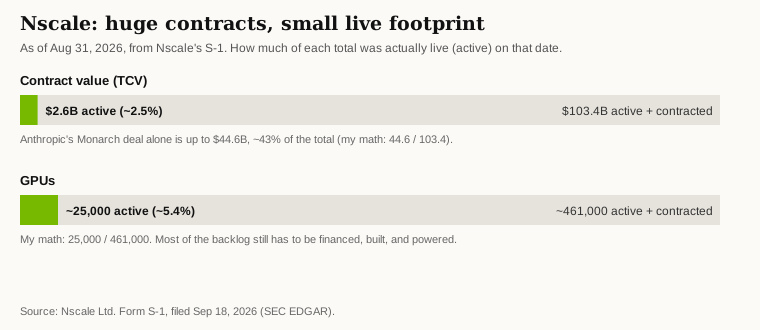
- $103.4B of active plus contracted TCV, but only $2.6B active. That's ~2.5% live (my math: 2.6 ÷ 103.4).
- ~461,000 active plus contracted GPUs, but only ~25,000 active. That's ~5.4% (my math: 25,000 ÷ 461,000).
- Anthropic's ~$44.6B is ~43% of the backlog (my math: 44.6 ÷ 103.4). The FT put it at "more than 40%" (TNW).
- First half of 2026: revenue of $140.6M (up 1,252%) and a net loss of $1,020.1M. That's about $7.26 lost per $1 of revenue (my math: 1,020.1 ÷ 140.6; the S-1 reports it as a −726% net loss margin).
That's not unusual for a company that's mid-buildout. Most costs come before the revenue does. But it explains why lenders want someone bigger in the deal.
And the execution track record is shaky. According to TechCrunch, Microsoft pulled out of a planned Nscale site in England in October after its grid connection was pushed into the 2030s, and runoff from the West Virginia site has flooded nearby homes more than once (TechCrunch). The FT reported that state regulators ordered a three-day construction halt in September and that Nscale has received 10 notices of violation for stormwater controls. A person close to Nscale blamed extreme weather and said the damage has been fixed. The FT also reported that the first 2 GW phase will run on 864 gas-fired engines (TNW).
Nvidia is already a lender of last resort
This is the part I think most people miss. The Nscale talks aren't a one-off. Nvidia's 10-Q for the quarter ended Jul 26, 2026 lays out a growing stack of credit support:
- $105B cap: SB Energy / OpenAI guarantees. In August, Nvidia agreed to guarantee leases for about 4.25 GW of IT load at SB Energy's PORTS-Pike Technology Campus in Pike County, Ohio, where OpenAI is the tenant on 20-year leases. Each guarantee kicks in when a lease starts, grows as each of nine phases goes live (the first expected in Nvidia's fiscal 2029), and shrinks as OpenAI pays rent. In exchange, the site will exclusively host Nvidia infrastructure, with limited exceptions (10-Q, Nvidia release).
- $3.5B: land, power, and shell guarantees for "select AI cloud partners'" data center lease obligations if they default.
- $36B: cloud capacity it agreed to rent from AI clouds, over terms "typically six years." Nvidia's commitment shrinks as third parties use the capacity.
- $20B: data center leases it signed and expects to reassign to third parties.
- $25B: equity investment commitments, on top of $99B of equity investments already made.
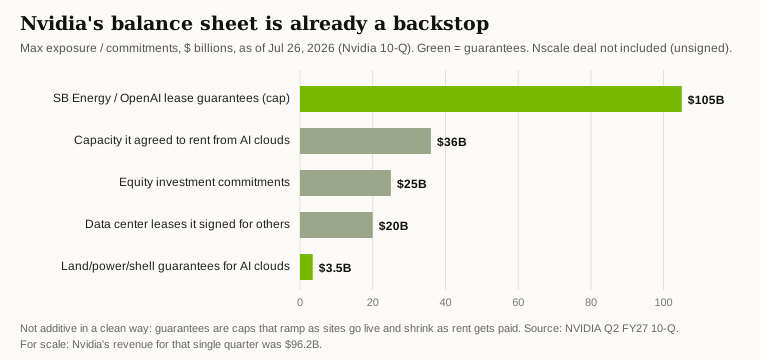
For scale, Nvidia's total maximum guarantee exposure of $108.5B is about 1.1x its revenue for that quarter ($96.2B) (my math: 108.5 ÷ 96.2, both from the 10-Q). The Information puts Nvidia's total investments and credit support to neoclouds and big customers at roughly $170B (TechCrunch).
Fun connection to yesterday's post: PORTS-Pike looks like the same SoftBank-linked campus behind AEP's big Piketon power-line deal. It's in Pike County, it's being developed with AEP Ohio, and SB Energy says it's paying for 100% of the grid upgrades, at least $5.1B, which lines up with AEP's ~$5B budget (PORTS-Pike FAQ, Nvidia release). So on that site, the tenant pays for the wires, and Nvidia backs the tenant's lease.
The 10-Q's description of what happens if OpenAI defaults is basically the same playbook reported for Nscale: Nvidia "may assume the applicable lease, require the landlord to seek a replacement tenant, initiate a sale process," or pursue other remedies.
Why Nvidia would do this
The way I see it, there are three reasons:
- It protects a GPU order. Anthropic doesn't only use Nvidia. It runs production inference and reinforcement-learning rollouts on Amazon's Trainium2 and Trainium3, per SemiAnalysis, and TechCrunch notes Anthropic has spread its spending across multiple chipmakers. A Vera Rubin campus that fails because the builder couldn't borrow is a Vera Rubin order that goes away.
- A guarantee is cheap until it isn't. Nvidia classifies its land, power, and shell guarantees as credit derivatives whose fair values were "not significant" (10-Q). No cash goes out the door unless there's a default. Compare that to buying equity or lending directly.
- The debt market closed on neoclouds. The WSJ reported that CoreWeave, Nebius, and Nscale have effectively been shut out of the bond market in recent weeks as lenders demand tougher terms (AI Weekly summary of WSJ, TNW). Shares of CoreWeave, Nebius, and IREN had each fallen more than 30% in October as of the prior week, per CNBC (TechCrunch). If the market won't lend, the supplier with the strongest balance sheet has to.
It ties straight back to Friday's post: lenders aren't really underwriting the GPUs. They're underwriting who stands behind the payments. An Nvidia guarantee swaps Nscale's credit for Nvidia's on the construction risk.
The catch
- It's still talks. Per the WSJ, Nvidia and other possible backers started demanding stricter terms after markets turned, and that's delayed Nscale's revised IPO prospectus. Nscale is now leaning toward a December listing instead of November, and some of its bankers warned the IPO is unlikely to hit its $30B to $35B target (TNW).
- The tenant has credit questions too. Anthropic filed to go public this past week, and Blackstone has warned investors it may get a below-investment-grade rating after the IPO (TechCrunch). A junk-rated tenant makes lenders lean even harder on whoever is guaranteeing the building.
- Concentration risk is moving to Nvidia. Every guarantee ties Nvidia's balance sheet more tightly to its own customers' ability to pay. Nvidia's 10-Q says it outright: customers or partners "may fail to fulfill their financial commitments, secure necessary capital or infrastructure, complete projects on schedule or within budget, or experience financial distress or insolvency."
My take
- Bull case: Nvidia is using its balance sheet like a moat. A guarantee that's almost free unless something breaks locks in multi-gigawatt Vera Rubin demand and keeps customers off Trainium and TPUs. Its exposure on PORTS-Pike also shrinks over time as OpenAI pays rent. If the AI demand curve holds, this is very cheap customer acquisition.
- Bear case: this is the classic late-cycle vendor-financing pattern. When the market won't fund your customers, you do, and your revenue starts depending on your own credit support. Nscale is the weakest link in the chain so far: 2.5% of its backlog is live, it lost more than $1B in six months, and its anchor customer can walk if deliveries slip.
- Where I land: I don't think a few billion in guarantees changes Nvidia's risk profile. $108.5B of guarantee caps, though, is starting to. The number I care about isn't any one deal. It's how fast that guarantee line grows each quarter. If it grows faster than revenue, the "picks and shovels" company is quietly turning into a bank.
What I'm watching
- Whether the guarantee gets signed, and on what terms, before Nscale's revised S-1.
- Nvidia's $1.0B purchase of Nscale notes/shares, which the S-1 says closes on or around Nov 16.
- Nvidia's Q3 FY27 results on Nov 17 (call at 2 p.m. PT) (Nvidia). I'll look straight at the guarantee table in the next 10-Q.
- Still on deck: the neocloud earnings I flagged in Friday's post.