The Tenant Pays: This Week's Utility Prints Show AI Is Now Paying for the Grid
AEP, FirstEnergy, and Dominion all reported this week. The data-center story has shifted from 'how much load is coming' to 'who pays for the wires.' SoftBank is funding a ~$5B set of Ohio power lines at an 11.35% return for AEP, and my math says that's about two cents per GPU-hour.
Tom Pechulis, , 8 min read
Yesterday I went deep on what it costs to borrow money for GPUs. Today's post is about the other big bill behind an AI data center: the power grid. Three of the biggest US utilities reported earnings this week, and the most interesting line wasn't how many gigawatts are coming. It was who's paying for the wires.
TL;DR
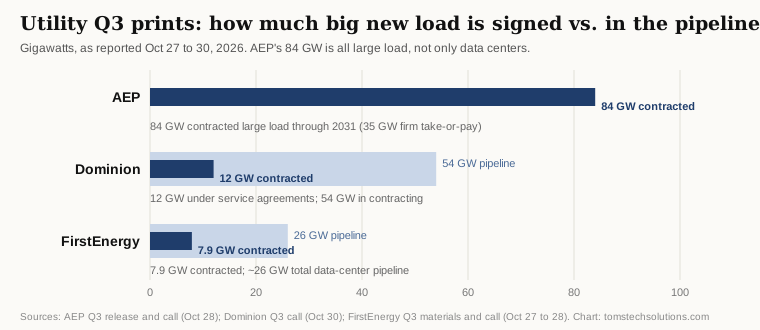
- AEP raised its five-year spending plan 30% to $100B and now has 84 GW of contracted new load through 2031, up from 69 GW a quarter ago (AEP release, Utility Dive).
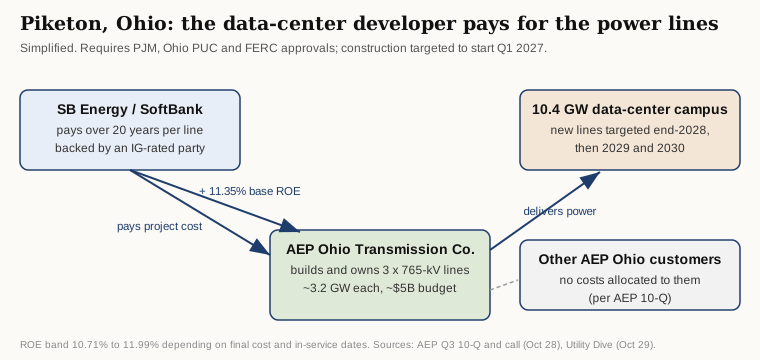
- The headline deal: a data-center developer is paying for the power lines. In Piketon, Ohio, AEP will build three giant 765-kV lines (budget ~$5B) for a planned 10.4 GW campus. Per AEP's 10-Q, the customer pays the full cost plus a base return on equity (ROE) of 11.35% to AEP, over 20 years. Utility Dive identifies that customer as SoftBank and its affiliates (AEP Q3 10-Q, Utility Dive).
- Contracted vs. "pipeline" is the number to watch. FirstEnergy has ~26 GW of data-center interest but only 7.9 GW contracted. Dominion has over 54 GW "in various stages of contracting" but over 12 GW under signed agreements (FirstEnergy call, Dominion call).
- My math: the Piketon-style transmission charge works out to roughly $0.02 per GPU-hour. That's under 1% of what a GPU rents for, and less than a quarter of what one extra point of interest on GPU debt costs. Hyperscalers will happily pay a rich return to the utility if it gets them power sooner.
Quick jargon decoder
| Term | Plain English |
|---|---|
| GW (gigawatt) | A billion watts. A 1 GW data-center campus uses roughly what a mid-size city does. |
| Transmission line (765 kV) | The highway-scale power lines that move electricity long distances. 765 kilovolts is the biggest class in the US. |
| Rate base | The pile of grid assets a regulated utility is allowed to earn a return on. Bigger rate base, bigger profits. |
| ROE (return on equity) | The profit rate regulators let a utility earn on the shareholders' share of that investment. |
| ESA (electric service agreement) | The signed contract between a big customer and the utility. |
| Take-or-pay | You pay for a minimum amount of power whether you use it or not. Like a gym membership you pay for even if you skip. |
| Pipeline | Interest, applications, and engineering studies. Not signed. Treat it like a wish list. |
Why the "who pays" question matters
Here's the old way it worked. A utility builds new lines and power plants, regulators approve it, and the cost gets spread across everyone's bill. That's fine when demand grows a few percent a year. It's a political problem when one data-center campus needs as much power as a city, and households worry they're subsidizing Big Tech.
So utilities are rewriting the rules. AEP's 10-Q lays out its large-load tariffs: contracts of up to 20 years, take-or-pay minimums covering 80% to 90% of contracted demand, credit support, and the customer paying for specified infrastructure. AEP has filed these in eight jurisdictions, with six approved and two pending (AEP 10-Q).
In plain English: if the AI boom fades, the data center is still on the hook for most of its bill, not your grandma.
AEP: the $100B print
The numbers from AEP's Oct 28 report (release, Utility Dive):
- $100B five-year capital plan through 2031, up from $78B. That includes ~$37B for transmission, $36B for generation (of which $20B is gas, up from $13B), and ~$22B for distribution.
- Rate base growing 13%+ a year, to $162B by 2031.
- 84 GW of incremental contracted load by 2031. 15 GW was signed in Q3 alone, and Piketon was the biggest driver. AEP only counts load backed by fully executed service agreements or letters of agreement.
- 35 GW of that is backed by firm take-or-pay ESAs, per the earnings call.
- Retail electric sales up 11% in Q3, mostly from data centers.
- Up to $21B of "fixed cost offsets" for residential customers over the life of the take-or-pay contracts in its vertically integrated states, up from $16B. The idea is that big new customers spread the grid's fixed costs over more kilowatt-hours. Note the "up to": that's a projection, not money already saved.
The Piketon deal, up close
From AEP's 10-Q:
- In August, an AEP transmission subsidiary, AEP Ohio, and "an unaffiliated customer" signed definitive agreements to build three 765-kV lines, each adding about 3.2 GW of capacity, for a proposed 10.4 GW campus.
- Target in-service dates: Dec 31 of 2028, 2029, and 2030. The first 800 MW can run on existing lines.
- Budget of ~$5B. That's up from the $4.2B figure in the March announcement.
- The customer is responsible for the costs, "including the applicable return, with no allocation of those costs to other OPCo customers."
- Base ROE of 11.35%, which can rise to 11.99% or fall to 10.71% depending on whether the project comes in on budget and on time. Payments run 20 years after each line goes live.
It still needs approvals from PJM (the regional grid operator), the Ohio utilities commission, and FERC (Utility Dive).
The part I find most telling is the return. AEP's own pending retail rate cases ask regulators for ROEs of 10.1% to 10.75% (same 10-Q). The data-center customer agreed to 11.35%, with a bonus for finishing early. That's a customer paying up for speed and certainty. It's the same logic as the neoclouds paying more for GPU debt: in this market, time-to-power is worth more than a point of return.
FirstEnergy: big pipeline, smaller signed number
FirstEnergy put out its materials on Oct 27 and held its call on Oct 28 (8-K deck, Utility Dive, call):
- ~26 GW total data-center pipeline, up 4.8% from last quarter, but only 7.9 GW contracted. About 4 GW more is in active negotiation.
- West Virginia's pipeline jumped to 6 GW from 4.3 GW.
- Maidsville Energy Center: a ~$2.7B project with a 1,200 MW gas plant plus 70 MW of solar. Turbines are reserved with Siemens Energy for 2030 delivery, and FirstEnergy expects a state approval order in Q4. It has also asked for bids on 3 GW more of gas turbines.
- Transmission spend to rise at least 25% above its $19B plan. Its rule of thumb: ~$250M of transmission upgrades per GW of data-center load.
- Bridge power: customers who want a 1 GW campus are asking to start with ~100 MW, served by reciprocating engines, fuel cells, or batteries while the big lines get built.
That last point lines up with what I wrote about power being the bottleneck. Nobody wants to wait until 2030 for their first megawatt.
Dominion: the biggest wish list, carefully worded
Dominion reported on Oct 30 (release, call). Its data centers are concentrated mainly in Loudoun County, Virginia, per the release's own risk language, and the numbers are huge:
- "Over 54 gigawatts of data center capacity in various stages of contracting," including over 12 GW under signed ESAs. That's 6+ GW added since the end of last year.
- Data centers come on under a large-load framework approved by Virginia regulators, which management says protects existing customers from cost shifts.
- Its preferred resource plan still has residential bills rising ~2.3% a year on average. "The tenant pays" doesn't mean bills stay flat.
- The pending merger with NextEra is still working through approvals, with a Virginia order expected by Jan 11, 2027.
Two other data points from this week
- Xcel's Q3 report describes a Google data center in Minnesota where Google will pay all costs for its new service for the life of the contract. Xcel says that's expected to create ~$1.1B of benefits for its other customers, pending approval (Xcel release).
- The counterexample: cheap federal money. On Oct 28, the Energy Department closed a $5.1B loan package to Alliant Energy for new gas plants, batteries, and LNG storage in Iowa and Wisconsin (DOE). The loans run to 2056 at the Treasury rate plus 0.375%, per Alliant's 8-K. Alliant expects demand to grow ~60% by 2031, "driven largely by new data center customers" (POWER). DOE says the loans could cut Alliant's interest costs by more than $46M a year (DOE project page). So here, data-center growth is being funded partly by taxpayer-backed credit, not by the tenant.
My math: what the power lines cost per GPU-hour
Tying this back to yesterday's break-even model:
Inputs (sourced):
- Piketon budget: ~$5B for ~9.6 GW of new line capacity (3 × ~3.2 GW), paid over 20 years (AEP 10-Q).
- ROE: 11.35% base (same).
- Utility debt cost: 4.7%, the average coupon on FirstEnergy's $2.6B of recent subsidiary debt (FirstEnergy call). I'm using it as a stand-in for what a big utility pays to borrow.
- Power per GPU: ~2.63 kW all-in for a GB300-class deployment. That's IREN's 200 MW for 76,000 GPUs (IREN deck).
Assumptions (mine):
- A 50/50 equity/debt split, so the blended return is 0.5 × 11.35% + 0.5 × 4.7% ≈ 8.0%.
- Cost recovered straight-line over 20 years, so 5% a year. This is the first-year, highest-charge view.
Result:
- Annual charge ≈ $5B × (8.0% + 5%) ≈ $650M a year.
- Per kW of line capacity: $650M ÷ 9.6M kW ≈ $68 per kW-year.
- Per GPU: $68 × 2.63 kW ≈ $178 a year, or ~$0.02 per GPU-hour.
- The ROE swing barely matters. Moving from 10.71% to 11.99% changes that by about ±$0.0005 per GPU-hour.
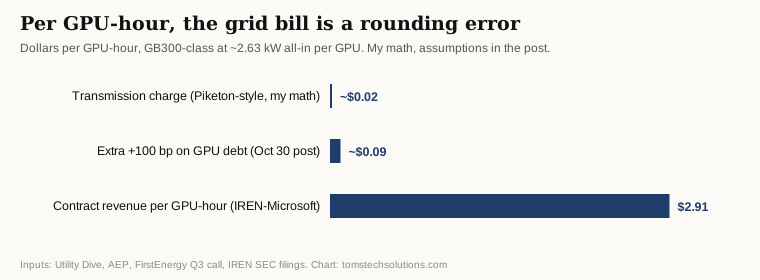
For scale: the IREN–Microsoft contract implies ~$2.91 per GPU-hour of revenue (IREN deck). Yesterday I estimated each extra +100 bp on GPU debt costs about $0.09 per GPU-hour. So the power lines cost the tenant less than a quarter of what one point of interest does.
Caveats: this is transmission only. It leaves out the electricity itself, generation capacity charges, and on-site substations, and it assumes the lines run full. Using FirstEnergy's lighter ~$250M-per-GW network-upgrade rule of thumb instead would roughly halve it. Either way, the direction holds.
That's the whole story in one number. For a hyperscaler, paying 11%+ to a utility for dedicated wires is cheap insurance. What's expensive is a GPU sitting idle because the power isn't there.
My take
- Bull case for utilities: they've found a way to grow rate base at 13% a year with the risk pushed onto investment-grade tech customers through take-or-pay contracts and direct payment. AEP's 9–11% earnings growth target from 2027 to 2031 is the payoff.
- Bear case: most of the headline gigawatts are still pipeline, not signed contracts. Dominion's 54 GW is mostly unsigned, and FirstEnergy's signed share is under a third. If AI capex cools, wish lists shrink first. Also, someone still has to approve all this. Piketon needs three regulators, and residential bills are still rising.
- For the GPU crowd: the grid isn't the expensive part of an AI data center. The money is. Watch who can borrow cheaply, not who can find a substation.
What I'm watching
- Entergy's Q3 on Nov 2, and Southern and Duke on Nov 5. Do the signed-vs-pipeline numbers hold up across the Southeast?
- The Piketon approvals at PJM, the Ohio commission, and FERC.
- Still on deck from yesterday: the Nov 3 midterms and the high-yield market, IREN on Nov 5, and CoreWeave's Q3 on Nov 10.