Nvidia Goes to the Phone Company: Building Around the Data Center Backlash
Two days after a midterm that put data center permits on the ballot, Nvidia reportedly pitched turning 130+ old Brightspeed telephone buildings into small inference sites, and Google committed $17B to a gas-and-fuel-cell campus in Wyoming. Two very different answers to the same question: where can you still plug in?
Tom Pechulis, , 9 min read
The midterms turned "where do we put the GPUs?" from an engineering question into a political one. In the 48 hours since, two of the biggest players answered it in opposite ways.
Nvidia, per The Information, pitched Apollo on turning 130+ old telephone buildings owned by its struggling broadband company Brightspeed into a network of small AI data centers. Google, the same day, committed $17 billion to a giant campus outside Cheyenne, Wyoming, that brings its own power. Small and hidden versus huge and self-powered. Both are about the same thing: getting compute turned on somewhere the neighbors and the grid will allow it.
TL;DR
- The backdrop: Democrats won both chambers of Congress, and Texas governor-elect Gina Hinojosa has proposed a statewide moratorium on new data center permits (CNBC). On Thursday, Nvidia fell 9.3%, AMD 17.3%, Micron 17.5%, and IREN 17% (CNBC).
- Nvidia's idea (reported, not announced): retrofit some of Brightspeed's 130+ telecom buildings, with an estimated ~1 GW of available power across up to 20 states, into an "inference network." Retrofits could start in early 2027. No deal, customers, or building count are confirmed (Investing.com/The Information; TechTimes).
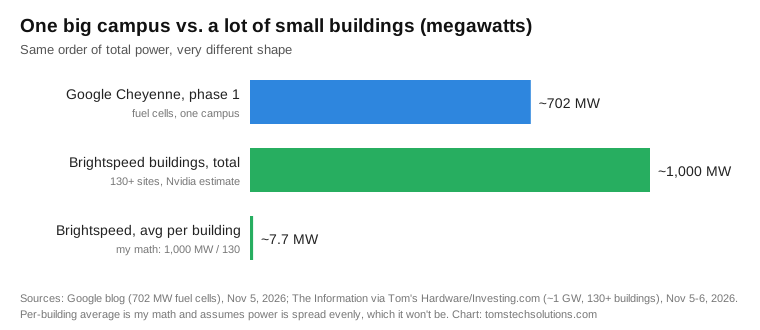
- Google's answer (announced): $17B for its first Wyoming data center, with a first phase built around a 702 MW fuel-cell plant with carbon capture, air cooling instead of water, and a promise to pay for 100% of the power it uses (Google). Google then bought the site from Crusoe.
- My take: the backlash doesn't kill the buildout. It reprices it. Power that already exists, already has permits, and already has a building around it just got more valuable, and the companies with the biggest balance sheets can afford to bring their own.
Quick jargon decoder
| Term | Plain English |
|---|---|
| Telecom building / central office | The unglamorous brick buildings where phone and internet lines from a town meet. They were built with heavy-duty power and backup because the phone network can't go down. |
| Inference | Running an AI model that's already trained, like answering your chatbot question. Training is building the model; inference is using it. Inference can be spread across many smaller sites. |
| GW / MW | Gigawatt and megawatt, units of power. 1 GW = 1,000 MW. A large modern AI campus is hundreds of MW to multiple GW. |
| Moratorium | A pause. Here, a temporary ban on approving new data center permits. |
| Fuel cell | A box that turns natural gas into electricity chemically instead of burning it. Think of a battery that keeps running as long as you feed it gas. |
| CCS (carbon capture and storage) | Catching the CO₂ from power generation and pumping it deep underground instead of into the air. |
| Neocloud | A GPU rental company that isn't Amazon, Microsoft, or Google, like CoreWeave, Nebius, or IREN. |
Why the ballot box matters for GPUs
The short version: building a big data center needs land, power, water, and a local government that says yes. That last part just got harder.
According to CNBC, there were dozens of local ballot measures in 10 states this week that would restrict data center construction in various ways. Ballotpedia tallied the results: voters sided with limiting data centers in 40 of 41 local contests, approving 27 restrictive measures (including five outright bans and three six-month moratoriums in Maine) and defeating 13 pro-data-center measures. One of the approved ones, in Grove City, Ohio, now requires a public vote for projects using more than 20 MW of power or 500,000 gallons of water a day. Research from the think tank IDCA, cited in the same piece, counts at least 46 AI data center projects across 20 states, representing more than $170 billion of announced investment, that were blocked, withdrawn, or stalled by community opposition between January 2024 and May 2026.
The market did not take it calmly. To be fair about cause and effect, NBC News says Thursday's selloff was triggered by soft Qualcomm and Arm earnings the night before, with the election results piling on. The Philadelphia semiconductor index fell 12.3%, its worst day since March 2020:
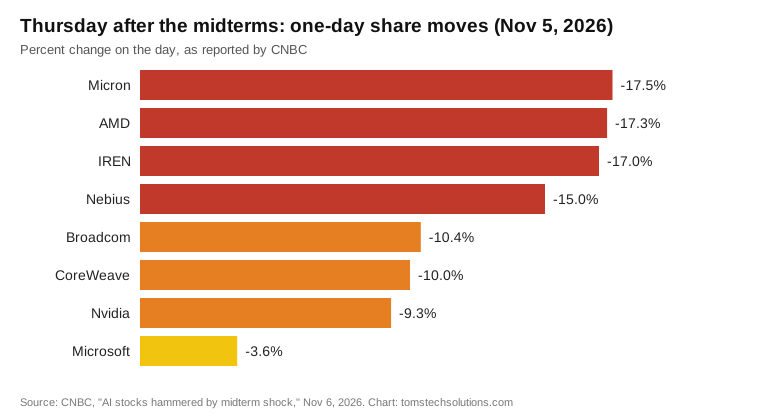
Two analyst lines from the coverage frame it better than I can. Barclays' Dominique Toublan: AI pushback is "bipartisan but local, making the buildout pricier rather than stalling it," and "scarce power favors the biggest balance sheets" (CNBC). And JPMorgan's James Sullivan says the split in stock performance comes from the view that "existing capacity is significantly more valuable now" (CNBC).
Timing matters too. Nomura's note, per CNBC, says much of the capacity due in 2027 is already under construction, so the real exposure is projects planned for 2028 and beyond (CNBC). So nobody's 2027 GPUs are stranded yet. The fight is over the next wave.
Nvidia's play: the phone company already did the hard part
Here's what's been reported. All of it traces to The Information's Nov 5 story, citing people familiar with the effort; Nvidia, Apollo, and Brightspeed have not announced anything.
- Nvidia pitched Apollo executives, who asked it to put the plan in writing to Brightspeed. Nvidia sent a proposal asking for facility data and site visits (Tom's Hardware; TechTimes).
- Brightspeed has 130+ buildings that Nvidia estimates add up to roughly 1 GW of available power, potentially across 20 states. Towns named in the report include Dothan, Alabama; Killeen, Texas; and Mansfield, Ohio (TechTimes; Investing.com).
- Nvidia calls it an "inference network." Retrofits could begin in early 2027, possibly with Vera Rubin servers and Groq technology, but there's no confirmed schedule (TechTimes).
- Brightspeed was formed in 2022 when Apollo bought Lumen's local phone and broadband business in 20 states for $7.5 billion. It has about $10 billion of debt, warned in September it may not survive as a going concern, and is in talks with creditors to raise $2 to $3 billion, per Bloomberg as relayed by The Next Web. One of its $2.5B loans was quoted at about 17 cents on the dollar. The WSJ has reported a bankruptcy filing could come as soon as December. That's reporting, not a filing.
- Who would own or rent the chips is unclear. The Information floated SpaceX, Anthropic, and OpenAI as possible customers but said it's unclear whether anyone has been approached (TechTimes). Apollo separately has a large Vera Rubin deal tied to SpaceX, which Tom's Hardware describes as about $40 billion for roughly 360,000 GPUs. Nothing says those chips go into these buildings.
Why this is clever: an old phone building is like a house that already has a 400-amp panel and a permit for a commercial use. You still have to remodel the kitchen, but you're not fighting the zoning board for a new subdivision. The power hookup is the slowest thing to get for a new data center, and these buildings already have one.
Why it's hard:
- Small pieces. My math: 1,000 MW ÷ 130 buildings ≈ 7.7 MW per building on average, and real sites won't be evenly sized. "Available power" on paper also isn't the same as power ready for dense GPU racks. Either way, each site is a small fraction of one big campus. That's fine for inference (each user question is small) and bad for training (one giant job needs everything wired tightly together in one place).
- Cooling and wiring. These buildings weren't designed for liquid-cooled AI racks. Tom's Hardware notes Nvidia would still need to install cooling and supporting gear, and that still needs local permits (Tom's Hardware). Datum CEO Zac Smith told The Information old telecom properties can unlock underused power but can be pricier to operate because of aging electrical gear (TechTimes).
- Ops at 130 addresses. Running one 700 MW campus with one security team and one parts cage is a lot easier than running 130 small sites. Every truck roll costs money.
- A shaky landlord. If Brightspeed restructures, the leases and building rights get messy fast.
Google's play: bring your own power plant
Google went the opposite direction: go big, go somewhere that wants you, and make your own electricity so you're not fighting over the local grid.
From Google's announcement and coverage by DCD and WyoFile:
- $17 billion, Google's first Wyoming data center, in Laramie County near Cheyenne, with partners Tallgrass Energy, Black Hills Energy, AEP, and Related Digital.
- Power anchor: a 702 MW fuel-cell project contracted with AEP, using Bloom Energy fuel cells running on natural gas, with most emissions captured and stored at Tallgrass's nearby sequestration hub. Google is also buying power from Tallgrass and Black Hills gas generators.
- Air-cooled to limit water use, and Google says it will pay for 100% of the power it uses plus the infrastructure its growth requires. That line is written straight at the "data centers raise my electric bill" voter.
- DCD says Google didn't disclose total capacity, though earlier reports put it at up to 2.7 GW; the site is 716 acres, with four data halls planned and construction slated to finish by 2031.
- The day after, Crusoe said Google bought the site after Crusoe did the pre-development work (site, approvals, power strategy). Terms weren't disclosed. Crusoe says it has 6+ GW contracted and 40+ GW in its pipeline.
Notice the playbook: a state that's courting data centers, a dedicated power plant so the local grid isn't the bottleneck, no water fight, and a pre-approved site. That is how you build big when the politics are getting harder. It is also very expensive, which is Barclays' point about balance sheets.
What I think
- The backlash is a tax, not a wall. Nothing in the last 48 hours says AI demand fell. What changed is the cost and time to add a new megawatt in a hostile county. Companies will route around that, and the two routes we saw are "use buildings that already have power" and "go where you're welcome and make your own power."
- Existing, permitted power is the scarce asset now. That's why Microsoft and Amazon traded up on Wednesday while CoreWeave dropped about 10% (CNBC). Old telecom buildings, bitcoin-mining sites, and decommissioned plants all start to look like land with a head start.
- Nvidia is acting more and more like a developer. I wrote last week about Nvidia co-signing for its customers; scouting buildings for them is another step from selling chips toward making sure chips have somewhere to go. It's smart, and it also means more of Nvidia's growth depends on the real-estate and power side working out.
- I'd discount the Brightspeed story until there's a signed deal. It's one outlet, exploratory, with no customers and a landlord that may restructure. Very useful as a signal of where Nvidia's head is. Not something I'd underwrite yet.
- Inference spreads out; training stays big. If this happens, it's the clearest sign yet that the next wave of buildout splits into a few giant training campuses (Google's Wyoming kind) and lots of smaller inference sites closer to users. The silicon is the same; the real estate isn't. Mid-curve take: the "AI needs 5 GW single sites" crowd and the "edge inference" crowd are both right, about different workloads.
What I'm watching
- CoreWeave on Nov 10 and Nebius on Nov 12. Funding costs, delivery dates, and anything they say about permitting in new markets.
- Ohio and Maine. The new local bans and moratoriums kick in, and whether a 20 MW vote trigger like Grove City's spreads to other towns.
- Texas. Whether a proposed permit moratorium turns into actual policy, and whether projects already under construction really stay exempt.
- Brightspeed. A signed Nvidia or Apollo agreement, a customer name, or a bankruptcy filing would each change the story.
- More "bring your own power" announcements. Fuel cells and on-site gas are becoming the default answer for big campuses that don't want to wait on the grid.