Science Wants Its Own Chips Again: Nvidia's Rubin HPC, Vera CPU Racks and AMD's Lux at SC26
At Supercomputing 2026, Nvidia announced a 2028 Rubin HPC GPU with 50,000+ CUDA cores and a CPU-only Vera rack for science, AMD opened its MI355X-based Lux system at Oak Ridge, and the TOP500 top 10 didn't move at all. Here's the FP64 fight in plain English, who's winning the national labs, and what it means for buyers, a few hours before Nvidia reports.
Tom Pechulis, , 11 min read
Supercomputing 2026 (SC26) opened in Chicago this week, and the most interesting thing about it is a reversal. For three GPU generations, the chips that power AI got steadily worse at the high-precision math that scientists use. This week Nvidia announced a GPU built for science, Rubin HPC, with "more than 50,000" CUDA cores, due in 2028 (Nvidia blog). It also launched a CPU-only rack for simulations (Nvidia newsroom). Meanwhile AMD's Lux supercomputer opened to scientists at Oak Ridge National Laboratory (AMD), and AMD spent the week publicly arguing that Nvidia's workaround for missing high-precision math doesn't cut it (Tom's Hardware).
All of this lands a few hours before Nvidia reports its quarter. Science is a small market next to AI, but it's where the "one chip for everything" story is starting to crack.
TL;DR
- Nvidia Rubin HPC: a new member of the Rubin family aimed at simulation and data-heavy science, with more than 50,000 CUDA cores (a record for Nvidia), seventh-generation NVLink, and availability expected in 2028 (Nvidia). Nvidia has not published its FP64 speed, memory, power or price (HPCwire, Tom's Hardware).
- Nvidia Vera CPU rack: 192 Vera CPUs, about 300 TB of memory, more than 200 TB/s of memory bandwidth, no GPUs at all. It's due from server makers in early 2027, and Germany's climate computing center DKRZ picked Vera for its next system (Nvidia).
- AMD Lux: 4,000+ MI355X GPUs in 500+ nodes, now open to users at Oak Ridge, and No. 14 on the new TOP500 at 220.79 petaflops (OLCF, TOP500). AMD co-invested and gets about half its compute time.
- TOP500: the top 10 didn't change at all, and only 27 of 500 systems are new, the lowest ever (TOP500). The money is going to AI factories, not classic supercomputers.
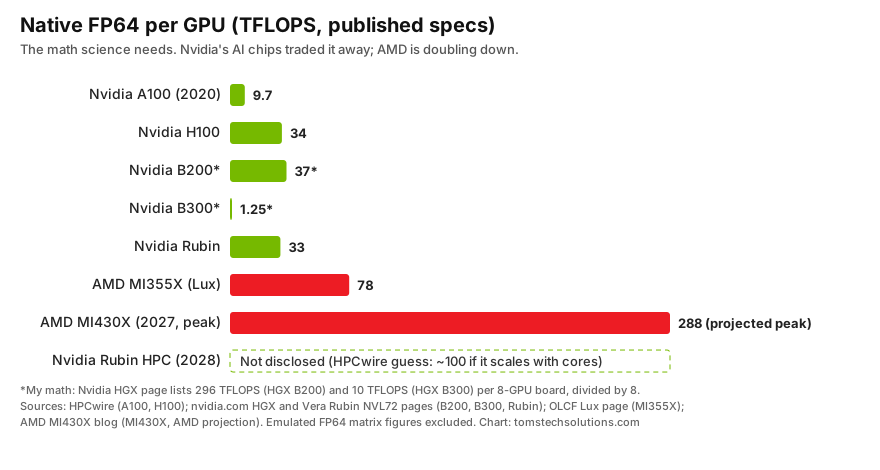
- The fight: AMD's upcoming MI430X promises 288 TFLOPS of native FP64 per GPU (AMD). Nvidia's current Rubin GPU lists 33 (Nvidia). On paper, that's about 8.7x (my math: 288 ÷ 33).
- My take: Nvidia building a science-specific GPU is an admission that emulation alone wasn't winning the labs. Until it publishes an FP64 number, though, AMD owns this niche on paper and on the TOP500.
Quick jargon decoder
| Term | Plain English |
|---|---|
| FP64 (double precision) | Math with 64-bit numbers, about 15–16 significant digits. Climate, physics and engineering codes need it because tiny rounding errors pile up over millions of steps. Think of a bank ledger that has to balance to the penny after a billion transactions. |
| FP8 / FP4 | Very low-precision math, 8 or 4 bits per number. Good enough for AI, which tolerates fuzz, and much faster. Like estimating a restaurant bill in your head instead of with a calculator. |
| FP64 emulation (Ozaki scheme) | Faking FP64 by doing several passes of lower-precision math and stitching the results together. Works well for one kind of problem (big dense matrix multiplies), less well for many others. |
| CUDA cores | Nvidia's name for the GPU's general-purpose math units, the ones that do normal (non-AI-matrix) arithmetic. More cores means more general simulation horsepower, but it's Nvidia's own counting unit, not a standard. |
| TFLOPS / petaflops / exaflops | Trillions / quadrillions / quintillions of math operations per second. 1 exaflop = 1,000 petaflops = 1,000,000 teraflops. |
| TOP500 / HPL | A twice-yearly ranking of the world's fastest supercomputers, measured by one FP64 benchmark called HPL (Linpack). "Rmax" is the measured score; "Rpeak" is the theoretical maximum. |
Why science fell out of fashion on GPUs
For a while, AI and science wanted the same chips. Then AI won the budget.
HPCwire lays out the arc: the A100 (2020) had 9.7 TFLOPS of FP64, Hopper's H100 and H200 jumped to 34, and then Blackwell went flat to down. Nvidia's own spec pages show how far it went. An 8-GPU HGX B200 board lists 296 TFLOPS of FP64, but the HGX B300 (Blackwell Ultra) lists just 10 TFLOPS for all eight GPUs (Nvidia HGX). By my math that's about 37 TFLOPS per B200 versus 1.25 per B300. Nvidia basically took FP64 out of its top AI chip to make room for AI math. Rubin brought it back to 33 TFLOPS per GPU (Nvidia), roughly Hopper level.
That's a rational business decision. Tom's Hardware puts it plainly: the market for AI compute exploded while demand for double precision in big supercomputers "has remained flat by comparison." Nvidia's answer for scientists was emulation. The same Rubin GPU that does 33 TFLOPS of native FP64 is rated at 200 TFLOPS on FP64 matrix multiplies (DGEMM) using Tensor Core-based emulation (Nvidia HGX, Nvidia technical blog).
AMD's argument: emulation only fits a sliver of science
AMD used SC26 to go after that emulation story directly. In a paper presented at the show, its researchers profiled 47 workload configurations across 11 applications and benchmarks on MI350X and MI355X GPUs (AMD). Their findings, in AMD's words and Tom's Hardware's summary:
- Less than 10% of the HPC workloads they sampled are the dense-matrix shape that emulation is good at. Of the 11 applications, only the Linpack-style one got a "sometimes" (AMD).
- Weather-style stencils, sparse solvers, Monte Carlo, particle transport and molecular dynamics still need real FP64 vector math (Tom's Hardware).
- Emulation can need up to ~3x the memory of native FP64. More memory per problem means more GPUs, more nodes, more power and more floor space (AMD).
The product behind the argument is the MI430X: up to 288 TFLOPS of peak native FP64, 432 GB of HBM4 at 23.3 TB/s, plus 9.2 petaflops of FP4 for AI (AMD). HPCwire says it's due in 2027 (HPCwire). It's already been picked for Oak Ridge's next flagship, Discovery, plus Alice Recoque in France and Herder at HLRS in Germany (AMD).
Two honest caveats. First, this is AMD grading its competitor's homework. The paper is AMD's own research, and AMD's MI430X performance figures are labeled projections, not measurements. Second, MI430X is a different animal from AMD's AI flagship: 9.2 PF of FP4 versus 40.3 PF on the MI455X, and a 4-GPU node versus a 72-GPU Helios rack (Tom's Hardware). AMD is literally making a separate chip for science. That's the point.
Intel joined in too: its D270 ("Crescent Island") card, a 350 W air-cooled PCIe card with 160 GB of LPDDR5X, advertises "full-rate, native FP64" alongside FP4–FP8 for inference (Intel). Intel didn't give a headline FP64 TFLOPS number, so it's not on my chart.
Nvidia's answer: Rubin HPC and a CPU-only rack
Rubin HPC. Nvidia's pitch is that AI agents are going to run lots of simulations ("test this molecule, now this one, now this one"), so simulation speed becomes the bottleneck on discovery (Nvidia). What it disclosed:
- More than 50,000 CUDA cores on one GPU, a record for Nvidia (Nvidia). Today's Rubin GPU has 28,672 (Tom's Hardware), so that's at least 1.74x (my math: 50,000 ÷ 28,672). HPCwire describes it as 3x the vector cores of Blackwell (HPCwire).
- A "sparse data acceleration capability" to keep those cores fed, and seventh-generation NVLink (Nvidia).
- Expected in 2028 (Nvidia).
What it didn't disclose: FP64 TFLOPS, memory, bandwidth, power, price or customers. Tom's Hardware speculates that the core count implies a multi-die package like Rubin Ultra, but Nvidia hasn't said (Tom's Hardware). HPCwire's guess is that FP64 lands around 100 TFLOPS if it scales linearly with cores (HPCwire). That's a reporter's estimate, not an Nvidia number. Even if it's right, it would be about a third of MI430X's paper peak, a year later.
HPCwire's headline calls this Nvidia "recommitting to FP64." I'd hold off on that until there's a spec sheet. Nvidia's own announcement talks about CUDA cores and data movement, and doesn't use the word FP64 at all.
Vera CPU rack. This one is shipping sooner and is more concrete (Nvidia):
- 192 Vera CPUs per liquid-cooled rack, eight per 1U tray, on Quantum-X800 InfiniBand. Each CPU has 88 custom cores and up to 1.2 TB/s of memory bandwidth. That's 16,896 cores per rack (my math: 192 × 88).
- About 300 TB of memory and 1 PB of storage per rack. It reuses NVL72 rack parts (chassis, power, cooling).
- Nvidia's own tests: 1.9x the performance and 2.4x the performance per watt of x86 on an OpenFOAM airflow simulation, and a projected 1.6x / 2x on the WRF weather model. Nvidia didn't say which x86 chips it compared against, so treat these as vendor claims.
- DKRZ, Germany's climate computing center, picked Vera for its HLRE-5 system (with GB200 GPUs), expected in early 2028. Racks ship from Dell, Lenovo, Supermicro and others starting early 2027. There's also a public beta of a new Fortran compiler, the language a lot of science code is still written in.
The simple read: a lot of science code never got ported to GPUs, and Nvidia wants that business too. This is a rack that competes with x86 server CPUs, not with AMD's GPUs.
Lux: what AMD actually has running today
While Nvidia talked about 2027 and 2028, AMD had a machine to show. Lux opened to scientific users at Oak Ridge on Nov 16 (AMD):
- 4,000+ MI355X GPUs in 500+ nodes, 1.1 PB of HBM, 288 GB per GPU (OLCF).
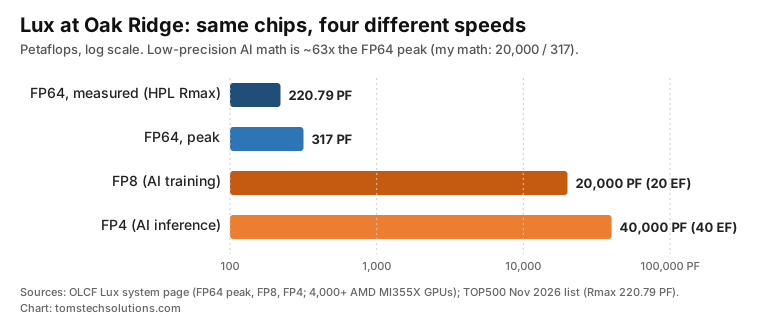
- No. 14 on the TOP500, with 220.79 PF measured on Linpack and 323.90 PF theoretical peak (TOP500). It's the first dedicated AI system for DOE's Genesis Mission, an AI-for-science program. Early projects include fusion power plant design, a materials "foundation model factory," and water forecasting for the Tennessee Valley (AMD).
- The business model is new. It's a DOE–AMD partnership "that combines federal and industry investments." About half of Lux's 3.5 million node-hours a year go to the Genesis Mission, and "the remaining half will be available to AMD" (ORNL). The OLCF resource page describes that second half as "proprietary (paid for) use under the DOE User Facility rate" (OLCF). No dollar figures were disclosed.
Fun detail: ORNL now writes "Super Intelligence (SI), formerly known as artificial intelligence" (ORNL). Marketing has entered the national labs.
Lux is also the cleanest picture of the precision tradeoff I've seen. OLCF lists the same machine at 317 PF of FP64, 20 exaflops of FP8 and 40 exaflops of FP4 (OLCF). That's about 63x more low-precision AI math than science math (my math: 20,000 ÷ 317), on the same chips. That gap is why AI money and science money pull chip design in different directions.
The TOP500 barely moved, and that's the story
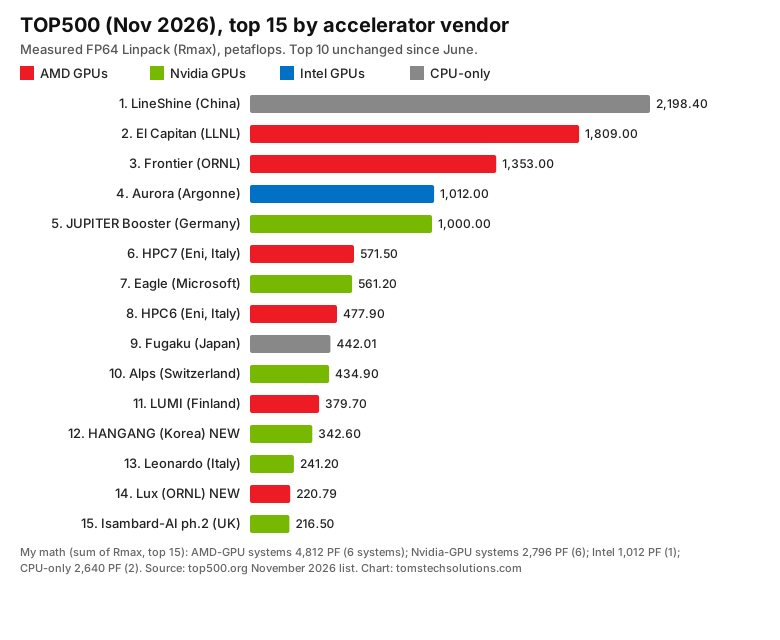
The 68th TOP500 list came out Monday, and the top 10 is identical to June (TOP500). China's LineShine is still No. 1 at 2.198 exaflops, followed by El Capitan (1.809), Frontier (1.353), Aurora (1.012) and JUPITER Booster (1.000). Only 27 systems are new, or 5.4% of the list, "the lowest number ever recorded by a wide margin." The biggest newcomer is Korea's HANGANG at No. 12 (Nvidia Grace Hopper, 342.6 PF).
TOP500 itself asks where all the hardware went, and answers it: citing Epoch AI, global AI compute has passed the equivalent of 15 million H100s, and five U.S. hyperscalers owned an estimated 71% of it as of Q4 2025 (TOP500). The total of all 500 systems on the list is 19.57 exaflops of FP64. Capital is flowing to AI factories, not to Linpack.
On who powers the top of the list, AMD is in strong shape. Of the top 15, AMD GPUs power six systems, including two of the top three (El Capitan and Frontier), for about 4,812 PF of combined Rmax. Nvidia powers six, for about 2,796 PF (my math, summing Rmax from the TOP500 list). Nvidia's biggest wins are in Europe and Asia (JUPITER, Alps, HANGANG), and one is a cloud machine (Microsoft's Eagle).
What it means for buyers and investors
- For labs and science buyers: you have real choices again. If your code is stencils, sparse solvers or Monte Carlo, the native FP64 number matters more than the AI number. Today AMD has it in hand (MI355X at 78 TF per GPU per OLCF, MI430X coming). Nvidia's Rubin HPC is a 2028 promise with no FP64 spec yet. If your code was never ported to GPUs, the Vera CPU rack is the new thing to benchmark, against x86, in 2027.
- For enterprise buyers running simulations (finance, oil and gas, engineering): don't buy an AI GPU and assume it's good at science. The B300's 1.25 TF per GPU (my math) is the cautionary tale. Check the precision you need before you check the price.
- For Nvidia's financials: this is a rounding error, at least for now. Analysts expect about $109.1 billion in revenue tonight (CNBC), and almost all of it comes from AI. Rubin HPC is about keeping CUDA as the default in labs so the next generation of scientists grows up on it, not this year's revenue.
- For AMD: the national labs are AMD's reference customers and its proof that big systems built on its software stack work. Lux's split-time model also gives AMD its own slice of a DOE machine to sell or use. It's a small revenue line, but it's very good marketing.
My take
The "one GPU for everything" era is ending at the edges. AI pushed precision down to FP4, and science still needs FP64, so both AMD and now Nvidia are building separate chips for the scientists. AMD got there first and has the TOP500 to show for it. Nvidia's Rubin HPC is a credible counter, but "more than 50,000 CUDA cores" is not an FP64 number, and I'll stay skeptical until there is one.
Bigger picture: the TOP500 freeze is the tell. When only 27 new systems make the list while AI capacity goes vertical, science gets the silicon that's left over, unless a vendor decides it's worth a dedicated chip. This week, three vendors said it is. I'd still watch who actually signs purchase orders for 2028.
I could be wrong about Nvidia's FP64 plans. If Rubin HPC ships with something like HPCwire's ~100 TF guess and the CUDA software lead, a lot of labs that would otherwise default to AMD will take a hard look. (For the spec-sheet side of Rubin, see my earlier post on how Vera Rubin's published specs shrank.)
Next up
- Wednesday morning: my full breakdown of Nvidia's Q3 FY27 results. Consensus is $109.1B in revenue and $2.47 EPS (LSEG via CNBC), with the call at 5 p.m. ET (2 p.m. PT) tonight. It's the first report under interim CEO Colette Kress, with the stock down 24% this month going in (CNBC). I'll also listen for whether anyone asks about Rubin HPC.
- Thursday: Anthropic's Nasdaq debut, once there's real trading data.
- Still watching: an FP64 spec for Rubin HPC, measured (not projected) MI430X results, and who buys the first Vera CPU racks.
Not investment advice. Vendor performance claims are the vendors' own, and product dates are company expectations.