Anthropic Goes Public at $83: The Record IPO, Decoded, and the $900.9B Compute Bill It Now Has to Pay
Anthropic priced the largest IPO ever at $83 a share, above its $70-78 range, and shares began trading on Nasdaq as ANT today. Here is what was raised, what it's worth, and what the money means for the GPU, TPU and Trainium orders behind a roughly $900B compute bill.
Tom Pechulis, , 9 min read
As promised, here's the Anthropic debut breakdown. One honest note up front: I'm writing this at about 10:15 a.m. ET (9:15 a.m. CT, 7:15 a.m. PT). Shares became eligible to trade at 10:00 a.m. ET, but in the sources I read the first actual trade hadn't printed yet. So the day-one pop is still an indication, not a result. I've labeled every intraday number with its time.
TL;DR
- Priced at $83.00 per share on Wednesday, Nov. 18, above the $70-$78 range. It sold 980 million Class A shares, 956,351,354 from Anthropic and 23,648,646 from existing holders. Ticker: ANT on Nasdaq (Anthropic's pricing release).
- About $81.3B raised in the IPO (my math: 980M × $83 = $81.34B), the largest IPO on record, ahead of SpaceX's June deal (CNBC). Add a $26.0B private placement from AMD, Broadcom, Google, Micron, Microsoft, Nvidia and TSMC and the total is over $107B (Reuters via CNA).
- Valuation: about $1.5T fully diluted at the IPO price (CNBC, AP). Reuters said the stock was set to open near $99.82 (indication as of 9:50 a.m. ET), which it put at about $1.8T (Reuters via CNA).
- The compute bill: Anthropic's prospectus lists about $900.9B of committed spend, "substantially all" compute and infrastructure, with $70.7B due in the next 12 months (prospectus).
- My take: the IPO doesn't create new chip demand. Most of that demand was already signed. What it changes is how comfortably Anthropic can pay for it.
Quick jargon decoder
| Term | Plain English |
|---|---|
| IPO | Initial public offering: the first time a company sells shares to the general public on a stock exchange. |
| Priced vs. opened | The IPO price ($83) is what big investors paid the night before. The opening price is set later by an auction on the exchange and is usually different. |
| Fully diluted | Counting not just shares that exist today but also options and other claims that could become shares. It makes the company look bigger than a plain share count does. |
| Private placement | A side deal where specific buyers purchase shares directly, outside the public offering. |
| Overallotment ("greenshoe") | An option letting the banks buy extra shares from the company at the IPO price if demand is hot. |
| Take-or-pay commitment | A contract where you owe the money whether or not you use the service, like a gym membership you can't cancel. |
| TPU / Trainium | Google's and Amazon's own AI chips, as opposed to Nvidia GPUs. |
| Perp futures | Crypto-exchange contracts that track a price without owning the stock. They're a rough mood gauge, not the real price. |
What happened, in order
Wednesday night: Anthropic priced the deal at $83, above the $70-$78 range it marketed in its preliminary prospectus, and bigger than the 825 million shares that prospectus described (prospectus cover, Anthropic). The banks also hold a 30-day option to buy up to 147 million more shares, which CNBC says would net the company another $12.2B and take the total IPO to $93.5B (CNBC). The sale is expected to close Friday, Nov. 20 (Anthropic).
Thursday morning: The Nasdaq opened up as much as 1.9% around 9:30 a.m. ET (NBC News), and Nvidia was up about 1.5% in premarket trading, per the same live blog. That's a change of mood: Nvidia had fallen about 2.9% on Wednesday even after a beat (The Economic Times).
Why no trade at the bell: Mega-IPOs don't start at 9:30. The exchange runs an opening auction to match buyers and sellers first, and the BBC expected the first trade in roughly an 11:00 a.m.-1:00 p.m. ET window (BBC). SpaceX's first trade came shortly after 11:46 a.m. ET in June (CryptoTicker, citing IPO Scoop).
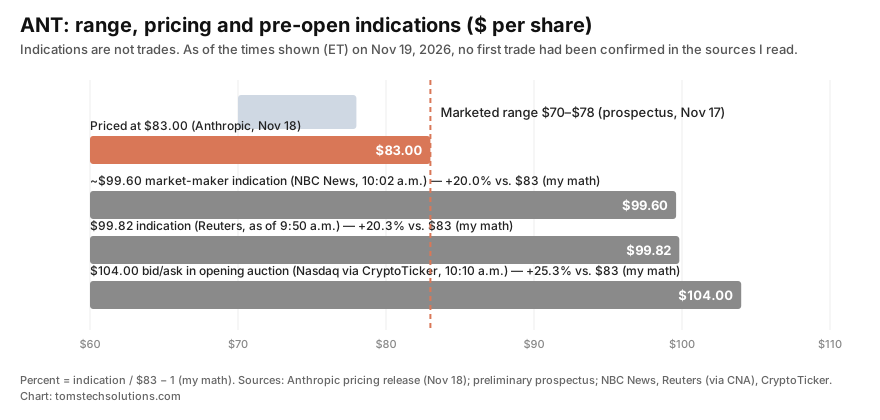
Pre-open indications (not trades), all ET:
- ~$99.60: where market makers were bidding, per NBC at 10:02 a.m. (+20.0% vs. $83, my math) (NBC News).
- $99.82: Reuters' indication as of 9:50 a.m. (+20.3%, my math) (Reuters via CNA).
- $104.00 bid and ask in the Nasdaq opening auction at 10:10 a.m., with no shares yet traded (+25.3%, my math) (CryptoTicker).
- Earlier, crypto perp futures were near $104, and CNBC's sources said the stock could trade into the "low $100s" (CNBC). Treat those as unconfirmed signals.
Those three numbers are spread over 20 minutes and they're moving. The real opening price will land somewhere in or near that band, but I can't tell you where, and neither can anyone else until the auction finishes.
The numbers behind the headline
How big is "biggest ever"? SpaceX raised $75B at its June IPO, and $85.7B once its extra-share option was exercised. Anthropic's base deal is about $81.3B, and $93.5B if its option is fully used (CNBC).
Where does the money go? Not all of the $81.3B is Anthropic's. My math: the company's own 956,351,354 shares × $83 ≈ $79.4B gross, before bank fees, and the selling holders' 23,648,646 shares × $83 ≈ $2.0B, which Anthropic doesn't receive (Anthropic). The banks' fee is about $550M (Reuters via CNA).
What the company says it will do with it. The prospectus says general corporate purposes: working capital, operating expenses, and capital expenditures "including investments in compute and infrastructure," plus hiring. It also plans to use part of the proceeds to cover $3.8B of employee tax withholding tied to stock awards. That figure was computed at an assumed $74 price in the preliminary prospectus, so the final number will differ (prospectus).
Is it profitable? No. For the nine months to Sept. 30, Anthropic reported about $33.24B of revenue (up roughly 1,200% year over year) and a $104B net loss, of which about $94.3B came from changes in the fair value of convertible notes and similar instruments, which is an accounting mark rather than cash out the door (CNBC). Run-rate revenue was about $81B at the end of October, roughly $10B above the prior month, per the same CNBC report. (Run-rate means the latest month, annualized.)
Who's buying? Anthropic targeted about 20% for retail investors versus a typical 5-10%, and sources told CNBC retail demand was the largest for any deal in history (CNBC). Vanda Research expects about $250M of retail net buying on day one (NBC News). The seven co-founders hold 50.1% of the voting power through a new entity (CNBC).
One valuation caveat. You'll see $1.5T (CNBC, AP, Reuters) and also numbers near $1.1T. The lower figure comes from CryptoTicker multiplying roughly 13.2B shares outstanding by $83, whereas the $1.5T figure is "fully diluted" (CryptoTicker). Both are fine, they just count different things. Sanity check on Reuters' $1.8T: $1.5T × ($99.82 ÷ $83) ≈ $1.80T (my math). It matches.
The infrastructure angle: what Anthropic owes
Here's the part that matters for chips. Anthropic's prospectus says it has entered purchase commitments and leases with an aggregate committed spend of about $900.9B, "substantially all of which is related to compute and infrastructure." About $451.6B of that falls before the end of 2030, and $70.7B is due in the 12 months after Sept. 30, 2026 (prospectus). (Earlier this month the amended S-1 said about $895.4B, which is what my earlier post covered. The prospectus number is a bit higher.)
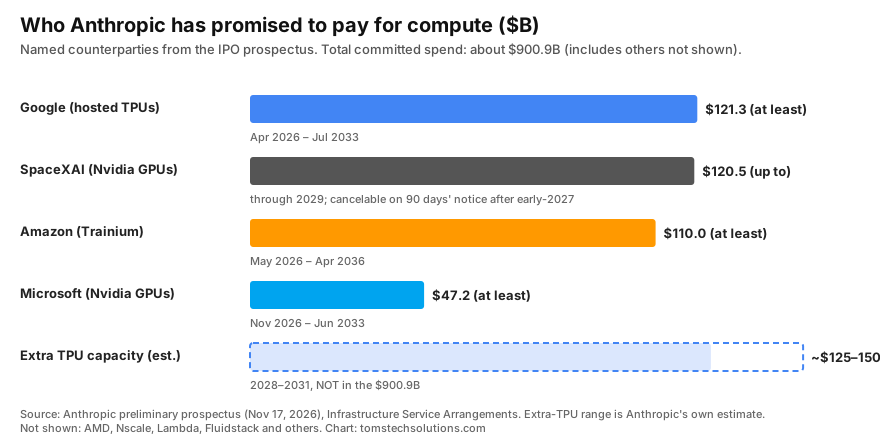
The biggest named pieces, all from the prospectus's "Infrastructure Service Arrangements" section (prospectus):
- Google: at least ~$121.3B between April 2026 and July 2033, owed "regardless of actual usage." Anthropic also committed to more TPU compute, delivered 2028-2031, which it estimates at $125B-$150B and which is not in the $900.9B table.
- Amazon: at least $110.0B from May 2026 to April 2036, also owed regardless of usage.
- SpaceXAI (Nvidia GPUs): up to $120.5B through 2029, about $3.1B a month once all capacity is delivered, which Anthropic expects in December 2026. Unlike the others, each agreement can be cancelled on 90 days' notice after initial periods ending January and March 2027.
- Microsoft (Nvidia GPUs): at least $47.2B, up to $49.2B, from November 2026 to June 2033.
- AMD: a hardware agreement to buy an initial tranche of Helios rack-scale systems in calendar 2027, subject to conditions.
Data Center Dynamics adds that the Google, Amazon and Microsoft deals are mostly non-cancelable, and that Anthropic's deals with neoclouds Nscale and Lambda depend on those partners securing financing or a facility lease (DCD). I covered the Google side of this in Google Cosigns Anthropic's Kentucky Build.
The prospectus also describes the strategy plainly: Anthropic treats compute as "a single, fungible pool" across AWS Trainium, Google TPUs, Nvidia GPUs and AMD GPUs, and shifts work between them based on price and performance (prospectus). Think of it like a trucking company that owns no trucks, rents from four fleets, and sends each load on whichever truck is cheapest that day.
Money in vs. money owed
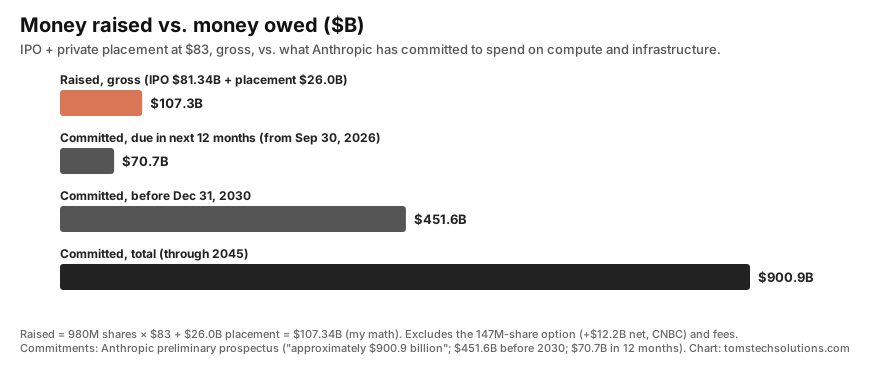
My math, inputs shown:
- Gross raise: $81.34B (IPO) + $26.0B (placement) = $107.34B.
- Against the $70.7B due in the next 12 months: 107.34 ÷ 70.7 ≈ 1.5×.
- Against the $900.9B total: 107.34 ÷ 900.9 ≈ 12%.
Caveats: that's gross, before fees; the money also has to cover payroll, tax withholding and everything else; and the $70.7B only covers the next year. DCD also reported compute and infrastructure expenses of $14.4B for the nine months ended Sept. 30 (DCD), so the bill for the next 12 months is about 4.9× that nine-month figure (my math: 70.7 ÷ 14.4; different time windows, so treat as rough).
Who put in the $26B, and why it's worth a raised eyebrow
The private placement buyers are AMD, Broadcom, Google, Micron, Microsoft, Nvidia and TSMC (CNBC, Reuters via CNA). The prospectus says Google's piece funds "a portion of its previously committed investment obligations" (prospectus). Several of these companies also sell chips or cloud capacity to Anthropic. Reuters notes that critics have questioned "circular financing," where money flows around the same group of companies, and says Anthropic's growth "has so far defied these concerns" (Reuters via CNA).
What I think it means for GPU, TPU and Trainium demand
- Demand was already contracted. The big cloud deals are take-or-pay, so the chips behind them are largely spoken for whether or not the stock pops. The IPO doesn't add orders, it makes the existing ones safer to pay.
- Financing risk drops, but doesn't vanish. Anthropic's losses are large, its commitments are huge, and some of the smaller partners need their own financing. A strong debut helps with all three. A weak one would make the next raise harder. That's why the first-day price matters beyond bragging rights.
- TPU and Trainium look like the winners of the multi-chip bet. The $121.3B Google and $110.0B Amazon commitments are among the biggest named lines, and Anthropic says it routes work across all four chip families. Nvidia is still in the mix through Microsoft and SpaceXAI, and AMD's 2027 tranche is a real but conditional order. This is my read of the filing, not something Anthropic claims.
- The wild card is the $125B-$150B of extra TPU capacity for 2028-2031. It's an estimate, with no fixed amount, and delivery could come via Google hosting or a financed purchase. If that gets signed, it's the next big number in this story.
I could be wrong that financing is the main swing factor. If revenue keeps compounding the way it did this year, adding roughly $10B of run-rate in a single month (to about $81B at the end of October, per CNBC), the commitments may look small in hindsight. Revenue growth did slow quarter to quarter, though: DCD reports Q3 revenue grew 47% over Q2, versus 144% growth in Q2 over Q1 (DCD). That's the thing I'd watch in the first earnings report.
Next up
- Today's close: where ANT settles versus the opening price. If the open really is near $100, the first-day gain at that level would be about 20% (my math), which would be roughly in line with SpaceX's 19.2% day-one close (CryptoTicker).
- Nov. 20: the IPO is expected to close, and the banks' extra-share option runs for 30 days (Anthropic).
- Employee lockups and the first earnings report. NBC says staff can sell only up to 10% of their equity at first, with up to 35% more after the fiscal-year earnings, due before the end of March 2027 (NBC News).
Not investment advice. Intraday figures were captured around 10:00-10:15 a.m. ET on Nov. 19, 2026, and will change. Prospectus figures come from the preliminary prospectus dated Nov. 17; the final prospectus filed this morning may differ in places. "My math" labels mark numbers I derived.