Google Cosigns Anthropic's Kentucky Megawatts
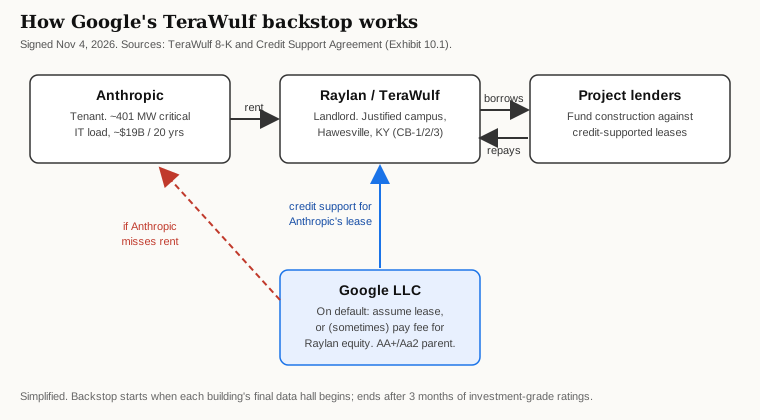
Google signed credit-support agreements to backstop Anthropic's ~$19B, 401 MW lease at TeraWulf's Hawesville campus. If Anthropic misses rent, Google can take the lease—or, in some cases, pay a termination fee for equity in the project SPV. Here's how it works, why the contract talks about TPU pods, and how it fits the new cosigner playbook.
Tom Pechulis, , 7 min read
Four days ago I wrote about Nvidia talking about co-signing Nscale's Anthropic data center. That one was still talks. This one is signed. On Wednesday, TeraWulf filed that Google LLC agreed to backstop Anthropic's rent at its Hawesville, Kentucky campus—about 401 MW of critical IT load on 20-year leases expected to generate roughly $19 billion of contracted revenue. Same tenant. Different landlord. A credit agreement you can actually open and read.
Everything below comes from TeraWulf's Nov 4 8-K, the form of Credit Support Agreement attached as Exhibit 10.1, TeraWulf's Nov 4 press release, its July 6 lease announcement, and coverage from CoinDesk and CNA/Reuters.
TL;DR
- What signed: three Google Credit Support Agreements covering buildings CB-1, CB-2, and CB-3 at TeraWulf's Justified Data Campus in Hawesville, KY (8-K).
- What's behind them: Anthropic's July 2026 lease for ~401 MW of critical IT load, ~$19B of contracted lease revenue over 20 years (July PR).
- What Google can do on a default: (1) pay the rent and assume the lease as tenant, or (2) under certain circumstances pay a termination fee and take equity in Raylan Data LLC, the project subsidiary—not in publicly traded TeraWulf (CSA; CoinDesk).
- When it kicks in: for each building, when the final data hall under that lease starts. Google's support starts only then, so it does not cover construction-period rent risk. It ends if Anthropic (or a guarantor affiliate) holds an investment-grade rating for three months (8-K).
- Why lenders care: Alphabet's senior unsecured debt is rated AA+ / Aa2. That is the point of the whole exercise (Nov 4 PR).
- Construction: Fluor signed a definitive EPC on a GMP basis for the three buildings, but guaranteed maximum pricing is still being established as engineering and procurement progress. Ready-for-service milestones run from late 2027 through Q2 2028 (Nov 4 PR).
Quick jargon decoder
| Term | Plain English |
|---|---|
| Credit backstop / credit support | A stronger company promising to cover a weaker company's bills if it can't pay. Co-signing, but for a data-center lease. |
| Critical IT load | The power that actually feeds the computers, measured in megawatts. Not the whole campus draw (cooling and transformers take more). |
| SPV / project subsidiary | A separate company that owns one project. Here that's Raylan Data LLC. A stake in Raylan is not a stake in TeraWulf stock. |
| Investment grade | A credit rating that says "safe borrower." BBB-/Baa3 and up. Below that is "junk," and junk borrowers pay a lot more interest. |
| EPC / GMP | Engineering, procurement, and construction. A guaranteed maximum price caps what the builder can bill for a defined scope. Fluor's contract is a definitive EPC on a GMP basis, but guaranteed maximum pricing is still being established. |
| TPU pods | Racks of Google's own AI chips (tensor processing units). The contract literally defines them. |
| Neocloud / bitcoin-miner-turned-landlord | Companies like CoreWeave, Nscale, IREN, and TeraWulf that are building AI capacity without a hyperscaler's cash machine behind them. |
As a landlord, the way I think about it: Anthropic is the tenant. TeraWulf is the landlord. Google is the rich relative who co-signs the lease—and who already owns a chunk of the tenant and sells it chips.
What actually got signed
The July lease was the headline. The November filing is the financing glue.
July 6, 2026 (TeraWulf PR):
- 20-year lease with Anthropic at Justified Data in Hawesville, Kentucky.
- ~401 MW of critical IT load.
- ~$19 billion of contracted lease revenue over the initial term.
- Initial capacity in the second half of 2027; full 401 MW by early 2028 (the Nov 4 materials now say phased delivery through Q2 2028).
November 4, 2026 (8-K):
- Three Credit Support Agreements among Raylan Data LLC (landlord), TeraWulf (landlord guarantor), Justified DataPower LLC (master landlord), Anthropic (tenant), and Google LLC.
- One agreement per building: CB-1, CB-2, CB-3.
- Same day: definitive Fluor EPC on a GMP basis for those three buildings (guaranteed maximum pricing is still being established), and lease amendments tied to the backstop.
CFO Patrick Fleury said the quiet part out loud: "Cost of capital is fundamental to infrastructure development." Strong investment-grade credit support is how a former bitcoin miner gets competitive long-term debt for a nearly $20B lease (Nov 4 PR).
What Google can do if Anthropic misses a payment
I opened the form agreement. The mechanics are clearer than most of these deals:
- Assume the lease. Google pays all rent currently due and becomes the tenant under a novation (CSA).
- Reject and buy in. Under certain circumstances Google can elect a "Rejection Option," pay a Termination Fee, and take an equity interest in Raylan equal to (Termination Fee) ÷ (total cost to develop the land, building, equipment, infrastructure, and financing). CoinDesk's plain-English example: pay 30% of project cost, own 30% of the SPV (CoinDesk; CSA).
- Defer the choice. Google can pay rent for a while and decide later.
Two constraints matter:
- First six years after each CSA goes effective, Google generally has to assume the lease rather than reject it, unless an "Equipment Capacity Trigger" fires: the TPU pods installed in that building, when operating, can consume less than 50% of the tenant's critical power (CSA; CoinDesk).
- The backstop ends once Anthropic or a guarantor affiliate keeps an investment-grade rating for three months (8-K).
That TPU clause is doing a lot of work. It only makes sense if Google expects its own chips in the halls. Anthropic already buys a lot of Google compute: TechCrunch reported in April that Google planned to invest up to $40B in Anthropic (cash plus compute) and that Google Cloud would provide 5 GW of capacity over five years, on top of a multi-gigawatt TPU deal with Google and Broadcom starting in 2027 (TechCrunch). So the co-signer is also the chip vendor and a large shareholder. That's a tighter loop than Nvidia's reported Nscale talks.
Why this fits the cosigner playbook
This is the third major flavor of the same idea in a week:
| Deal | Status | Who stands behind it | What's protected |
|---|---|---|---|
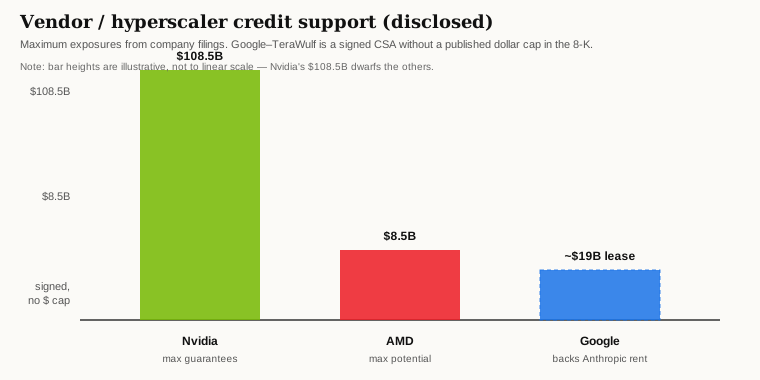
| Nvidia → Nscale / Anthropic (WV) | Talks, not signed | Nvidia (reported residual-value guarantee) | Construction / power debt for ~460 MW (prior post) |
| Nvidia → SB Energy / OpenAI (OH) | Signed | Nvidia, $105B cap | OpenAI's leases at PORTS-Pike (Nvidia 10-Q) |
| AMD → commercial partners | Signed | AMD, $8.5B max potential ($7.7B lease + $750M debt) as of Sep 26, 2026; plus $13.3B of not-yet-started leases it expects to assign/sublease | Partner lease and debt obligations (AMD 10-Q) |
| Google → TeraWulf / Anthropic (KY) | Signed Nov 4 | Google / Alphabet (AA+/Aa2) | Anthropic's rent on ~401 MW / ~$19B leases |
The pattern from GPU debt decoded still holds: lenders aren't really underwriting the GPUs or even the neocloud. They're underwriting who stands behind the payments. CoreWeave's five-year CDS was past 1,100 basis points this week, and midterm results have investors pricing tighter permitting as a further squeeze on new supply (CNBC). Against that backdrop, a signed Google backstop is exactly what a project-finance desk wants to see.
One difference from the Nvidia–Nscale rumor: this backstop is about the tenant's rent, not the landlord's construction loan. Google is standing behind Anthropic. TeraWulf still has to raise the project debt, but now the cash-flow story is "Anthropic, or Google, pays the rent," plus Fluor on a GMP-basis EPC whose guaranteed maximum price is still being established. That's a cleaner credit than "a thin-balance-sheet builder will finish on time."
My take
- Bull case: this is what a mature AI infrastructure deal looks like. Long-term contracted demand, investment-grade credit support, a real EPC on a GMP basis (guaranteed maximum pricing still being established), and phased delivery dates. Google protects its Anthropic relationship and its TPU attach rate. TeraWulf gets financeable paper. Anthropic locks power and shell without putting its own balance sheet on the loan docs.
- Bear case: the AI buildout's credit risk is concentrating in a handful of big-tech balance sheets. Nvidia already disclosed $108.5B of maximum guarantee exposure. AMD is at $8.5B and climbing. Google just added another multi-year contingent claim tied to Anthropic. If model demand or Anthropic's cash conversion slips, those contingent claims stop being free options.
- Where I land: I'd rather see a signed Google CSA than another round of "in talks" headlines. The TPU-pod trigger is the tell: Google isn't just being a nice landlord's friend. It's protecting a campus it expects to fill with its own silicon. For the neocloud debt squeeze, the message is blunt. If you want to build for a frontier lab in 2027–28, someone with an AA-ish balance sheet has to co-sign—chip vendor, cloud parent, or both.
What I'm watching
- Whether TeraWulf announces the project financing that this backstop was designed to unlock, and at what spread.
- IREN after the close today, CoreWeave on Nov 10, Nebius on Nov 12—same watchlist as yesterday. Do any of them show similar credit-support language?
- Nscale's revised S-1 / Nvidia guarantee—still talks last I checked; a signed Google deal raises the bar for whatever Nvidia puts on paper.
- Anthropic's IPO path and rating. The CSA literally ends once Anthropic (or a guarantor) is investment-grade for three months. A below-IG rating after listing is why this backstop exists.