AMD's Helios Hits the Books: A Record Quarter, a $17B Guide, and a Thin Cash Line
AMD's Q3 was the first quarter its Helios racks and MI455X GPUs shipped for revenue. Data center sales nearly doubled to $8.5B, Q4 is guided to ~$17B, and Lisa Su now sees 2027 revenue up more than 80%. Underneath: free cash flow of just $554M, a $3B inventory build, and a $1.1B OpenAI-warrant charge. Here's what the print says, in plain English.
Tom Pechulis, , 10 min read
Yesterday I wrote about Nvidia quietly trimming Vera Rubin's memory bandwidth, which left AMD's MI455X ahead on paper on that one spec. Last night AMD reported its first quarter with real revenue from that chip and from Helios, its 72-GPU rack. So, did the paper lead turn into actual sales? Yes. AMD's data center revenue nearly doubled to $8.5B, and the company guided Q4 to about $17B. The cash flow statement tells a more complicated story, though, and that's the part I want to walk through.
Everything below comes from AMD's Q3 2026 earnings release (Nov 3), the earnings call transcript, and coverage from CNBC, Yahoo Finance, and The Verge.
TL;DR
- The beat: revenue was $13.38B, up 45% from a year ago, vs. $13.09B expected. Adjusted EPS was $2.09 vs. $1.95 expected (LSEG consensus, per CNBC).
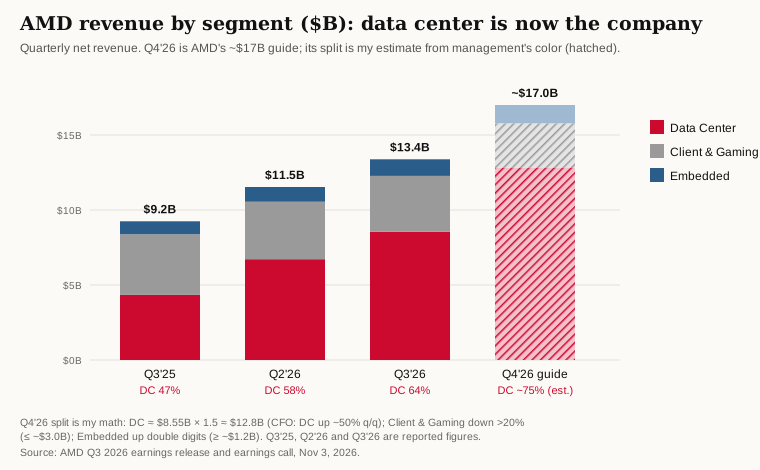
- Data center revenue was $8.55B, +97% year over year and +27% from last quarter. It's now 64% of AMD, up from 47% a year ago (AMD release).
- Helios is real revenue now. Q3 was "the first quarter that we shipped MI455 and Helios racks for revenue," per Lisa Su. Anthropic, Meta, Microsoft, OpenAI and Oracle all have racks online (call).
- The guide: about $17B for Q4 (±3%), vs. $16.2B expected. Data center is guided up ~50% from Q3, and in Q4 the AI GPU business passes server CPUs in dollars for the first time.
- 2027: AMD now expects revenue to grow more than 80%, with server CPUs roughly doubling and data center AI "significantly more than" doubling.
- The catch: free cash flow was only $554M (4% of revenue). That's because AMD built ~$3B of inventory and its customers owe it ~$1.9B more. GAAP EPS also took a $1.1B non-cash hit from the warrants AMD gave OpenAI.
Quick jargon decoder
| Term | Plain English |
|---|---|
| Helios | AMD's rack-scale AI system: 72 MI455X GPUs plus EPYC CPUs and networking, sold as one unit. It's AMD's answer to Nvidia's NVL72 racks. |
| MI450 series / MI455X | AMD's newest data center GPU family. MI455X is the flagship chip that goes into Helios. |
| EPYC (Turin, Venice) | AMD's server CPUs. Turin is the current generation; Venice is the new one that just started shipping. |
| Guide | The revenue forecast a company gives for next quarter. Beating the guide is good; raising it is what moves stocks. |
| GAAP vs. non-GAAP | GAAP is official accounting. Non-GAAP is the company's own version, which strips out items like stock pay and one-time charges. Wall Street mostly trades on non-GAAP. |
| Free cash flow (FCF) | Cash from operations minus spending on equipment. It's the cash that's actually left over. Profit is an opinion; cash is a fact. |
| Warrant | A right to buy shares at a set price later. Here, AMD gave OpenAI the right to buy up to 160M AMD shares for $0.01 each if it hits purchase milestones. |
| Working capital | Money tied up in running the business: inventory on shelves, bills customers haven't paid yet, minus bills AMD hasn't paid yet. |
What happened
The headline numbers (AMD release):
| Q3'26 | Q3'25 | Change | |
|---|---|---|---|
| Revenue | $13.38B | $9.25B | +45% |
| Data center revenue | $8.55B | $4.34B | +97% |
| Data center operating margin | 34% | 25% | +9 pts (my math: $2,882M ÷ $8,546M; $1,074M ÷ $4,341M) |
| Non-GAAP gross margin | 56% | 54% | +2 pts |
| Non-GAAP EPS | $2.09 | $1.20 | +74% |
| GAAP EPS | $1.46 | $0.75 | +95% |
| Free cash flow | $554M | $1,530M | −64% |
Not everything went up:
- Client (PC) revenue was $2.9B, up 7% from a year ago but down 4% from last quarter.
- Gaming fell 40% to $773M.
- Su said PC sales slowed late in the quarter as "higher memory and component costs weighed on demand." AMD is planning for PC unit shipments to decline by a double-digit percentage in 2027 (call).
That's the memory crunch from the AI buildout showing up on the consumer side of the same company. The Verge has more on that angle (The Verge).
On the stock: shares rose as much as 8% after hours, then gave back some of those gains as election results came in (CNBC). By this morning, Yahoo Finance described the stock as roughly flat (Yahoo Finance). I'm not going to guess at the close.
The Helios part (the reason I care)
The key milestone is in the call. Su said AMD "started shipping MI455X in volume in the quarter," and that lead customers "including Anthropic, Meta, Microsoft, OpenAI, and Oracle, brought their first Helios racks online quickly." She expects Helios deployments to "increase substantially" in Q4 as HPE, Dell, Lenovo, Supermicro and others start shipping systems (call).
Three things stood out to me:
- Q4 is the crossover. CFO Jean Hu said Q4 "is actually going to be the quarter Data Center AI business surpass server business." Asked whether that was "barely" or by a lot, she said data center AI will be "much higher than server business in Q4," in dollars. My rough math: if data center grows ~50% to about $12.8B ($8.55B × 1.5), that's roughly 75% of a $17B quarter.
- The bandwidth pitch is now explicit. Su said MI455X leads in compute FLOPS, memory capacity and scale-out bandwidth, and that Helios "delivers an even larger lead in memory bandwidth and higher scale-up bandwidth than the competition." That's the exact gap I wrote about yesterday after Nvidia's spec revision: 23.3 vs. 19.2 TB/s per GPU and 260 vs. 216 TB/s of rack scale-up, both on paper (yesterday's post). It's still a vendor claim. Measured tokens per dollar on shipping racks is what will settle it.
- Supply, not demand, is the ceiling. Su: "It is true that demand is higher than supply." AMD says it has secured "the wafers, substrates, advanced packaging, memory, and other key components needed to support much higher growth next year" (call). Every AI chip print this year has had some version of that line. It means the 2027 number is really a supply-chain forecast.
On 2027 specifically: Su said AMD now expects revenue to "grow more than 80%" next year, "more than twice" the long-term model from last November's analyst day. Server CPUs should roughly double, and data center AI should "significantly more than double." Data center should be more than 80% of total revenue.
My math on what that implies:
- 2026 revenue: about $52B ($35.17B for the first nine months, plus ~$17B for Q4).
- 2027 revenue: "more than 80%" growth means more than ~$94B.
- 2027 data center: more than 80% of that is more than ~$75B.
These are rough implied floors, not guidance AMD gave in dollars.
The part the headline skips: cash
This is the one chart I'd want a skeptic to see.
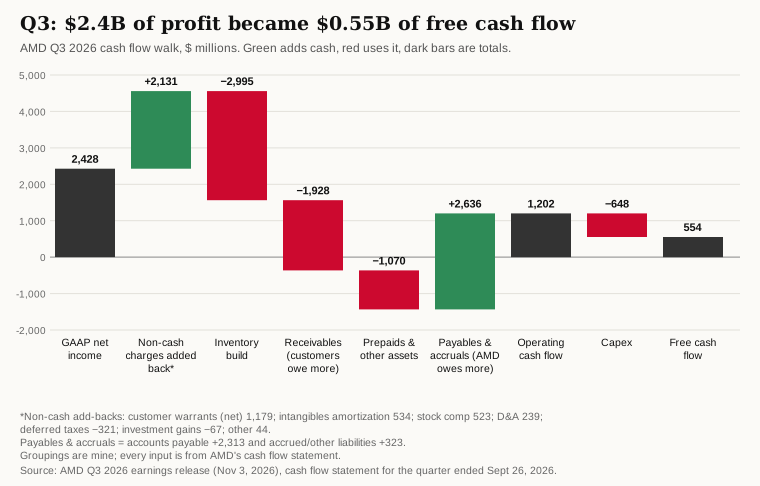
AMD earned $2.43B of GAAP net income in Q3 but generated only $1.20B of operating cash flow. After $648M of capex (spending on equipment and facilities), free cash flow was $554M. That's down from $1.56B last quarter and $1.53B a year ago (AMD release).
Where did the cash go? Working capital (cash tied up in running the business):
- Inventory build: inventory rose $3.0B in the quarter to $11.5B. Hu said that was "to fulfill our strong data center demand." She also said AMD expects to keep investing in inventory and capacity into 2027 (call). A Helios rack carries a lot of expensive HBM, so ramping racks ties up a lot of cash.
- Receivables: money customers owe AMD rose $1.9B. Accounts receivable is now $9.2B.
- Partial offset: AMD stretched its own bills. Accounts payable rose $2.3B, to $7.8B, up from $2.9B at the end of last year.
- New debt: total debt rose to $7.1B, including a $4.75B bond deal in August. Cash and short-term investments were $15.8B (AMD release; call).
Is this a red flag? Not by itself. A hardware company ramping a brand-new product almost always builds inventory before it ships, and Q4's ~50% data center jump should turn a lot of that inventory into receivables, then into cash. But it's the same pattern I flagged for the hyperscalers last week: the capex held, the cash didn't. The AI buildout is getting more working-capital-heavy at every layer of the stack. I want to see Q4 free cash flow snap back. If inventory keeps climbing faster than revenue, that's a different story.
The OpenAI warrant, decoded
GAAP EPS was $1.46 while non-GAAP was $2.09. A big part of the gap is a line called "change in fair value of warrant liability": $1.097B, or $0.66 per share (AMD release).
Background: in October 2025, AMD gave OpenAI a warrant for up to 160 million AMD shares at $0.01 each.
- The first tranche vests after the first 1 gigawatt of MI450-series GPUs is delivered.
- Full vesting requires OpenAI (directly or through partners) to buy 6 GW of AMD GPUs.
- Vesting also requires AMD's stock to hit price targets that escalate to $600 for the final tranche, plus "technical and commercial conditions" (AMD 8-K, Oct 6, 2025).
What changed this quarter: Hu said AMD "began recognizing the accounting impact of warrants issued under our previously announced customer agreement as we shipped MI450 series GPUs." The charge reflects AMD's higher share price and a higher estimated probability that the warrant conditions will be met. She said these charges are expected to grow as AMD and the customer progress under the agreement (call).
How to read it:
- It's non-cash. It doesn't touch non-GAAP results or free cash flow.
- It's still a real cost to shareholders. It shows up as dilution if and when OpenAI exercises the warrant. Hu said Q4 share count won't include the warrants, and AMD will guide on share dilution in 2027 once vesting conditions are met.
- Revenue is already net of it. The reported revenue figures already subtract the grant-date value of the warrant.
- The irony: the more AMD's stock rises and the more GPUs OpenAI takes, the bigger the GAAP charge. A growing warrant expense is, in a sense, a sign the deal is working.
The vendor-financing theme continues. CNBC reports AMD agreed to invest $1B in Meta's equity offering and has committed up to $5B to Anthropic (CNBC). On the call, Bank of America's Vivek Arya asked about competitors offering "residual value guarantees" (a promise to cover part of a GPU's value if it falls). Su said AMD is "selectively investing with our lead partners," with "the first principle being investing in our growth." That's the same playbook I covered in Nvidia co-signing Nscale's debt. AMD is doing it with equity and warrants instead of loan guarantees.
Two numbers from the Q&A, with caveats
Analyst framing, not AMD guidance. On the call:
- Arya described "roughly 3 GW or so of planned AMD deployments into 2027."
- TD Cowen's Joshua Buchalter described AMD's outlook as "$15 billion-$20 billion per gigawatt."
Su answered both questions without restating either figure (call). If you multiply them you get a big 2027 AI number, but I'm not going to present analysts' shorthand as AMD's forecast.
On memory costs: asked whether AMD can pass rising HBM costs on to customers, Su said AMD is "working with our customers to ensure that those costs are shared." That's the polite version of "prices are going up." It's worth watching against the 55% gross margin guide (CNBC notes it came in slightly below the 55.3% consensus).
My take
- Bull case: this is the quarter AMD stopped being a "maybe" in AI racks. Five of the biggest AI buyers have Helios online, Q4 data center is guided up ~50%, AI passes CPUs, and the 2027 outlook went up. The CPU business is a quiet monster too: server revenue is set to roughly double next year because agents need CPUs, not just GPUs. Data center margin went from 25% to 34% in a year, which is real operating leverage.
- Bear case: free cash flow is $554M on a $13.4B quarter. Inventory, receivables and debt all jumped. The growth is being financed partly by suppliers (payables), partly by bondholders, and partly with equity sweeteners handed to the biggest customers. The PC business is shrinking into 2027. And "demand exceeds supply" means the 2027 forecast depends on HBM and packaging that AMD shares with Nvidia.
- Where I land: the P&L (profit and loss statement) is as strong as AMD has ever printed, and Helios looks like a real product, not a slide. But I'd judge AMD on Q4 cash conversion, not on the 80% headline. If Q4 data center lands near my ~$12.8B math and free cash flow recovers as the inventory ships, this was a ramp quarter. If inventory keeps building, that's a yellow flag. For the bandwidth debate from yesterday's post, the answer won't come from spec sheets. It'll come from neoclouds and labs publishing measured Helios vs. Rubin throughput.
What I'm watching
- IREN on Nov 5, CoreWeave on Nov 10, Nebius on Nov 12 (K2 Capital, Oct 31). Do any of them mention AMD capacity, or throughput on shipping Rubin?
- Nvidia Q3 FY27 on Nov 17 (Nvidia IR). With AMD guiding a ~50% data center step-up, Nvidia's data center guide and HBM supply commentary are the obvious comparison.
- AMD at UBS (Dec 1) and Barclays (Dec 9) (call). Any update on Helios rack volumes or the first OpenAI warrant tranche.
- AMD's 10-Q for the full warrant accounting footnote and any customer-concentration disclosure.