Anthropic's $895 Billion Compute Bill, Decoded
Anthropic's amended IPO filing puts a number on its compute commitments for the first time: about $895.4B, with $69.8B due in the next 12 months. Here's what's inside that number, who gets paid (Broadcom tops the list, not Nvidia), why Q3 swung to a loss on pricey short-term compute, and what it means for the neoclouds.
Tom Pechulis, , 9 min read
For two days I've been writing about the people selling AI compute and how they pay for it: what GPU debt costs and Nvidia co-signing Nscale's debt for a building Anthropic will rent. This morning we got the other side of the ledger. Anthropic filed an amended IPO prospectus (an S-1/A) and, for the first time, put a total on what it has promised to spend on compute: about $895.4 billion.
TL;DR
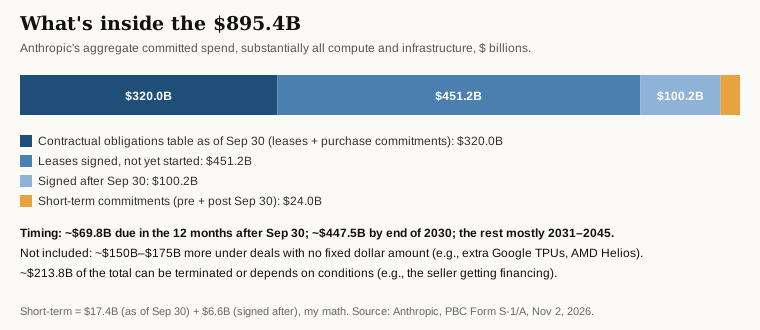
- The number: Anthropic has signed purchase commitments and leases worth ~$895.4B, "substantially all of which is related to compute and infrastructure." About $447.5B lands before the end of 2030, and the rest mostly between 2031 and 2045. About $69.8B is due in the 12 months after Sep 30 (Anthropic S-1/A, CNBC, Axios).
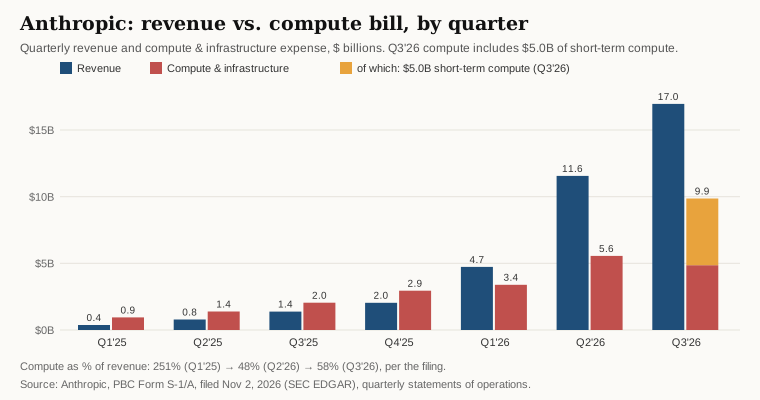
- The quarter: Q3 revenue hit $16.96B, up ~47% from Q2, but Anthropic swung to a $567M operating loss after a $974M operating profit in Q2. The main culprit: $5.0B of short-term compute that "currently costs significantly more" than its long-term deals (S-1/A).
- Who gets paid: the biggest single named counterparty is Broadcom (~$161.2B of TPU equipment lease rent), followed by Google (~$121.3B), SpaceX's AI unit (up to $120.5B), and Amazon ($110B). Broadcom is also offering to lend Anthropic up to $42B to pay that rent.
- Why it matters: the AI buildout's biggest buyer is now a company with ~$132B of cash and ~$895B of commitments. Every neocloud, chip vendor, and lender in the chain is effectively underwriting Anthropic's revenue growth.
Quick jargon decoder
| Term | Plain English |
|---|---|
| S-1 / S-1/A | The document a company files with the SEC to go public. The "/A" is an amendment: the first version (filed Oct 26) left many numbers blank. |
| Purchase commitment | A signed promise to buy something in the future, often whether or not you end up using it. |
| Take-or-pay | "Pay for it even if you don't take it." If you use less than you promised, you still owe the minimum. |
| Finance lease | Renting equipment for most of its useful life. Accountants treat it almost like buying it with a loan. |
| Short-term compute | Capacity rented on short notice, when your long-term contracts aren't enough. Think of it as booking a hotel last-minute instead of signing a lease: it costs more. |
| TPU | Google's custom AI chip, an alternative to Nvidia GPUs. Broadcom helps design and build them. |
| Neocloud | A company that rents out GPUs (CoreWeave, Lambda, Nscale), with no giant profitable business behind it. |
| PIK (paid in kind) | Interest that isn't paid in cash; it's added to the loan balance instead. |
What's inside the $895.4B
The headline number isn't one bucket. The filing builds it from five pieces (S-1/A, Contractual Obligations):
- $320.0B in the formal obligations table as of Sep 30. Almost all of it ($313.8B) is purchase commitments, mainly minimum payments for cloud hosting and other infrastructure services, plus $4.2B of operating leases and $2.0B of finance leases.
- $451.2B of leases that were signed but haven't started yet. They're expected to start between 2026 and 2028, with a weighted-average term of about 10 years.
- $100.2B of new commitments signed after Sep 30, mostly data center leases and hosting deals.
- ~$24.0B of short-term commitments (my math: $17.4B as of Sep 30 + $6.6B signed after).
That adds back to $895.4B (my math: 320.0 + 451.2 + 100.2 + 17.4 + 6.6 = 895.4).
Two caveats cut both ways:
- It could be smaller. About $213.8B of it is subject to termination rights or conditions before it starts, such as "the counterparty's ability to secure financing, facilities, or regulatory approvals." If those conditions aren't met, the deal can be terminated. That's roughly 24% of the total (my math: 213.8 ÷ 895.4).
- It could be bigger. The total excludes deals with no fixed dollar amount. Anthropic estimates those at another ~$150B to $175B, including $125B to $150B of additional Google TPU capacity delivered 2028–2031 and more than $20B of AMD Helios rack systems starting in 2027.
Who gets paid
The named deals, all from the same section of the S-1/A:
- Broadcom: ~$161.2B of rent (excluding interest) under five-year equipment leases that give Anthropic TPU-based compute. Some came online in 2026, with more starting in 2027. These are non-cancelable.
- Google: at least ~$121.3B of cloud spend from April 2026 to July 2033, "regardless of actual usage." If Anthropic spends less, it pays Google the difference. Yahoo Finance notes that's up from $114.5B in the first filing (Yahoo Finance).
- SpaceXAI (formerly xAI): up to $120.5B for Nvidia GPU compute, about $3.1B a month once all capacity is delivered, which Anthropic expects in December 2026. After initial periods ending in January and March 2027, either side can cancel on 90 days' notice.
- Amazon: at least $110.0B from May 2026 to April 2036, also regardless of usage.
- Microsoft: at least $44.9B from November 2026 to June 2033.
- Nscale: up to ~$44.6B and Lambda: ~$41.3B, both for Nvidia GPU compute, with fees owed only once capacity is delivered and accepted.
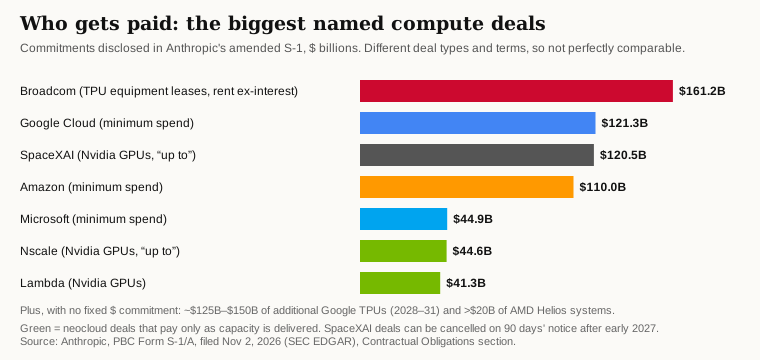
The thing that jumped out at me: Nvidia isn't among the biggest named counterparties. Its chips show up mostly through middlemen: SpaceXAI, Nscale, and Lambda. (The NYT does report Anthropic is also buying chips directly from Nvidia, AMD, and Broadcom for some sites (NYT via DNYUZ).) But the single largest line is Broadcom's TPU leases, and the second largest is Google's cloud. Anthropic itself says it runs a "multi-chip compute architecture across AWS Trainium, Google TPUs, NVIDIA GPUs, and AMD GPUs." That's the backdrop for why Nvidia is willing to co-sign Nscale's debt: it's competing for Anthropic's wallet against custom silicon.
Broadcom: landlord and lender
This is the most SemiAnalysis-brained detail in the filing. Alongside the 2026 lease, Broadcom signed a note purchase agreement under which Anthropic can issue up to $42.0B of convertible notes to Broadcom (or a financial partner Broadcom picks) solely to pay quarterly rent on that lease (S-1/A). The terms:
- 9.00% interest, paid in kind (added to the balance, not paid in cash).
- If certain revenue-growth conditions aren't met, new notes carry 13.00% and convert at a bigger discount.
- The holder can convert into stock at 90% of the 30-day average share price after the IPO.
- No notes are expected before the IPO. The draw period starts once the leased equipment is ready for service.
In plain English: the chip vendor is renting Anthropic the hardware, and it's offering to lend Anthropic the money to pay the rent, with the option to take stock instead of cash. Broadcom has also already assigned parts of these leases to other financing entities, including a special-purpose vehicle formed in October.
Sound familiar? It's the same pattern as Nvidia's guarantees from yesterday's post. The suppliers are financing the demand for their own chips. The difference is that Broadcom gets paid in Anthropic's credit and, possibly, its equity.
Why Q3 swung to a loss
The quarterly table in the S-1/A tells the story:
- Revenue: $11.56B in Q2 → $16.96B in Q3, up ~47% (my math: 16,956 ÷ 11,555). CNBC notes that's a sharp slowdown from 144% quarter-on-quarter growth in Q2 (CNBC).
- Compute and infrastructure: $5.56B → $9.86B. That's 58% of revenue, up from 48%.
- Operating income: +$974M → −$567M.
Anthropic blames the loss mainly on $5.0B of short-term compute plus $2.0B of non-cash charges tied to a donation-matching program. On its own adjusted measure (which strips out items like stock-based compensation), operating income still rose to $2.5B, but the margin fell from 19% to 15%.
The key mechanic: Anthropic says it typically books compute 12 to 18 months before it's available. When demand ran ahead of that long-term capacity, it bought short-term compute at a premium. By my math, about half of Q3's compute bill was short-term capacity (5.0 ÷ 9.86 ≈ 51%). And the filing says it expects short-term compute use "to continue to increase in the near term," squeezing margins.
The New York Times has the human version of this story: Anthropic signing dozens of deals with ex-crypto miners, neoclouds, and tech giants, and now considering data center sites as small as 50 MW, supplemented with batteries and natural gas, because smaller sites come online faster (NYT via DNYUZ).
Can it pay?
The bull and bear math, using only the filing:
- Cash: ~$131.9B of cash and short-term investments at Sep 30 (my math: $95.6B cash + $36.3B short-term investments). That's huge. The total commitment is still ~6.8x that (my math: 895.4 ÷ 131.9).
- Next 12 months: $69.8B due. Q3 revenue annualized is ~$67.8B (my math: 16.96 × 4). So the next year's committed compute bill is roughly equal to the current revenue run-rate, before paying a single employee.
- The fine print: Anthropic warns that its revenue is "primarily consumption-based" and mostly not locked in long term, while its compute commitments run for years. A default under some commercial agreements could trigger cross-defaults under its credit facility and some convertible notes.
None of that means Anthropic is in trouble. Revenue went from $1.38B to $16.96B in a year. But it does mean that the whole chain, from Broadcom and Google to Lambda, Nscale, and their lenders, is betting that the line keeps going up and to the right.
What it means for neoclouds
This filing is basically a cheat sheet for Friday's GPU debt post:
- Good news: Anthropic is a buyer of last resort for short-term capacity, and it's paying up for it. That's exactly what GPU renters want to sell.
- Bad news: the neocloud deals are the conditional ones. Lambda's biggest contract (~$34.9B of the $41.3B) can be terminated by either side if Lambda doesn't secure the facility lease in time. Nscale has to use "best efforts" to line up financing. And Nscale is one of the neoclouds the WSJ reported were effectively shut out of the bond market in recent weeks, along with CoreWeave and Nebius (AI Weekly summary of WSJ).
- The credit question: Axios, citing the FT, notes Anthropic may not get an investment-grade rating on its debt (Axios). Lenders to the neoclouds are lending against Anthropic's contract. If the tenant is junk-rated, the building's debt costs more.
My take
- Bull case: a company growing revenue ~12x year over year is rationally locking up scarce power and chips years ahead. The short-term compute premium is a sign of too much demand, not too little. And about a quarter of the commitments are conditional, so there's flexibility built in.
- Bear case: $895B of commitments against ~$68B of run-rate revenue and consumption-based contracts is a big duration mismatch. The vendors financing it (Broadcom's PIK notes, Nvidia's guarantees) make the loop more circular, not less.
- Where I land: the number to watch isn't the $895B. It's the $69.8B due in the next 12 months versus revenue, and how much of the compute bill keeps being short-term. If short-term stays near half of compute, margins stay under pressure. If long-term capacity catches up, Q2's profit was the real trend.
What I'm watching
- The IPO pricing. The price range is still blank, per Yahoo Finance. K2 Capital, citing press reports, says the listing is targeted for the week of Nov 16 (K2 Capital, Oct 31).
- Neocloud prints: IREN on Nov 5, CoreWeave on Nov 10, and Nebius on Nov 12 (K2 Capital sector note, Oct 31). I want to hear how much short-term capacity they're selling and at what price.
- Nvidia Q3 FY27 on Nov 17, and whether the Nscale guarantee gets signed.
- Broadcom's next filing. How it books the Anthropic lease assignments and whether the $42B note facility shows up.