The GPU-Hour Gets a Futures Curve: What Polymarket's New Compute Markets Say About AI Rental Prices
Polymarket now lets anyone bet on what an Nvidia H100, B200 or B300 will rent for, out to December 2028, plus a 24/7 H100 perpetual. Here's how the contracts work, what the curve is pricing in, why two price indexes disagree by almost $3 on the B200, and why lenders should care more than gamblers.
Tom Pechulis, , 10 min read
The last week was all export rules and shipping pauses. While that was going on, something quieter happened that I think matters more over the long run: the price of renting a GPU got a public futures curve.
On Nov. 25, Polymarket rolled out a compute dashboard that turns its bets on Nvidia GPU rental prices into a forward curve for the H100, B200 and B300, running out to December 2028 (Finance Magnates, crypto.news). A day later it launched an H100 perpetual future: a contract that tracks the hourly rental price of one H100, trades 24/7, never expires, and allows up to 3x leverage (Polymarket docs). B200 and B300 perps followed, and Polymarket's launch page now lists all three as live (Polymarket).
CEO Shayne Coplan called it "a yield curve for the cost of compute" (Finance Magnates). That's the right way to think about it.
TL;DR
- What launched: Public markets on what H100, B200 and B300 GPUs will rent for, month by month through Dec. 2028, plus always-on perps for all three chips. Everything settles in cash against a rental price index from a company called Ornn. Nobody gets a GPU (Polymarket docs, Crypto Briefing).
- What the curve says: Traders expect rents to fall. As of this morning, H100 is priced around $3.06/hour for December and $2.06 for December 2028. B200 goes from $9.41 to $5.61 (Polycopy tracker). That's roughly a third off for H100 and 40% off for B200 (my math).
- The catch: The far end of the curve barely trades, and the two indexes Wall Street plans to use don't agree. On Nov. 25, Ornn had the B200 at $9.76/hour while Silicon Data, the index behind CME's planned contract, had it at $6.99 (crypto.news, Silicon Data).
- Why it matters: Coplan says hundreds of billions of dollars of compute is being committed years in advance (Finance Magnates). Every GPU loan depends on what those chips will rent for. Now there's a public number to check that against, and it's lower than today's price.
How it works, in plain English
Think of it like betting on gas prices, except the "gas" is one GPU for one hour.
There are two kinds of contract:
- Monthly yes/no markets. Each one asks something like "Will the H100's average rental price in March 2027 be above $3.00?" A "Yes" share trades between $0 and $1, and the price is the market's odds. $0.63 means 63% (Polymarket Institutional). Stack a ladder of these at different prices and you can back out the price traders expect. Polymarket calls that the PIRP (Polymarket-implied rental price). It averages the middle 60% of outcomes so the thinly traded extremes don't drag it around (Polymarket Institutional). Each month settles on the average of Ornn's daily index for that month.
- The H100 perpetual ("perp"). One contract = one H100 SXM GPU-hour. It tracks a 24-hour average of Ornn's hourly H100 prints, trades around the clock, and allows 3x leverage on positions up to $500K. B200 and B300 versions work the same way and were scheduled to open Nov. 27 (Polymarket docs). Why the 24-hour average? Polymarket says single hours of H100 pricing have moved more than 20% while the daily level stayed flat (Polymarket docs). Spot GPU pricing is noisy.
None of this delivers compute. You can't use a winning contract to rent a GPU at the forecast price (Finance Magnates). It's a hedge or a bet on a number.
This isn't brand new. Polymarket has listed compute contracts since February, and in June it announced a six-figure H100 hedge between FalconX and AneraLabs (Crypto Briefing, crypto.news). What's new is the full curve out to 2028, the perp, and the marketing push. Polymarket is running a launch rewards pool that grows from $30,000 to up to $150,000 with volume, and cut the taker fee on the H100, B200 and B300 perps to 0.01% through Dec. 6 (Polymarket).
What the curve is pricing in
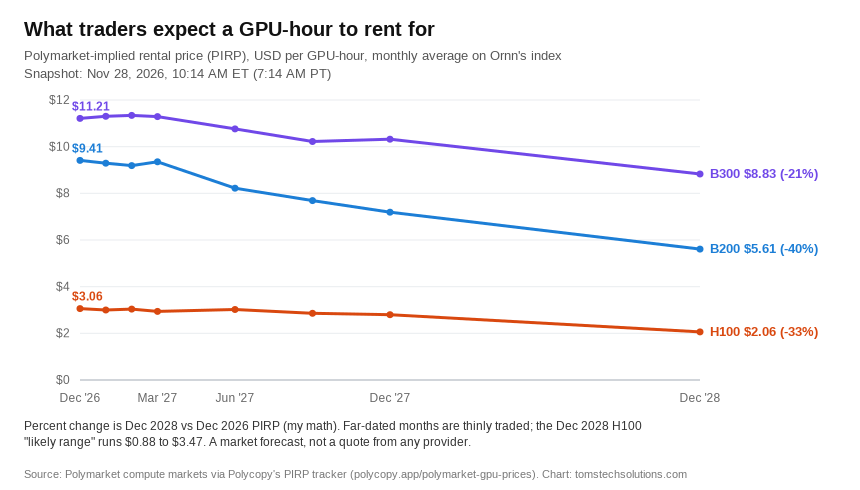
Three things jump out.
1. Everything slopes down. From December 2026 to December 2028, the implied price drops about 33% for H100, 40% for B200, 21% for B300, and 30% for H200 (my math from Polycopy's PIRP table: $3.06→$2.06, $9.41→$5.61, $11.21→$8.83, $6.61→$4.62). In commodity terms, that's backwardation: today's price is higher than the future price. Oil does this when supply is tight now but expected to loosen. My read is the market is saying the same about GPUs: Rubin-class supply shows up and older chips get cheaper.
2. It's not falling yet. Spot is actually going the other way. Ornn's H100 benchmark was up 10.9% week over week on Nov. 25, and B200 was up 6.4%. B300 was the exception, down 7.1% to $10.83 (SnowRock). Silicon Data's neocloud H100 index went from $2.90 on Oct. 29 to $3.07 on Nov. 27, and B200 from $6.47 to $7.02 (Silicon Data H100, B200). That's +6% and +8.5% in a month (my math). So the curve is flat through roughly mid-2027 and the drop happens later.
Speculation, flagged as such: one possible reason B300 is soft while the others firm up is the new export rule. Dealers have listed thousands of B300s originally meant for data centers serving Chinese renters, per CNBC as summarized by TechTimes. Those are listings, not completed sales, and I can't prove they're moving the index.
3. Blackwell depreciates faster than Hopper. B200 drops the most in percentage terms. That's the market saying a B200 is a much worse asset to own in 2028 once Rubin-class parts arrive. If you're a neocloud that just bought B200s on debt, that's the line to stare at.
How much should you trust it? Less the further out you go. On Nov. 25, December 2026 H100 contracts had $386,217 in volume, versus $58,160 for December 2028 (SnowRock). The Dec. 2028 H100 "likely range" (the middle half of outcomes) is $0.88 to $3.47 (Polycopy). That's a shrug, not a forecast. Total volume across these markets is about $13.4M as of this morning (Polycopy). Real money, but tiny next to the GPU deals it's supposed to price.
What this does to a GPU's paycheck
The reason anyone cares: a GPU cloud earns back its hardware one rental hour at a time. If the hourly price falls, so does the paycheck.
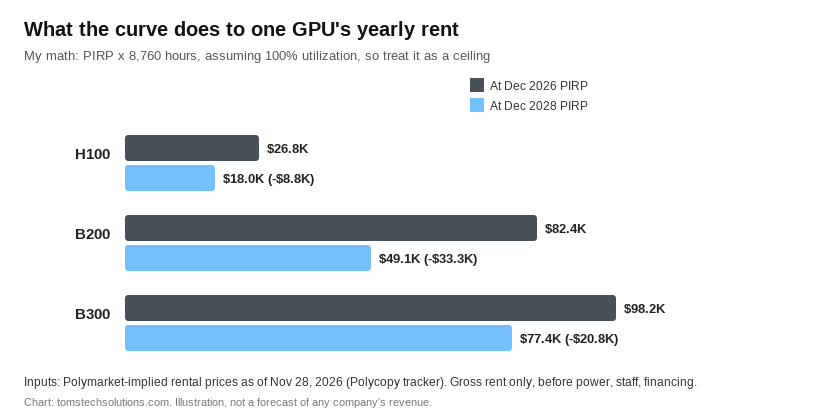
My math, at 100% utilization (a ceiling, since real fleets don't rent every hour), using the PIRPs above × 8,760 hours/year:
| GPU | Rent/year at Dec '26 price | Rent/year at Dec '28 price | Difference |
|---|---|---|---|
| H100 | $26.8K | $18.0K | −$8.8K |
| B200 | $82.4K | $49.1K | −$33.3K |
| B300 | $98.2K | $77.4K | −$20.8K |
Multiply by a fleet of tens of thousands of GPUs and the gap between "rent stays at today's price" and "rent follows the curve" becomes the difference between a loan that pays back on time and one that doesn't. I covered the debt side in GPU debt, decoded, and the price-cutting side in the SpaceX Blackwell price cut. This curve is the first public, tradable version of that question.
Coplan said this part out loud. He wrote that a lot of long-term compute deals are "essentially a levered bet on what GPUs will rent for in the future (what could go wrong lol)," and that "every GPU loan will have a market price to check against" (Finance Magnates). Polymarket's own institutional pitch names lenders underwriting GPU-backed loans and neoclouds protecting rental revenue as target users (Polymarket Institutional).
Two thermometers, one patient
Here's the part I find most interesting as an infra person. A futures contract is only as good as the index it settles on. And there are now competing indexes.
- Ornn's Compute Price Index (OCPI) is built only from completed rental transactions, which ICE calls a first (ICE). It weights trades by volume, caps extreme prices, and keeps contributors private (SnowRock). Polymarket settles on it, and ICE plans futures on it.
- Silicon Data's rental index standardizes observed prices across neoclouds and GPU marketplaces for specs, term, and location (Silicon Data). CME plans futures on it: 730 GPU-hours (one month) per contract, listed out 36 months (CME Group).
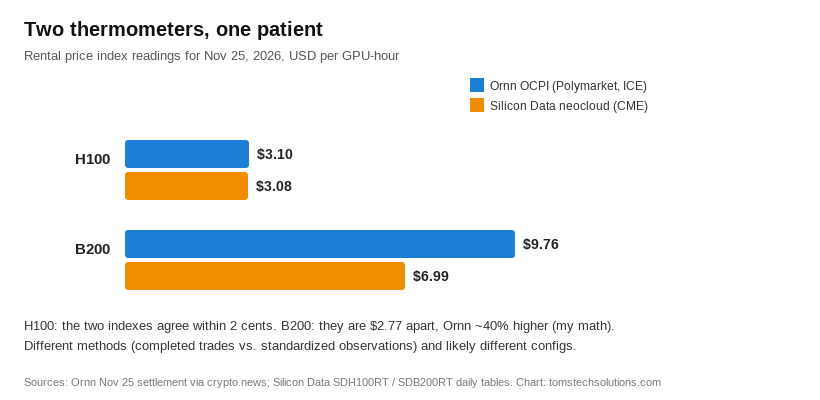
On H100, they agree: Ornn's Nov. 25 settlement was $3.10, Silicon Data's was $3.08 (crypto.news, Silicon Data). On B200, they don't: $9.76 vs. $6.99, a $2.77 gap. Ornn is about 40% higher (my math). I don't know which is "right." Different methods and probably different machine configs are a likely reason. But it means a B200 hedge on CME and a B200 bet on Polymarket would be referencing very different numbers.
Traders call this basis risk: the gap between what your hedge pays and what you actually pay. One X user asked how closely Ornn's on-demand index would track the bill for a buyer on a 12-month capacity deal (SnowRock). That's exactly the issue. Regulators are asking a version of the same question: whether price indexes can reflect privately negotiated GPU deals, which account for much of the market's trading (TokenPost).
The race to own the GPU price
Polymarket isn't alone. It's just first to have a live curve the public can see.
- ICE + Ornn announced GPU futures in May (ICE). As of a Sept. 29 notice, H100 (HPR) and B200 (BKL) contracts are waiting on a CFTC comment period, with no listing date set (ICE Futures U.S. notice).
- CME + Silicon Data say compute futures will launch "later this year," pending regulatory review (CME Group).
- Kalshi pulled its compute markets in August amid CFTC scrutiny and is now working with Compute Desk on a new attempt. The CFTC pushed its decision to early 2027 (Bloomberg Law, TokenPost).
- Polymarket US, the regulated American entity, self-certified "Compute Index Value Contracts" with the CFTC in August (crypto.news). Polymarket's international, blockchain-based platform operates separately from that US exchange (crypto.news).
Fittingly, Polymarket has a market on this too. Traders give 8% odds of the first US compute futures trade happening by Dec. 31, and 75% by June 30, 2027 (Polycopy).
What I think
- This is the right product at a weird moment. GPU rental is starting to behave like a commodity: lots of sellers, a standard unit, a price that moves daily. Commodities get futures curves. And as Coplan put it, "AI financing sobers up" (Finance Magnates), so the people buying, selling and lending against compute need a way to hedge.
- The curve is a reality check for GPU loan models. If your model assumes a B200 rents for $9+/hour for five years and the market says ~$5.60 by end-2028, you need a good reason why you're right and the market's wrong. Even a thin market makes that question harder to ignore.
- The index war matters more than the venue. Whoever becomes "the" GPU price, Ornn or Silicon Data or someone else, gets to define what a GPU is worth for lenders and buyers. A ~40% disagreement on B200 has to shrink before anyone hedges real size.
- Don't over-read the far end yet. A few hundred thousand dollars of volume can't price 2028 with confidence. Treat the 2028 numbers as a sentiment gauge. The near months are where the signal is.
Jargon decoder
- GPU-hour: renting one GPU for one hour. The basic unit of AI cloud pricing.
- Perpetual future (perp): a futures contract with no expiry date. A periodic "funding" payment between buyers and sellers keeps it close to the index.
- Cash-settled: you get paid the price difference in money. No GPUs change hands.
- Backwardation: future prices below today's price. Usually means "tight now, looser later."
- Basis risk: your hedge pays based on index A, but your actual cost follows price B. The gap is your leftover risk.
- Neocloud: a GPU-focused cloud company that isn't AWS, Azure or Google.
Next up
- Dec. 1: Jensen's closed-door House interview with three committees (TechTimes). Senate Banking has asked for Dec. 3, but no date is set yet.
- Dec. 6: End of Polymarket's compute perps launch promo (Polymarket). I want to see if volume holds up once the rewards and the 0.01% fee go away.
- Whether Ornn and Silicon Data's B200 readings start to converge.
- CME's compute futures launch, promised "later this year" pending regulators, and the CFTC's early-2027 decision on Kalshi's contracts.
- Still watching: any Nvidia statement on the Southeast Asia shipment pause, the Jan. 19 comment deadline on the remote-access rule, and the ~Feb. 17 license deadline.
Sources opened for this post: Polymarket compute perps docs, Polymarket Institutional compute page, Polymarket H100 launch competition, Finance Magnates (Nov 25), crypto.news (Nov 26), Crypto Briefing (Nov 25), SnowRock (Nov 25), Polycopy PIRP tracker (snapshot Nov 28, 10:14 AM ET), ICE + Ornn release (May 19), ICE Futures U.S. notice (Sept 29), CME compute futures, Silicon Data H100 index, Silicon Data B200 index, Bloomberg Law (Nov 18), TokenPost (Nov 18), TechTimes (Nov 27). Market prices move constantly; curve figures are a snapshot. Not investment advice.