SpaceX Cuts Blackwell Rental Prices by Up to a Third: Glut Signal, or Spot Catching Up?
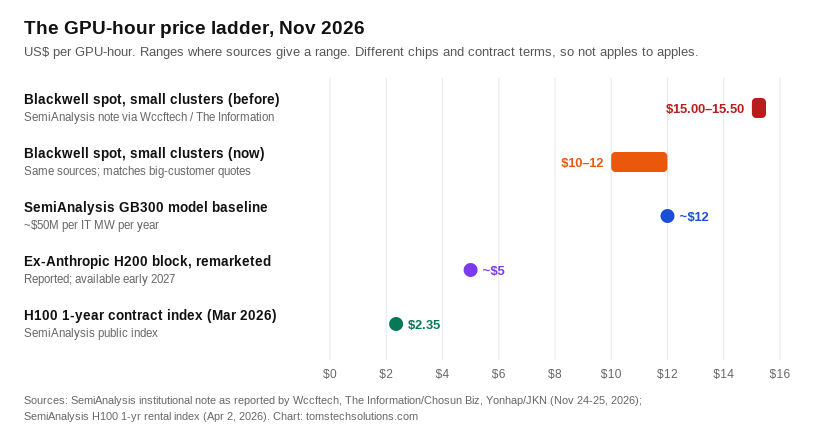
A SemiAnalysis client note says SpaceX cut small-cluster Blackwell spot prices from ~$15/GPU-hour to $10-12 and is remarketing a ~50,000-GPU H200 block Anthropic reportedly won't renew at ~$5. Neoclouds fell 11-12% on Tuesday. Here's what the cut actually is, what it isn't, and the math for anyone renting or financing GPUs.
Tom Pechulis, , 9 min read
Back in September I wrote that H100 rental prices went up in 2026, not down. On Tuesday we got the first real data point pointing the other way.
SemiAnalysis told its institutional clients that "we are starting to see signs of a broader pricing cooldown" in the market for Nvidia's AI chips, citing price cuts by SpaceX (The Information via Benzinga). The same day, CoreWeave fell 11.84%, Iren 11.54% and Nebius 10.74% (CNBC).
The note itself is for paying clients. I haven't seen it. Everything below about its contents comes from outlets that reported on it, and I've linked each one. Here's what it says, and why I think "glut" is the wrong word, at least for now.
TL;DR
- The cut (reported): SpaceX dropped its Blackwell spot quote for small clusters from about $15.00-15.50 per GPU-hour to $10-12. That's the same range it already quotes big customers like Anthropic and Google (Wccftech, Chosun Biz citing The Information, Yonhap via JKN).
- The H200 block (reported, not confirmed): Anthropic may not renew a cluster of roughly 50,000 H200s at SpaceX. SpaceX is reportedly offering that capacity to others from early 2027 at about $5/GPU-hour (Wccftech, note as reposted on Xueqiu).
- The baseline didn't move: SemiAnalysis kept its model assumption of about $50M per IT megawatt per year for GB300, which it equates to roughly $12/GPU-hour. SpaceX's new quote sits inside that (Wccftech).
- My take: This is the small-buyer premium getting squeezed out, not prices collapsing. In data-center units, SpaceX's new spot price lands right where CoreWeave says its short-term capacity already sells. The real tells come in 2027: whether that H200 block clears at $5, and what Anthropic does once its contracts become cancellable.
Quick jargon decoder
- GPU-hour: Renting one GPU for one hour. It's the basic price unit of the AI cloud business.
- Spot vs. contract: Spot is the walk-up rate for short-term capacity. Contracts lock in a price for one to five years. Think hotel rack rate vs. a corporate rate.
- Small cluster vs. large cluster: Small means tens to hundreds of GPUs. Large means tens of thousands networked into one training machine. Big buyers usually get a volume discount.
- Neocloud: A company whose main business is renting GPUs, like CoreWeave, Nebius or Iren. Not a general-purpose cloud like AWS.
- $/MW-year: Revenue per megawatt of IT power per year. Data-center people use it because power, not chip count, is what limits a site.
What was actually reported
Three separate threads got bundled into one headline, so let me pull them apart.
1. Blackwell spot got cheaper for small buyers. Small-cluster quotes went from about $15-15.50 to $10-12 per GPU-hour. Chosun Biz and Yonhap both describe it as a 20-35% cut. My math: $15.00 → $12 is -20%, $15.50 → $10 is -35.5%, and midpoint to midpoint ($15.25 → $11) is about -28%.
The important detail is the new price. It matches what SpaceX already quotes Anthropic and Google for large clusters (Wccftech). Chosun Biz's read, which I share: since small spot contracts fell to the level of big ones, "it is difficult to interpret the move as a marketwide price decline" (Chosun Biz).
Everyday version: the convenience store dropped its price to match Costco. That tells you the convenience store was overcharging. It doesn't tell you groceries got cheaper.
2. The H200 block. Per the note, Anthropic might not renew roughly 50,000 H200s at SpaceX, and SpaceX is already shopping them at about $5/GPU-hour for early 2027 (Wccftech). The Chinese-language repost of the note calls this "industry information" (行业消息) (Xueqiu). Neither company has confirmed it publicly, as far as I can find. Treat it as a report, not a fact.
Some context. Earlier this month, unverified notes from an Anthropic meeting with sell-side analysts said it wouldn't extend its SpaceX compute deal past mid-2027. Musk's reply: "We would be happy to take the compute back. No problem. But I think the opposite is going to happen" (TeslaNorth).
3. More supply coming. The note and The Information both point to new supply. One source is capacity that was rented to Chinese customers and now needs new tenants because of the US remote-access rule (Chosun Biz, Xueqiu). That rule took effect Nov 19. It restricts overseas data centers that "remotely supply significant volumes of compute" to companies headquartered in "countries of concern" (the rule's Country Group D:5) or Macau. It also adds a license requirement for advanced chips going to Indonesia, Malaysia, Singapore, Thailand and Brazil (Federal Register). The Information also expects more custom chips from Google and other Big Tech firms to ship starting next year (Chosun Biz).
Convert it to megawatts and the "cut" looks different
GPU-hour prices are hard to compare across chips. Data-center people think in revenue per megawatt, so I converted.
SemiAnalysis equates $50M per IT MW per year with about $12/GPU-hour. Working backwards (my math): $50M ÷ (8,760 hours × $12) ≈ 476 GPUs per IT megawatt, or about 2.1 kW per GPU once you include the CPUs, networking and everything else in the rack. Using that same ratio:
- SpaceX's old small-cluster spot ($15-15.50) ≈ $62.5-64.6M per MW-year.
- SpaceX's new spot ($10-12) ≈ $41.7-50M per MW-year.
Now compare that with what CoreWeave said on its Q3 call two weeks ago. It's "selling capacity at more than 40 million per megawatt annually" on short-term deals, while new 4- to 5-year contracts are "moving to 20 million to 25 million per megawatt" (CoreWeave Q3 call, Motley Fool transcript).
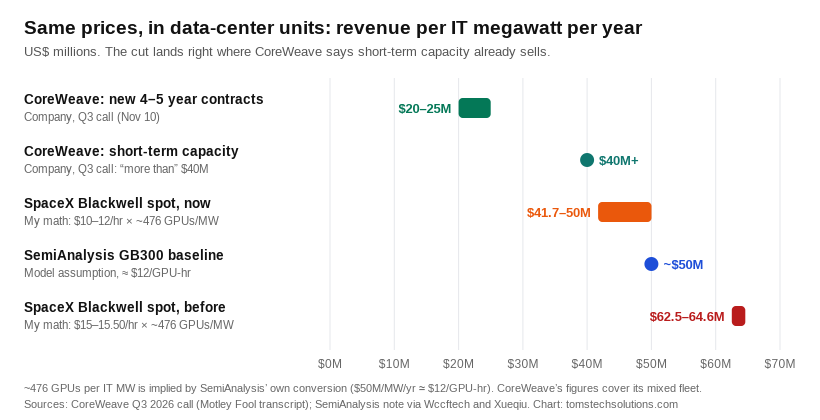
So SpaceX didn't undercut the market. It came down to the market. Its old small-cluster price was a scarcity premium well above what the biggest neocloud says it gets for short-term capacity. Caveat: CoreWeave's numbers cover its whole mixed fleet, and my 476 GPUs/MW comes from SemiAnalysis's own GB300 conversion. These are ballpark comparisons, not exact ones.
The Xueqiu repost also says the analysts think new Blackwell deployments still earn attractive returns at $10-12, so they don't expect the cut to slow SpaceX's 2027 buildout. It adds that Vera Rubin pricing sits "significantly higher" than Blackwell (Xueqiu). That's single-sourced to the repost, so weigh it accordingly.
Why SpaceX is the one cutting
SpaceX isn't a side player in GPU rental. It's one of the biggest.
- Its SI segment (formerly "AI") booked $7.56B of Q3 revenue out of $14.58B total. My math: about 52% of the company (SpaceX Q3 release).
- Nameplate compute reached 1.7 GW at Sept 30, up from 0.6 GW a year earlier. SI capex was $16.4B in the quarter alone (SpaceX Q3 release).
- One compute customer, "Customer B," was 34.5% of Q3 revenue. Bloomberg's source says that's Anthropic (Bloomberg Línea). My math: 34.5% × $14,575M ≈ $5.0B in one quarter.
- Anthropic's IPO filing commits up to $120.5B through 2029, about $3.1B a month from December. Anthropic can cancel with 90 days' notice once the non-cancellable periods end in January and March 2027 (Bloomberg Línea).
Put those together and the incentive is obvious. SpaceX is adding capacity fast, and its biggest tenant has an exit door opening in 2027. When you're building capacity that quickly and one tenant pays a third of the bills, you start pricing to fill the building, not to protect the rate card.
For scale, my math on the H200 block: 50,000 GPUs × $5 × 8,760 hours ≈ $2.2B a year at 100% utilization. That's real money, but it's about 6% (my math) of Anthropic's ~$37B annual run-rate commitment ($3.1B × 12). The H200 block isn't the risk. The bigger contract is.
Who should actually worry
Neoclouds with renewal math built on today's prices. CoreWeave says more than 130,000 GPUs come off contract in 2027 and about 170,000 in 2028. "At current pricing levels," re-renting them would be worth "nearly 10 billion of annualized incremental revenue" (CoreWeave Q3 call). My math: $10B ÷ 300,000 GPUs ÷ 8,760 hours ≈ $3.81 per GPU-hour on average across whatever mix of chips comes off contract (CoreWeave didn't break that out in what I read). CoreWeave also said Ampere and Hopper pricing rose 30-50% quarter over quarter in Q3. If H200-class capacity starts clearing at $5 in early 2027 while Blackwell spot drifts lower, that renewal number gets harder to hit. Chosun Biz flagged the same risk (Chosun Biz).
Less worried: lenders on long leases. The $44B Vera Rubin financing I wrote about last week leases racks to SpaceX for about five years. Those bondholders are exposed to SpaceX's credit, not to the spot rate. Spot prices matter to them only if they get bad enough to hurt SpaceX's ability to pay.
Not worried yet: demand at the server layer. Dell reported Tuesday after the close: record $54.9B revenue, $22.0B of AI-optimized server revenue (+291% year over year), and a record $132.3B AI backlog after $60.2B of orders. It raised its full-year AI server guide from $74B to $78B (Dell). People are still ordering racks at record pace. The question is what those racks rent for once they're plugged in.
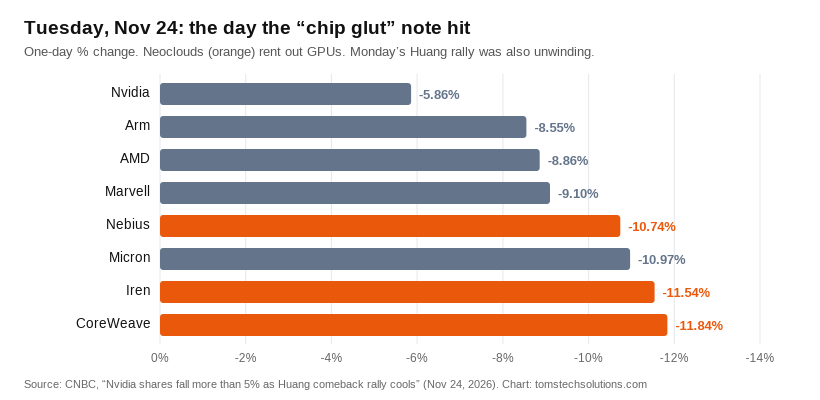
One caveat on that chart: Tuesday was also the unwind of Monday's Huang-reinstatement rally. The Information said Anthropic closed below its IPO price that day too (The Information via Benzinga). Not every point of those drops is about GPU pricing.
My read
Opinion section. Weigh accordingly.
- "Cooldown" is the right word. "Glut" isn't, yet. The scarcity premium on short-notice Blackwell is gone. That's what happens when a 1.7 GW operator decides to fill capacity. Even SemiAnalysis's baseline didn't move, and its public H100 index went from $1.70 to $2.35 between October 2025 and March 2026 (my math: +38%) (SemiAnalysis). One cut at one provider doesn't erase that.
- The $5 H200 quote is the number I'd watch. If a 50,000-GPU block of previous-gen chips clears quickly at $5, Hopper demand is fine. If it sits, or gets re-quoted lower, older-chip pricing will follow, and that hits neocloud renewals in 2027.
- If you're buying compute, this is leverage. Small buyers just got big-buyer pricing from one of the largest GPU landlords. If you're negotiating a 2027 contract, ask for spot-indexed terms or a price reset clause. A year ago nobody would have given you one.
- The tail risk is concentration. The scariest line in this story isn't a price. It's that one tenant was 34.5% of SpaceX's quarterly revenue, with cancellation windows opening early next year.
The low-key take: GPU rental is starting to look like a normal commodity market, with a spot price, a term price and a spread between them. That's healthy. It's just not what anyone priced in at the top.
Next up
- Next SemiAnalysis H100 index update and any public Blackwell or H200 price data. One note is a signal. Two months of data is a trend.
- Dec 1 / Dec 3: Huang's House interview and Senate Banking hearing.
- Dec 9: Broadcom earnings, the custom-chip side of the supply question.
- Dec 17: Micron earnings. Micron fell 10.97% on Tuesday (CNBC), so memory pricing is now part of the same debate.
- Jan-Mar 2027: Anthropic's SpaceX contracts become cancellable on 90 days' notice.
Sources opened for this post: The Information via Benzinga (Nov 24), Wccftech (Nov 25), Chosun Biz (Nov 25), Yonhap via JKN (Nov 25), Xueqiu repost of the SemiAnalysis note (Nov 25), CNBC (Nov 24), CoreWeave Q3 2026 call transcript (Nov 10), SpaceX Q3 2026 results (SEC), Bloomberg Línea (Oct 30), TeslaNorth (Nov 11), Federal Register remote-access rule (Nov 19), SemiAnalysis H100 rental index launch (Apr 2), Dell Q3 FY27 results (Nov 24). The SemiAnalysis client note itself is paywalled; I haven't read it and rely on the reporting above. Not investment advice.