Jensen's Back, Megaspeed's Blacklisted: What Monday's Nvidia Reversal Settled, and What It Didn't
Nvidia's board reinstated Jensen Huang 11 days after he resigned, the stock ripped 31.5%, and on the same day Commerce put Megaspeed and Alibaba's Singapore unit on the Entity List. The CEO question is answered. The export-control and compliance questions that started all this are not, and they're the ones GPU buyers should watch.
Tom Pechulis, , 9 min read
Ten days ago I wrote Nvidia Without Jensen. That post now has an expiration date. Yesterday (Monday, Nov 23), Nvidia's board reinstated Jensen Huang as president, CEO and board member, "effective immediately."
The same day, the Commerce Department added seven companies tied to Megaspeed to its Entity List. Megaspeed is the Southeast Asian cloud company at the center of the scandal. One of the seven is Alibaba's Singapore subsidiary.
So Monday settled one question and made another one bigger. Here's the split.
TL;DR
- The reversal (fact): The board's vote was unanimous. It says it got "input from senior levels of the United States government" and is "confident that Mr. Huang's reinstatement poses no national security risk." Harvey Jones stays chair. Colette Kress goes back to just being CFO (Nvidia). Six days earlier, Jones said the board "does not intend to reinstate Jensen as CEO" (TechCrunch).
- The market (fact): NVDA closed +31.5%, adding nearly $1 trillion in value, its best day since May 2003. The Nasdaq rose 6.51% (CNBC, Reuters). This morning it's giving some back: NVDA was down about 6.3% at 10:13 AM ET (Yahoo Finance).
- The blacklist (fact): The seven firms need a license for all items subject to US export rules, and applications get a presumption of denial (BIS rule). Alibaba calls the listing of its unit "erroneous" (Reuters).
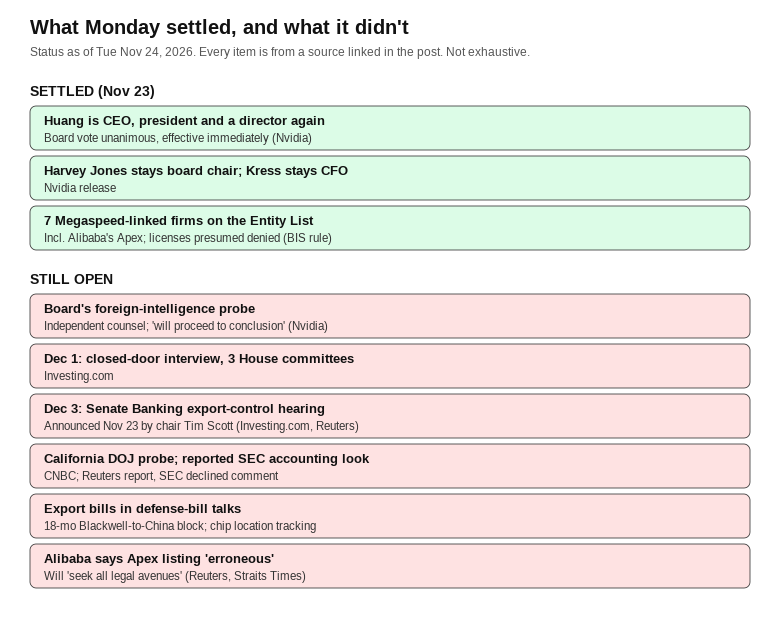
- Still open (fact): The board's own investigation, a California DOJ probe, a reported SEC look at Nvidia's accounting, a Dec 1 House interview and a Dec 3 Senate hearing (CNBC, Investing.com).
- My take: The roadmap and the allocation desk get their decision-maker back, which matters more than people outside the industry think. But the thing that pushed Huang out, chips leaking to China through Southeast Asian clouds, is now being handled through regulators and Congress. Expect much tighter know-your-customer checks on anyone renting or reselling Nvidia capacity in Asia.
Quick jargon decoder
- Entity List: A Commerce Department blacklist. US companies (and foreign companies shipping US-origin tech) need a license to sell to anyone on it.
- Presumption of denial: You can apply for that license, but the default answer is no. In practice, a near-ban.
- "Items subject to the EAR": Basically anything covered by US export rules. Not just GPUs: servers, networking gear, and a lot of software and parts too.
- Cloud partner: A company Nvidia officially certifies to rent out its GPUs. Think "authorized dealer" for compute.
- KYC (know your customer): Checking who's actually on the other end of a sale. For GPUs, that means who ends up using them, not just who signs the purchase order.
What actually happened Monday
The board's statement is short, and every sentence has a job. Four things stand out to me:
- Government input was the stated basis. The board says it got input from "senior levels" of the US government. On CNBC, President Trump said he "convinced" the board and that Huang "did nothing wrong" (CNBC). Per CNBC, Trump also posted that the government "does not possess evidence that he has engaged in any unlawful conduct" (CNBC).
- The investigation keeps going. The committee of independent directors looking into whether Huang was "the target of a foreign intelligence effort" will "proceed to conclusion," and Huang says he'll cooperate (Nvidia).
- New compliance machinery. There's a new National Security and Export Control Committee made up only of independent directors. It's hiring national-security counsel, and Nvidia is searching for its first Chief Compliance Officer (Nvidia).
- What changed in six days? The statement doesn't say. Henley Business School's Nada Kakabadse put it bluntly to Reuters: "Two unanimous decisions in eleven days, pointing in opposite directions" (Reuters via Investing.com).
I'm leaving the personal side out, same as last time. What matters for this blog is that Nvidia's governance just got a lot more formal, and that the formal part is pointed squarely at export compliance.
The market round trip
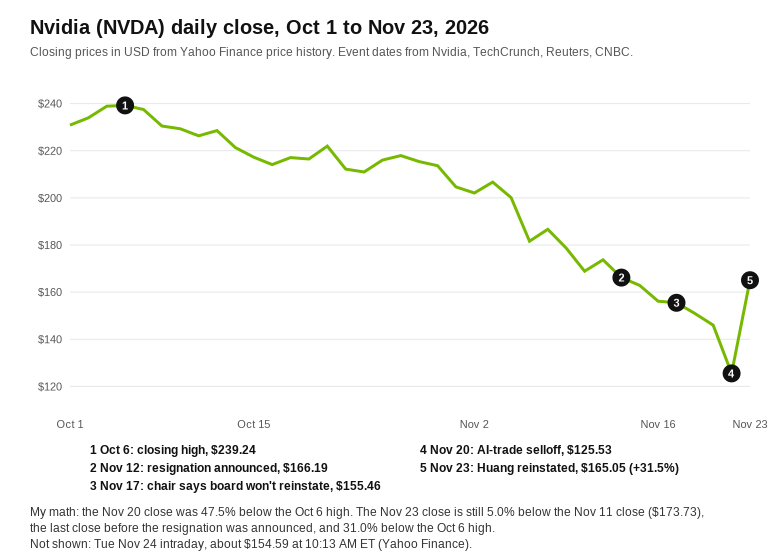
The chart above has the closing prices. Some quick math (mine, using Yahoo Finance closes):
- Peak to trough: $239.24 (Oct 6) to $125.53 (Nov 20) is -47.5%. That's the "lost 50% of its value or whatever the number was" Trump referred to on CNBC.
- Monday: $125.53 to $165.05 is +31.5%, which matches CNBC's 31.48%.
- Still not whole: $165.05 is 5.0% below the $173.73 close on Nov 11, the last close before the resignation was announced. It's 31.0% below the October high. Reuters made the same point: the gains "were not enough, however, to erase all losses since Huang's resignation" (Reuters).
The rest of the stack moved with Nvidia on Monday: CoreWeave +22.32%, Iren +23.86%, Nebius +20.28%, Dell +20.46%, Micron +19.04%, AMD +6.85% (CNBC). That tells you how much of Friday's meltdown was about Nvidia specifically.
Tuesday is cooling off. As of mid-morning ET, Nvidia was down about 6-8% and AMD, Broadcom, Micron and SK Hynix were all lower (Yahoo Finance). Traders also see a 95% chance of a 25 bp Fed hike in December (Yahoo Finance live). Plenty of what worried this market a week ago is still here.
The part that matters more for infrastructure: Megaspeed
The BIS rule adds seven entities:
- Malaysia: MSFusion, PT Megaspeed International, Speedmatrix
- Singapore: Apex Enterprise Solutions (Singapore), Megaspeed International, Swiftdata
- Thailand: Megaspeed (Thailand)
The stated reason is "significant risk" of their "being or becoming involved in the diversion of advanced computing commodities to unauthorized end uses or end users." Reuters says this is the first time Commerce has added anyone to the list since October 2025 (Reuters).
Three details stand out to me as an infrastructure person:
1. This was a certified Nvidia cloud partner. Megaspeed used its Alibaba relationship to get designated as an official Nvidia cloud partner, according to the Financial Times as cited by Reuters. US authorities say Nvidia put Megaspeed on a "no sell" list in June 2025 (Straits Times). That's the authorized-dealer channel going wrong, not a random black market.
2. The money was a capacity prepayment backed by the hardware. Apex paid about $4.2 billion to Megaspeed and other companies as a prepayment for computing capacity in Southeast Asia, and took some of their assets as a pledge, according to a person familiar with the matter cited by Reuters. That person said prepayments like this are common between data center companies and their customers. Speedmatrix pledged its entire business to Apex as collateral, according to the FT, and had about 8.8 billion ringgit ($2.14 billion) in assets at the end of 2024, according to corporate filings (Reuters). Speedmatrix pledged "specified IT and network equipment, intellectual property and related rights" under a June 18, 2024 agreement (Straits Times).
It's the same structure I wrote about with Nebius prepayments, just in a riskier place. A customer prepays, the operator builds, and the GPUs are the collateral. If the operator ends up on a blacklist, that collateral is a pile of hardware the operator can't easily get US-origin parts or service for. (My read of an EAR-wide license requirement, not something BIS spelled out for this case.)
3. Alibaba is fighting it. "Apex has never diverted advanced computing chips subject to US export restrictions," Alibaba said, adding it will "seek all legal avenues" (Reuters, Straits Times). Singapore's prime minister said Tuesday the country will continue its own Megaspeed investigation (Reuters).
China: the revenue line that's now under a microscope
Here's why Washington cares so much. Per Reuters, citing Nvidia's results, revenue from customers headquartered in China and Hong Kong went from $2.97 billion in the October 2025 quarter to $11.05 billion in the quarter ended Oct 25, 2026. My math: that's about 3.7x year over year.
Most of that isn't data center flagships. It's lower-power products, and the one to watch is the RTX PRO 5500, a professional card that can run AI models. Reuters says Chinese orders top 6 million units against expected global production of up to 3 million in 2027, at roughly $11,400 each. My math: 6M × $11,400 ≈ $68B, consistent with Reuters' earlier "nearly $70 billion at listed prices."
Now, two people told Reuters that some Chinese customers have started cancelling or holding off on orders because they worry the card won't be allowed into China. Reuters couldn't determine how many. Some US agencies are also discussing whether to extend restrictions to Jetson robotics chips, according to one person familiar (Reuters). That's still a discussion, not a rule.
And here's what's actually moving in Congress, per Investing.com:
- Warren and Banks: block Nvidia from selling Blackwell chips to China for at least 18 months.
- Warren and Cotton: require Nvidia chips sent abroad to have a tracking or location-security mechanism.
- Both, plus limits on chipmaking equipment, are in "final stages of negotiation" for the annual defense bill, which usually passes in December.
Lawmakers from both parties are also pushing the Chip Security Act, aimed at keeping legally exported chips from being diverted to China (Reuters). The politics shift in January too: Democrats won control of the House and Senate on Nov 3 (Reuters), and Bernstein's Stacy Rasgon says that could keep Huang and Nvidia in the "crosshairs" (CNBC).
What I think it means for people buying GPUs
Opinion section. Weigh accordingly.
1. The allocation desk has its decision-maker back. When supply is tight, Nvidia picks who gets Vera Rubin and when, and who it backs financially (see Nvidia the Cosigner). That runs through the CEO. Quilter Cheviot's Ben Barringer told Reuters the alternative risked Huang "taking some of Nvidia's best talent with him" (Reuters via Investing.com). For big buyers, Monday lowered the odds of a messy year of re-negotiated relationships.
2. Deal-making might slow anyway. Questar's Richard Reyle called Nvidia "kind of the central bank of the AI trade" and said scrutiny makes it "very difficult for them to have the same level of deal-making capacity" (CNBC). With a Chief Compliance Officer reporting to a board committee and a national-security committee watching, I'd expect slower and more lawyered paper on anything that touches Asia. That includes cloud partner certifications, financing backstops, and big prepay deals.
3. If you run GPUs in Southeast Asia, KYC just got real. A certified partner is now on the Entity List, and Congress is negotiating chip location tracking. Expect more end-user certifications, audit rights and possibly location attestations in contracts for capacity in Singapore, Malaysia and Thailand. If you rent there, ask your provider now how they'd prove where every GPU is and who's using it.
4. The leadership question could come back. StoneX's Cody Acree called the board investigation the "key risk." Any finding that "confidential information was shared" would "reopen the leadership question." He also thinks the government input "lowers the odds of an adverse finding" (CNBC). I agree it's lower. I don't think it's zero.
The low-key take: Monday wasn't a reset. Nvidia got its founder back, and in return its China and Southeast Asia business now runs under a lot more supervision. The roadmap is safe. The real question for 2027 is who gets to be on the other end of a GPU sale.
Next up
- Today after the close: Dell reports fiscal Q3. Investors are watching AI-server margins and memory costs, after server makers reportedly sought 25-45% price increases on already-agreed contracts (Yahoo Finance).
- Dec 1: Huang's closed-door transcribed interview with three House committees.
- Dec 3: Senate Banking hearing on export-control oversight (Investing.com).
- December: Whether the Blackwell block and chip-tracking language make it into the defense bill.
- Still on the list: Broadcom earnings Dec 9, Micron Dec 17.
Sources opened for this post: Nvidia release (Nov 23), Reuters: Huang returns (Nov 23), Reuters via Investing.com: market reaction and comments (Nov 23), Reuters: China business (Nov 23), Reuters via Investing.com: Megaspeed blacklist (Nov 23-24), BIS Entity List rule, Federal Register public inspection, Straits Times (Nov 24), CNBC: rally (Nov 23), CNBC: investigations aren't over (Nov 24), Investing.com: Dec 3 hearing (Nov 23), TechCrunch (Nov 17), Yahoo Finance (Nov 24), Yahoo Finance live (Nov 24), Yahoo Finance on Dell (Nov 24), and NVDA closes from Yahoo Finance price history. Not investment advice.