Nvidia Closed Its $1 Billion Naver Check. The Factory Behind It Is the Real Story
On Friday Nvidia paid 1.34 trillion won for a 4.13% stake in Naver, the last step in a deal that lets Brookfield own the GPUs and buildings while Naver Cloud runs the factory.
Tom Pechulis, , 15 min read
Yesterday I wrote about Nvidia hunting for old telephone buildings in the U.S., looking for somewhere it could still plug GPUs in. On Friday in Seoul, a different Nvidia move actually closed: not a building search, a $1 billion equity check.
Naver disclosed that Nvidia paid 1,341,199,957,500 won for 6,558,435 new common shares, a 4.13% stake that makes the chipmaker Naver's third-largest shareholder (Yonhap; Maeil Business; Newsworks). The interesting part is what that check was waiting on. Nvidia had said it would not close until Naver lined up at least $9 billion of separate infrastructure financing. That door opened on October 27, when Naver signed an agreement with Brookfield to fund the GPUs and data centers through a special-purpose company. Friday was the equity side catching up.
TL;DR
- What closed Friday: Naver received Nvidia's $1 billion subscription in full — 1,341,199,957,500 won for 6,558,435 new shares at 204,500 won each (my math, and the issue price in filing summaries of the Nov 6 DART disclosure). That is about 4.13% of Naver. The new shares are scheduled to list on November 27, and Nvidia has agreed not to sell them for a year (Maeil Business; Yonhap Infomax; kchipnews).
- Who sits where: Coverage of Friday's disclosure says Nvidia becomes Naver's third-largest shareholder, behind the National Pension Service and BlackRock (Newsworks; Maeil Business). An October 30 preview put those two at 9.49% and 7.31% as of August (Yonhap Infomax; Seoul Economic Daily).
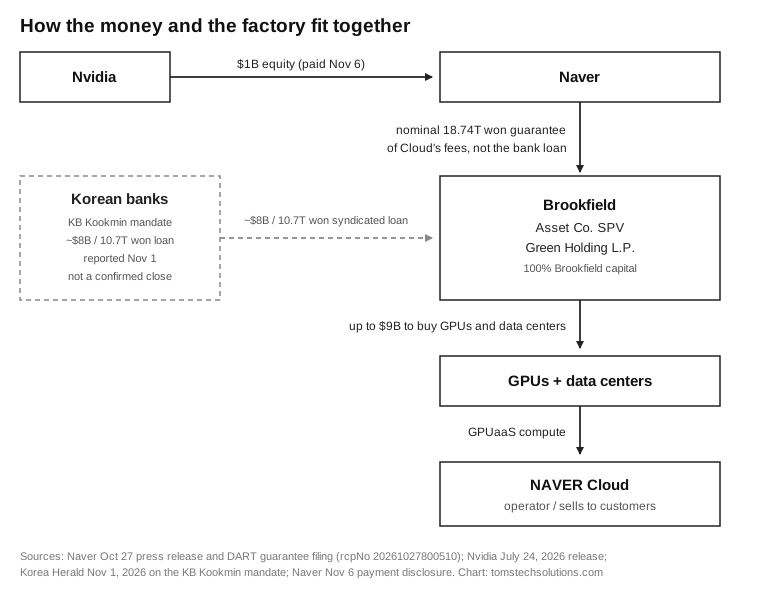
- What the check unlocked: A factory in which Brookfield's vehicle, tentatively called Asset Co., invests up to $9 billion to buy GPUs and data centers, then sells compute to NAVER Cloud, which operates the plant. Usage fees are tied to the business's revenue. Naver's press release described an up-to-eight-year payment guarantee; its October 27 filing puts the nominal amount at 18.74 trillion won, or 64.73% of Naver's equity, through as late as the end of 2034 if the full $9 billion is used, and says no payment was actually owed yet (Naver, Oct 27; DART guarantee filing via samara). That guarantee covers NAVER Cloud's supply fees, not a separate bank loan. On November 1, the Korea Herald reported that KB Kookmin has a mandate to lead a 10.7 trillion won (about $8 billion) syndicated loan for the Brookfield-backed project — a mandate, not a confirmed close.
- The accounting twist: Brookfield contributes 100% of Asset Co.'s capital, but Naver says the vehicle is still expected to be treated as a Naver subsidiary under Korean accounting rules because Naver is seen as controlling it (Naver, Oct 27; Korea Herald). This is not a clean disappearing trick for the assets.
- When the megawatts show up: Naver's October 27 fair-disclosure filing sets tentative targets of 55 MW in the first half of 2027, 100 MW by the end of 2027, and 200 MW in 2028, with a longer-term path to gigawatt-scale infrastructure centered on GAK Sejong (DART fair disclosure via samara; Naver, Oct 27). A Naver representative told Maeil Business the company plans to start generating revenue from that 55 MW in the first half of next year.
- My take: Nvidia is no longer just shipping chips and hoping someone else finds the building and the loan. It bought a seat at the operator, made a giant asset manager own the heavy iron, and still required the financing to be in place before it wired the equity. The money closed on Friday. The first 55 MW is still a 2027 story.
Quick jargon decoder
| Term | Plain English |
|---|---|
| Third-party allotment | A company sells brand-new shares to one chosen buyer, not to existing shareholders or the public. Here, Naver sold the new shares only to Nvidia. |
| SPV / Asset Co. | A separate company created to hold a specific pile of assets. Think of a box that owns the GPUs and buildings, so those assets are not sitting directly on Brookfield's or Naver's main balance sheet — though, as noted below, Korean accounting may still pull the box back onto Naver's books. |
| Usage fees tied to revenue | NAVER Cloud does not necessarily pay a fixed rent from day one. The bill can flex with how much money the factory business is making, which keeps the payment lighter while the plant is still ramping up. |
| Payment guarantee | If NAVER Cloud does not pay Asset Co., parent-company Naver promises to cover the bill. The press release said "up to eight years"; the filing runs as late as the end of 2034 and says each batch's payments last six years from when that batch starts. It is like co-signing a lease for your subsidiary. |
| Syndicated loan | A big loan split among several banks, with one bank leading the paperwork. KB Kookmin has a mandate to lead one of these for the factory; that is not the same as the loan already being closed. |
| K-IFRS consolidation | Korean accounting rules that decide whether you have to put another company's assets and debts on your own books. "Control" can matter more than who wrote the equity check. |
| DSX | Nvidia's bundled recipe for an AI factory: the chips, the servers, the software that runs them, and pieces of the building systems, designed so a customer is not assembling that stack from scratch (Nvidia, July 24). |
| GPU-as-a-service | Renting time on someone else's GPUs instead of buying the machines, the way you might pay for a hotel room instead of buying the hotel. |
| MW / GW | Megawatt and gigawatt, units of power. 1 GW = 1,000 MW. Fifty-five MW is a serious AI hall; a gigawatt is a giant campus. |
| Lock-up | A promise not to sell the new shares for a set time. Nvidia's is one year, so this is not a trading stake it can flip next week. |
What actually closed on Friday
The dollar figure was never a mystery. The suspense was the calendar.
Nvidia and Naver announced the planned $1 billion investment on July 24, during South Korean President Lee Jae Myung's AI Summit visit to San Francisco. Nvidia said the investment was subject to customary closing conditions and to Naver "finalizing at least $9 billion of committed financing for the project, separate from NVIDIA's planned investment." Brookfield, at that point, had only a nonbinding term sheet to fund up to $9 billion. Naver would "fund the remaining amounts."
That financing condition was the gate. On October 27, Naver said it had signed the $9 billion Brookfield agreement and had therefore met "the precondition for NVIDIA's strategic equity investment." On October 30 it disclosed that Nvidia's payment date would be November 6, moved from an earlier target of October 30, and that the new shares would list on November 27 instead of November 20 (Yonhap Infomax; Seoul Economic Daily).
Friday's filing is the payment landing. Summaries of Naver's voluntary disclosure (DART 20261106800553) and Korean business press match on the specifics (kchipnews; economyreports; Maeil Business):
- Subscriber: NVIDIA Corporation
- 6,558,435 new common shares
- 1,341,199,957,500 won received on November 6
- Issue price: 204,500 won a share, a 0% discount to a 204,276 won reference price (Heyholder summary of the Nov 3 amendment)
- Use of proceeds: new businesses related to the AI factory
- Listing scheduled for November 27
- One-year restriction on selling the new shares, via mandatory custody at the Korea Securities Depository (Heyholder; Yonhap Infomax)
Two details are easy to mix up, so I want to be precise. Some English reports, including Yonhap, phrase Friday as Nvidia already having "issued" or "acquired" the stake. The payment cleared on November 6; the shares are scheduled to list on November 27. And the share count is smaller than the October preview because the subscription was fixed in dollars. Early figures used a provisional 7,241,564 shares and about 1.48 trillion won; Naver reset the won amount and the share count on November 3 for the confirmed exchange rate, not because Nvidia shrank the $1 billion check (Yonhap Infomax; AIVS; economyreports). Filing summaries put that confirmed rate at 1,341.20 won per dollar. My math: 1,341,199,957,500 won ÷ $1 billion = 1,341.20 won per dollar, and 6,558,435 × 204,500 = 1,341,199,957,500 won exactly.
The 4.13% figure also checks out. Filing summaries put Naver's shares outstanding before the increase at 152,126,544 as of October 29 (AIVS; economyreports). My math: 6,558,435 ÷ (152,126,544 + 6,558,435) = 4.13%.
The factory the check was waiting on
If you only read the headline, this is "Nvidia bought 4% of Korea's biggest internet company." If you read the contracts, it is a three-party split of who owns the iron, who runs it, and who supplies the chips.
From Naver's October 27 release:
- Brookfield sets up a special-purpose vehicle, tentatively named Asset Co.
- Asset Co. invests up to $9 billion "to acquire AI infrastructure such as GPUs and data centers."
- It then provides that computing power to NAVER Cloud, "the AI factory operator."
- Naver and NAVER Cloud run the business, using the clusters and data-center know-how they already have.
- Nvidia collaborates on technology "centered on next-generation high-performance computing platforms such as DSX."
- Usage-fee payments are tied to business revenue, which Naver says should ease the early financial pressure of standing up a big plant.
- Naver will guarantee NAVER Cloud's usage-fee obligations for up to eight years. Naver's own wording is that the guarantee "in itself, does not result in actual cash outflows or cost burdens for NAVER." That is true until the guarantee is called. A co-signed lease does not cost you anything either, until the tenant misses rent.
The October 27 debt-guarantee filing is more specific than the press release, and it is the document I would underwrite against. Naver is guaranteeing NAVER Cloud's payments to Green Holding L.P. — a special-purpose vehicle of the Brookfield AI Infrastructure Fund — and to Asset Co. The listed guarantee amount is 18,740,000,000,000 won, against Naver equity of 28,953,013,365,595 won, or 64.73% of equity (the filing's own ratio; my math matches). The outer window is October 27, 2026 to December 31, 2034. The filing is careful about what that number is not: it is the nominal total of supply fees Naver Cloud would be expected to pay through the end of 2034 if the full $9 billion investment cap is used. As of the filing date, "no confirmed supply-payment obligation or other payment obligation" existed. Actual payment obligations run for six years from the start of each batch, GPU purchases happen "in phases by batch according to demand," and the total can move with the investment schedule, interest rates, exchange rates, and cost true-ups. Other items the guarantee also covers, such as damages or penalties, were left out of the 18.74 trillion won figure because they could not be estimated yet.
The Korea Herald, writing on the October 27 filing, added that NAVER Cloud will use a GPU-as-a-service arrangement and sell AI data-center services to outside customers. Korean coverage has often described the whole package — Nvidia's $1 billion plus Brookfield's up to $9 billion — as a $10 billion AI factory project. I would keep those as two separate piles: an equity check into Naver, and an "up to $9 billion" vehicle that buys infrastructure. The July announcement also said Naver itself would fund whatever is left, so $1 billion + $9 billion is not obviously the entire bill.
There is also a bank-debt layer that is easy to miss if you only read the equity headline. On November 1, the Korea Herald reported that KB Kookmin Bank had secured a mandate to lead a 10.7 trillion won (about $8 billion) syndicated loan for the Brookfield-backed project that will supply NAVER Cloud. The bank called it South Korea's first GPU financing and its largest-ever syndicated-loan arrangement. The Herald said the loan is part of a project valued at about 13 trillion won, that other Korean banks and securities firms were participating without naming a final lender list or terms, and — this matters — that Naver's guarantee does not cover the syndicated loan itself. A mandate is not the same thing as a closed loan, so I would not treat the 10.7 trillion won as money already in Asset Co.'s account. It does tell you how Brookfield's "up to $9 billion" is likely to be funded: not as a single equity check from an asset manager, but as a vehicle that can borrow against long-term compute contracts.
On Friday, the same day Nvidia's payment posted, Seoul Economic Daily reported that Brookfield described the $9 billion agreement as financing more than 200 MW of Nvidia GPU infrastructure "across multiple data centers" in Korea, with Brookfield owning the assets directly and NAVER Cloud taking the entire computing capacity under a long-term contract. Brookfield, in that account, called it the largest sponsor-led private investment ever made in South Korea and its first AI computing-infrastructure investment in the country. I could not open a Brookfield.com copy of that statement, so I am relying on Seoul Economic Daily's report of what Brookfield said, not on Brookfield's own webpage.
Sikander Rashid, Brookfield's global head of AI infrastructure, said the ability "to deliver capital and computing capacity at scale to meet rising demand will be more critical than ever" (Seoul Economic Daily). That is the quiet point of this structure. The scarce inputs are no longer just GPUs. They are someone willing to own the GPUs and the building for a long time, and someone credible enough to run them.
The twist: Brookfield writes the check, Naver may still book the box
Here is the part that would be easy to skim past.
Naver's October 27 note says that even though Asset Co. "will be established with 100 percent of its capital contributed by Brookfield, it is expected to become a subsidiary of NAVER because NAVER is recognized as having control under the Korean International Financial Reporting Standards (K-IFRS)." The Korea Herald made the same point: the vehicle is expected to land in Naver's consolidated financial statements.
In plain English, Brookfield puts up the money and, according to Friday's Brookfield comments, owns the assets. Naver still expects to treat the box as its subsidiary because it controls the operation. That can pull the assets — and the related obligations — onto Naver's books even though Naver did not write the $9 billion check.
I wrote last week about Nvidia co-signing customer debt so a neocloud could borrow against a data center. This is a different tool in the same drawer. There, Nvidia was talking about guaranteeing someone else's construction loan. Here, Nvidia bought equity in the operator, Brookfield's vehicle bought the iron, and Naver co-signed its own subsidiary's usage fees. Three balance sheets, one factory.
Whether that is "capital light" for Naver depends entirely on how the accountants treat Asset Co. Naver is telling you, up front, that it may not stay off the group's books.
What you get for the money, and when
The capacity plan has been consistent since the summer, which is worth something in a market full of moving gigawatt slogans.
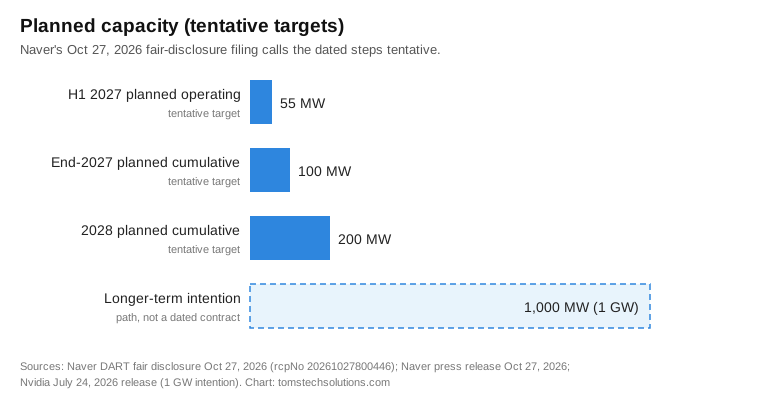
Naver's October 27 fair-disclosure filing is the most detailed public schedule, and it labels the dates as tentative targets that can move. It plans 55 MW in the first half of 2027, 100 MW cumulative by the end of 2027, and 200 MW cumulative in 2028, then a gigawatt-scale build whose specific timetable is still "under discussion." The same filing says Naver will lead site selection, construction, and operations, Nvidia will be the GPU supplier, and the first hub is the hyperscale data center GAK Sejong (각 세종), with later phases aimed at the rest of Asia-Pacific, Europe, and the Middle East. GAK Sejong is Naver's own large data center in Sejong, a planned city south of Seoul — not a rented hall in someone else's building. The October 27 press release matches the 55 MW and 200 MW steps and the Sejong hub, without spelling out the 100 MW year-end 2027 waypoint. The Korea Herald, citing the company, has said the expanded Sejong facility is expected to house about 100,000 Nvidia GPUs. I have not seen that GPU count in the filings I opened, so I am treating it as reported by the Herald rather than as a figure I can check against a primary table.
The July 24 announcement framed that 200 MW as more than tripling a 55 MW DSX buildout, called the plant a multi-tenant "NVIDIA DSX AI factory," and said Naver "intends to expand its deployment of NVIDIA AI infrastructure to 1 gigawatt." It also said the 200 MW factory is expected to feature Vera Rubin and Blackwell platforms. Friday's payment disclosure did not repeat chip SKUs, so I am treating Rubin and Blackwell as the summer plan, not as a new confirmation that landed with the wire transfer.
Two calendars are now running in parallel. The equity calendar is almost done: payment on November 6, listing on November 27, a one-year lock-up behind that. The megawatt calendar does not start until the first half of 2027, and the 200 MW step is 2028. My math, against the 1 GW ambition: 55 MW is 5.5%, 100 MW is 10%, and 200 MW is 20%. The headline numbers are large. The first revenue Naver is pointing to is a 55 MW hall in the first half of next year.
What I think
- The structure is the story, not the stake. A 4.13% holding does not let Nvidia run Naver. It does give Nvidia a long-term seat next to Korea's largest internet company, with a one-year lock-up that says this is a partnership stake rather than a trade. The operational design is more interesting: an asset manager owns the GPUs and the buildings, a local operator runs them and sells the compute, and the chip vendor is both the supplier and a shareholder.
- Nvidia used the $9 billion as a tripwire. It told the market in July that its own $1 billion would not close until Naver had committed financing in place. That is a more careful posture than "we will figure out the campus later." It is also another data point that Nvidia's growth now depends on other people's ability to raise and deploy infrastructure capital, not just on shipping more accelerators.
- Do not call this off-balance-sheet and walk away. Naver's own K-IFRS note is the tell, and so is an 18.74 trillion won guarantee equal to about two-thirds of the parent company's equity. If Asset Co. consolidates, Naver may show a much larger infrastructure footprint than the "$1 billion in, Brookfield pays for the rest" headline implies. The guarantee also does not backstop the bank loan, which means lenders are being asked to underwrite NAVER Cloud's ability to keep paying for compute, not a residual value on used GPUs. Watch the next set of financial statements, not just the press releases.
- "Up to $9 billion" is not $9 billion in the bank tomorrow. The agreement is a ceiling, the GPU buys happen in demand-driven batches, and the KB Kookmin facility was reported as a mandate rather than a closed syndication. The halls and the overseas sites still have to be bought, built, and turned on. Seoul Economic Daily's account of multiple Korean data centers is broader than Naver's "GAK Sejong as the core hub" language; both can be true if Sejong is the first hall and later halls follow. I would wait for named sites before underwriting a multi-campus map.
- This is the other answer to yesterday's question. In the U.S., the fight is over permits, neighbors, and who pays for the grid. In Korea, a national "sovereign AI factory" is being financed by a Canadian asset manager and a U.S. chip company, run by the local internet incumbent, and aimed at domestic and overseas customers. Different politics. Same underlying problem: someone has to own the iron for a long time.
What I'm watching
- CoreWeave on November 10 and Nebius on November 12, which I flagged yesterday. Funding costs and delivery dates are the other half of this market; Friday's close is what a funded factory looks like on paper.
- November 27. Do the new shares list on schedule?
- Named halls beyond GAK Sejong, in Korea or overseas. Naver has mentioned expanding into Asia, Europe, and the Middle East (Maeil Business). A city and a megawatt number would turn that from a slide into a project.
- The first 55 MW in the first half of 2027. That is the first date that tells you whether this structure turns capital into compute, or just into a well-designed press release.
- How Naver books Asset Co. If the vehicle shows up as a subsidiary, the "Brookfield owns it, we just operate it" story gets a lot more complicated, and a lot more interesting.