Nvidia Pulls the Brake Itself: Why AI Servers Stopped Shipping to Four Southeast Asian Countries
Nvidia has reportedly told Dell, Supermicro and other partners to stop shipping servers to Malaysia, Singapore, Thailand and Indonesia while it sorts out compliance with the new US rule. Here's what the pause actually covers, why Singapore's huge revenue number is mostly paperwork, and who really feels it.
Tom Pechulis, , 8 min read
Yesterday's post ended on the loan book. Today the story moved one step up the supply chain: the chips themselves stopped moving.
On Thanksgiving, the Financial Times reported that Nvidia told its manufacturing partners to stop shipping servers with its chips to Malaysia, Singapore, Thailand and Indonesia. Partners like Dell and Supermicro told buyers in those countries that Nvidia "would not allow their orders to be shipped" (Reuters via Investing.com, Nov 26). The Wall Street Journal reported the same instruction and said the pause is for "an unspecified period" while Nvidia checks whether its regional partners meet US export rules (TechCrunch, Nov 26).
This is the follow-through on the remote-access rule and the Megaspeed blacklisting. The difference: this time it's Nvidia turning the tap off, not Washington.
TL;DR
- What happened: Nvidia reportedly paused server shipments to four Southeast Asian countries. Nobody knows yet if it's temporary. Nvidia, Dell and Supermicro haven't commented publicly (Reuters, DCD).
- Why: A US rule in force since Nov. 19 requires a license to ship advanced chips to Indonesia, Malaysia, Singapore, Thailand and Brazil (Federal Register). Nvidia seems to be checking its own sales channel before regulators do it for them.
- Not confirmed everywhere: Singapore's Deputy Prime Minister Gan Kim Yong said this morning, "We have not confirmed it" (Lianhe Zaobao, Nov 27).
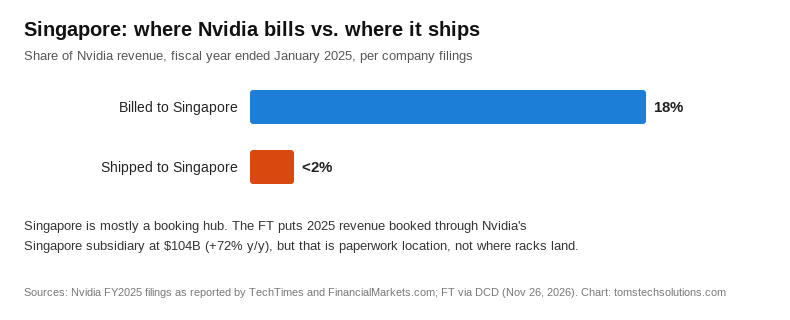
- The scary number is mostly paperwork: Nvidia booked $104B of 2025 revenue through its Singapore subsidiary, per the FT (DCD), but in its fiscal 2025 filings Singapore was 18% of revenue by billing address and under 2% by actual shipments (TechTimes).
- Who really feels it: Malaysia's data center boom (and its stocks), lenders to non-US operators, and server makers who need those racks to ship to book revenue.
What the pause covers, and what it doesn't
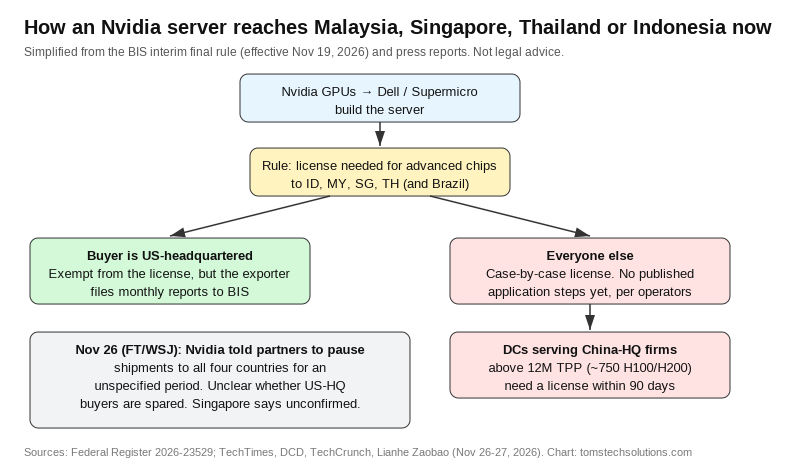
The rule behind all of this is the Commerce Department's interim final rule, effective Nov. 19, 2026. Two pieces matter here (Federal Register):
- A country license. Exporting or transferring advanced AI chips to or inside Indonesia, Malaysia, Singapore, Thailand or Brazil now needs a license, reviewed case by case. BIS calls these countries a "higher-than-normal risk of diversion." (Diversion = chips quietly ending up in China.)
- A remote-access license. Data centers that rent compute to companies headquartered in China, Macau or other embargoed places have 90 days to get a license if they want to keep doing it. The trigger is 12 million "TPP" (total processing performance, the rule's compute yardstick), which a TechCrunch writer pegged at roughly 750 H100 or H200 GPUs (TechTimes).
There's a carve-out: buyers headquartered in the US (or with a US parent) are exempt from the country license, as long as the exporter files monthly reports to BIS (Federal Register). Think of it as a fast lane with a toll booth: a US hyperscaler's subsidiary in Johor can still get gear, but every box gets logged (The Rakyat Post).
What we don't know, and this matters:
- How long. Neither the FT nor the WSJ gave a timeline (TechTimes).
- Whether US-headquartered buyers are paused too. The reports don't say (TechTimes). If hyperscalers are spared, this is a much smaller deal.
- Brazil. It's covered by the rule but isn't named in the halt reports.
- How to apply. Regional cloud execs say Washington set the 90-day clock without publishing instructions on how to get the license (The Rakyat Post).
My read: this looks like Nvidia self-policing. Its CEO just came back from a scandal tied to a Singapore cloud company now under investigation, and S&P put its AA rating on watch a day earlier, citing governance (FinancialMarkets.com). The cheapest move is to freeze the channel and re-vet customers. That fits with Nvidia already cutting more than half its authorized Asian buyers in July after adding a customer whitelist and inspecting data centers in the region (TechTimes).
Why Washington cares about this corner of the map
The short version: renting is the new smuggling. Chinese firms can't import top GPUs, but until last week they could legally rent them in a data center next door.
The Institute for Progress (IFP) estimates China will have about 4.6 million H100-equivalents of AI compute by the end of 2026, and that about 1.05 million of that comes from remote access to overseas data centers, about 75% of it in Southeast Asia (IFP, Oct 19). The WSJ cited IFP at about 24% of China's AI compute (TechCrunch); I get ~23% from IFP's central figures (my math: 1.05M / 4.6M). Same ballpark.
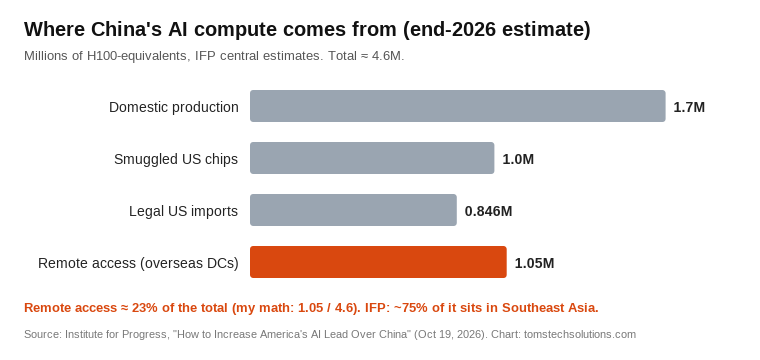
So remote access is roughly as big as smuggling, and bigger than everything China legally imported. That's why the rule exists, and why Nvidia can't afford to be the company whose servers keep showing up in the wrong places.
The Singapore number, decoded
You'll see "$104 billion" in a lot of headlines. The FT, citing Nvidia's company accounts, says that's how much revenue Nvidia booked through its Singapore subsidiary in 2025, up 72% (DCD). That sounds like a fifth of Nvidia is about to vanish. It isn't.
Singapore is where a lot of Nvidia invoices are sent, not where racks are installed. In the fiscal year ended January 2025, Singapore was 18% of revenue by billing location but under 2% by products shipped there (TechTimes, FinancialMarkets.com). When Nvidia last broke Singapore out (fiscal Q2 2026), it was about $10.2B, and Nvidia said more than 99% of the data center compute revenue billed there came from US customer orders, per TokenPost's read of the filings.
Nvidia now reports revenue by the customer's headquarters instead, and Southeast Asian customers sit in an "Other" bucket that was just $1.6B, about 1.4% of last quarter's $115.8B (TokenPost). Thailand's deputy PM said US chips in the categories under review are "about 0.7% of Thailand's total chip imports" (24/7 Wall St.).
Bottom line: for Nvidia's P&L, the direct hit looks small. Demand is still bigger than supply, so a box that can't go to Johor can probably go to Texas. The bigger risk for Nvidia is reputational and regulatory, not revenue.
Who actually eats it
Malaysia. This is ground zero. Malaysia has approved about RM385.7B of data center and AI infrastructure investment since 2021 (The Rakyat Post). In just the first nine months of 2026, data center and cloud projects were RM123.5B, 35.2% of all approved investment in the country (Straits Times). The country has 117 data centers with a combined max power demand of about 23,500 MW, per the trade minister (Straits Times).
The market noticed. On Thursday, YTL Power, Nvidia's AI cloud partner in Johor, fell 10.4% to RM3.54, even though the broader KLCI rose more than 1.2% (The Rakyat Post). YTL has called reports that Megaspeed's Malaysian unit ran Nvidia chips at its Johor site for Alibaba "completely untrue" (The Rakyat Post).
The capital markets are already hesitating. DayOne and Firmus Grid have put IPO plans on hold, and AirTrunk postponed a US$1.5B Singapore REIT (Straits Times). One unnamed Shanghai-based source told the Straits Times that up to half of signed future capacity in Southeast Asia "may not happen." That's one anonymous voice, so treat it as a worst case, not a forecast.
Lenders. A KL banker told the Straits Times his bank is reviewing its exposure and putting new deals on hold, and expects three to six months before things get clearer (Straits Times). That lines up with the ~$500M Aolani loan freeze I wrote about yesterday (TechTimes).
Server makers. Dell just reported $54.9B of quarterly revenue, $22.0B of AI server revenue, and a record $132.3B AI backlog (Dell). Backlog only turns into revenue when racks ship, and Dell hasn't broken out its Southeast Asia exposure (24/7 Wall St.). Supermicro said Asia was 6% of revenue last quarter, with no country split (24/7 Wall St.). Both stocks were already down about 30% in November before this news (24/7 Wall St.), and neither had traded in the US on it as of this morning.
Nvidia's stock? Shrugging so far. Shares were up about 4% premarket, near $155, after closing Wednesday at $149.30 (FinancialMarkets.com). Markets close early today at 1 p.m. ET.
What I think
- It's a pause, not a ban, for now. Everything in the reporting points to compliance homework: re-vetting partners, figuring out who's US-headquartered, setting up monthly reporting. If US hyperscalers get their gear in a few weeks, the real impact lands on independent and China-facing operators. Which is exactly who the rule targets.
- The cost moves to the order desk. Under this rule, the company shipping the server has to know where it ends up (TechTimes). That turns Dell and Supermicro compliance teams into the front line. Expect slower deliveries and more paperwork for everyone in the region, even clean buyers.
- Southeast Asia splits in two. Data centers with US tenants keep growing (DayOne, for example, says four of its five largest customers are non-Asian, including Oracle, per the Straits Times), maybe even faster as they pick up stranded capacity cheap. Sites that were built around ByteDance or other Chinese renters get repriced, refinanced or sit empty. Same country, two very different credit stories.
- For Nvidia, the number to watch isn't Singapore revenue. It's whether BIS actually grants licenses before mid-February. Quick approvals and this is a speed bump. Slow or no approvals and it turns into a permanent loss of the China rental market, which IFP estimates at roughly $7.8B a year in rental spend (IFP). Meaningful for neoclouds, a rounding error for Nvidia.
Next up
- Dec. 1: Jensen's closed-door House interview with three committees (TechTimes).
- Dec. 3: The date Senate Banking asked him to appear; no date has been confirmed yet (TechTimes).
- Any statement from Nvidia on how long the pause lasts and whether US-HQ buyers are exempt.
- Jan. 19, 2027: Comment deadline on the rule (TechTimes). ~Feb. 17, 2027: End of the 90-day license window (my math from the Nov. 19 effective date).
Sources opened for this post: Reuters via Investing.com (Nov 26), DCD (Nov 26), TechCrunch citing WSJ (Nov 26), The Verge (Nov 26), TechTimes (Nov 27), Lianhe Zaobao (Nov 27), Federal Register interim final rule, Institute for Progress (Oct 19), The Rakyat Post (Nov 26), Straits Times (Nov 25), 24/7 Wall St. (Nov 27), Dell Q3 FY27 release (Nov 24), FinancialMarkets.com (Nov 27), TokenPost (Nov 17). The FT and WSJ stories are paywalled; I'm relying on the summaries above. Not investment advice.