The Remote-Access Rule Hits the Loan Book: Frozen Asian GPU Deals and a Wave of B300s for Sale
A week after Washington's remote-access rule took effect, the bill is landing on lenders. About $6.5B of GPU-backed loans in Southeast Asia are stuck, a ByteDance-linked deal is described internally as dead, and sellers are shopping thousands of B300s. Here's how the rule works, why the trigger is so low, and the math on who eats the loss.
Tom Pechulis, , 9 min read
Happy Thanksgiving. Markets are closed today, which makes it a good morning to look at a story that moved slowly all week and then all at once: the new US rule on remote access to AI chips has stopped being a policy story and become a credit story.
On Wednesday, Bloomberg reported that lenders "have hit the brakes on billions of dollars in loans" tied to ByteDance, Alibaba and Tencent, and that banks trying to sell down their exposure "are struggling to find interested buyers" (Bloomberg, Nov 25). The same day, CNBC reported that an "unusually high volume" of Nvidia GPUs has been put up for sale since the rule was announced, including deals for thousands of B300s (CNBC, Nov 25).
Last week I went through the BIS license paper trail for China and then Jensen's return and the Megaspeed blacklisting. This is the follow-through: what happens to the people who financed the GPUs.
TL;DR
- The rule: Since Nov. 19, a data center anywhere in the world needs a US license if it gives China-headquartered companies access to more than 12 million "TPP" of compute (Federal Register). That's only about 750 H200s or 42 Vera Rubins (CSIS), and roughly 200 B300s by TechTimes' estimate (TechTimes).
- The money: GPU-backed loans in Southeast Asia totaling slightly over $6.5B are now under review, per IFR, and one banker expects financing there to slow "for at least six to 12 months" (IFR).
- The casualty list: A $480M loan for GB300 racks rented to ByteDance has been frozen, and some bankers internally call it "dead" (Business Times/Bloomberg).
- The hardware: Sellers are shopping B300s meant for Chinese tenants (CNBC). One index shows B300 rental prices down 7% in a month (TNW citing Bloomberg).
- My take: This isn't a demand collapse. It's a customer problem. The GPUs are fine. The contracts behind them aren't. The question for every lender is the same one: if the tenant can't legally use the chips, what's the collateral worth, and who eats the gap?
Jargon decoder
- Remote access: Renting compute over the internet from a data center in another country. A Chinese company can't buy a top Nvidia chip, but until now it could often rent one sitting in Malaysia.
- TPP (total processing performance): The government's yardstick for chip horsepower. BIS defines it as 2 × the chip's trillions of operations per second × the bit length of the math, per TechTimes' walkthrough. Think of it as horsepower for export law.
- Offtaker: The customer who signs a long contract to rent the capacity. In a GPU loan, the offtaker's payments are what repay the bank.
- DSCR (debt-service coverage ratio): Cash coming in divided by loan payments due. 1.15x means $1.15 of income for every $1.00 owed.
- Neocloud: A newer GPU rental company, as opposed to AWS, Azure or Google.
What the rule actually does
The interim final rule, published Nov. 19 and effective the same day, does two things (Federal Register):
- A worldwide remote-access test. You can't knowingly export chips to a data center that will give more than 12,000,000 aggregate TPP to companies headquartered (or whose parent is headquartered) in Macau or Country Group D:5, which includes China. The count is aggregated across "linked data centers," which explicitly includes "digitally-linked" sites, not just buildings next to each other. Commercial recommender systems (the stuff that picks your next video or product) are carved out.
- Five new license countries. Advanced chips going to or within Indonesia, Malaysia, Singapore, Thailand and Brazil now need a license, because the government sees them as higher diversion risk (Federal Register). US-headquartered buyers there are exempt if the exporter files monthly reports (CSIS).
Two details make this bite on existing deals, not just new ones. Data centers already serving China-linked customers have 90 days to get a license or stop (Federal Register). By my math, 90 days from Nov. 19 lands on Feb. 17, 2027. And because the rule controls the end use of the hardware, it reaches chips that were already exported (CSIS).
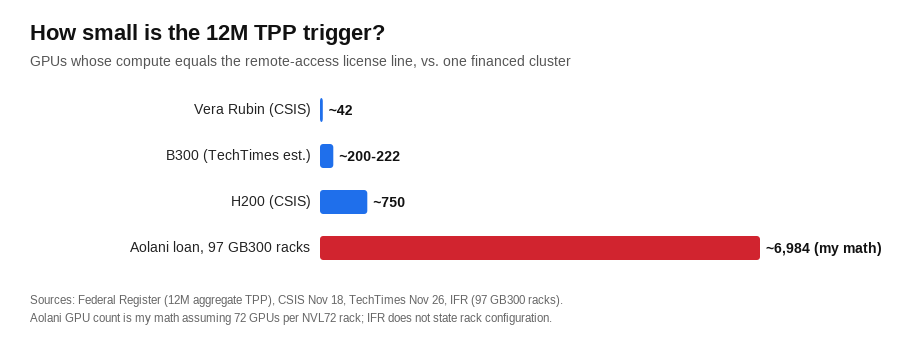
That threshold is tiny next to the clusters being financed. CSIS calls it "low by data center numbers" (CSIS). For scale, take the Aolani deal below: IFR says it finances 97 racks of Nvidia GB300 servers (IFR). If those are standard 72-GPU NVL72 racks (my assumption, IFR doesn't say), that's 97 × 72 = ~6,984 GPUs, or roughly 35x the ~200-GPU line (my math, using TechTimes' B300 estimate). There's no "trim it a little to stay under" option at that size.
Where the money is stuck
Here's what has been reported as frozen, delayed or under review:
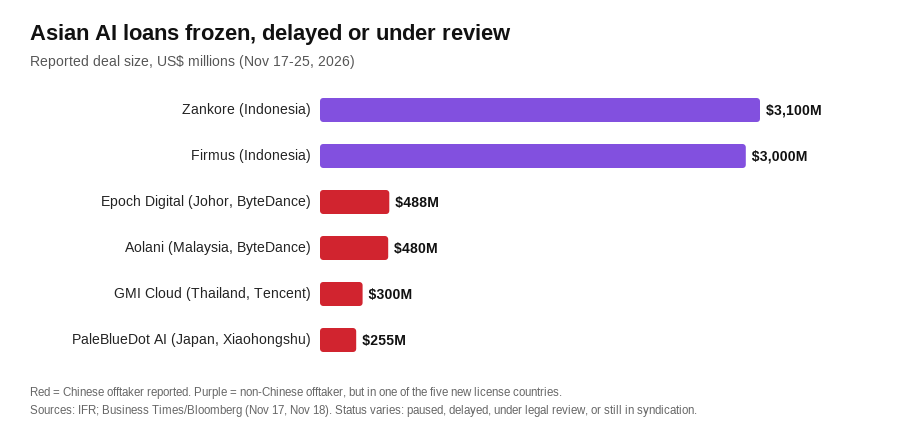
- Aolani, $480M (Malaysia, ByteDance offtake). Five lenders discussed pulling out; DBS is lead arranger (Business Times/Bloomberg). Per IFR, the facility is sized to a 1.15x DSCR with the GPUs pledged as collateral (IFR).
- Firmus, $3B (Indonesia) and Zankore, $3.1B (Indonesia). Neither is reported as China-linked, but Indonesia is one of the five new license countries, so lenders are still working through it. Zankore is also waiting on details of a proposed Nvidia backstop (IFR).
- Epoch Digital, $488M (Johor, ByteDance offtake). Not a GPU loan, it funds the building. The Nov. 30 commitment deadline is expected to be pushed back (IFR).
- GMI Cloud, $300M (Thailand, Tencent). The proposed term sheet would force full early repayment if Tencent lands on a US restricted list (Business Times/Bloomberg).
- PaleBlueDot AI, $255M (Japan, Xiaohongshu). Japan isn't one of the five countries, but a lender is getting legal opinions anyway, including on whether a change in law could trigger mandatory prepayment (Business Times/Bloomberg).
The deals "in the market" that IFR counts (Firmus, Zankore, Aolani) add up to $6.58B by my math, which matches IFR's "slightly over US$6.5bn." For context, Asia-Pacific data center companies have raised about $49B in loans since 2023, per Bloomberg data (Business Times/Bloomberg).
The quote that sums it up came from a UC Berkeley Haas professor: "The headline is about chips, but the bill lands on the lenders" (Business Times/Bloomberg). And from a senior loan banker in Singapore: "No one would be brave enough to consider committing US$100m, even for a non-Chinese offtaker... until the rules are clearer" (IFR).
Why GPU loans are more fragile than building loans
This is the part I find most interesting, and it's the same capital-stack question from my Applied Digital vs. ING post.
A building loan is backed by a shell, power and a long lease. If a tenant walks, you find another tenant. Painful, but the asset still works. A banker at a Chinese bank put it plainly to IFR: a data center operator "might be able to claim compensation under the lease or find another tenant," but with a GPU loan, "banks may not be able to fund the purchase as structured" (IFR).
A GPU loan is backed by one customer's payments and a depreciating box of chips. Look at the Aolani structure:
- 1.15x DSCR means the cushion is thin. By my math, cash flow only has to fall about 13% (1 − 1/1.15) before income no longer covers the loan payment. That's like buying a house where the rent covers the mortgage with $150 a month to spare.
- If the offtaker (ByteDance) can't legally use the capacity, the cushion isn't 13%. It's potentially zero, and recovery falls back on what the GPUs fetch secondhand (IFR).
- By my math, $480M over ~6,984 GPUs (again assuming NVL72 racks) is roughly $69K of debt per GPU. Every dollar the resale price slips below that comes out of the lenders' pocket.
The fixes bankers are weighing, per IFR: swap to lower-spec chips to get under the threshold, find a non-Chinese offtaker, or get a license in time (IFR). Each has a catch. Lower-spec chips mean less revenue against the same debt. A new tenant means re-papering the deal. And a license is a case-by-case review with no promised timeline.
So where do the GPUs go?
To the US, mostly, if anyone takes them.
CNBC's sources say sellers began floating deals for thousands of B300s after the rule, and GPU Mart's president said one seller told them the sale was related to the rule (CNBC). TechTimes correctly flags that these are deals floated, not completed sales, and no prices or buyers were named (TechTimes).
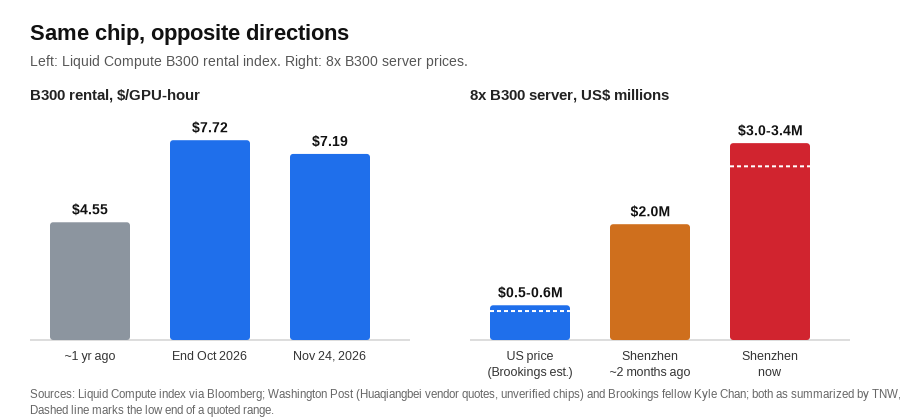
Liquid Compute's CEO told Bloomberg that Asia-Pacific neoclouds with Chinese offtakers "have excess capacity" and are "trying to broker it into the US." Its index had a B300 renting for $7.72/hour at the end of October and $7.19 by Tuesday, down 7%, versus $4.55 a year ago (TNW citing Bloomberg).
Two caveats keep me from calling this a glut:
- Not every tracker agrees. TechTimes cites a separate tracker with the median on-demand B300 at $9.50/GPU-hour as of Nov. 25, up about 20% over 90 days (TechTimes). Different windows, different methods.
- New supply is still tight. China Times reports new B300 orders take 26 to 40 weeks to arrive, per supply-chain sources (TNW).
Meanwhile, in China, the squeeze shows up the other way. The Washington Post found Shenzhen vendors quoting $3M-3.4M for an 8× B300 server, versus about $2M two months ago, and a Brookings fellow put the US price at around $500K-600K (TNW citing the Washington Post). The Post couldn't verify the chips on offer. By my math that's a 5-7x markup. That's the smuggling incentive in one number, and it's exactly why Washington wrote the rule.
So the same chip is getting cheaper to rent in the US and more expensive on the grey market in China. That's what a closed loophole looks like.
The governments are going along
Malaysia's trade minister said operators should comply, and that all 117 approved data center projects would be told to (CNA). Singapore's prime minister said, "We do not want Singapore to be used and abused as a conduit," per the FT as summarized by TNW (TNW). No one in the region is fighting this publicly. That matters for lenders: there's no local political fix coming.
And Nvidia had a rough Wednesday too
Nvidia fell 4% Wednesday as the post-Jensen-return rally faded (CNBC). S&P put Nvidia's ratings on CreditWatch negative over governance, citing board independence, oversight and succession, and said evidence of export violations or misleading China disclosures would weigh on its view. It also said Nvidia's competitive position and financials are unchanged for now (Investing.com). Nvidia declined to comment to CNBC on the GPU resales (CNBC).
What I think
- This is a counterparty shock, not a demand shock. Nobody stopped wanting B300s. A specific set of tenants lost legal access to them. Capacity gets reassigned at a lower price, and the people holding the loans take the haircut.
- The real loss is in thin-cushion GPU debt. Building loans with long leases bend. GPU loans at 1.15x coverage with one Chinese offtaker can break. Expect more early-repayment clauses like GMI Cloud's to become standard, plus higher pricing on any Southeast Asia GPU deal for a while.
- US renters get a small gift. If a few thousand B300s get redirected west, that's a modest tailwind for spot prices for buyers, and another headwind for neocloud margins, which already took a hit this week.
- Watch the 90-day clock. The real tell is how many licenses BIS actually grants before mid-February. If they come through, a lot of this unfreezes. If not, expect forced sales and restructurings in Q1.
Next up
- Dec. 1: Site visits for Epoch Digital's $488M Johor loan (IFR). A good read on whether lenders are still engaged.
- Jan. 19, 2027: Comment deadline on the rule (Federal Register).
- ~Feb. 17, 2027: End of the 90-day license window (my math from the Nov. 19 effective date).
- Any first public data on licenses granted, and whether those B300s actually find US buyers, and at what price.
Sources opened for this post: Federal Register interim final rule (Nov 19), CSIS (Nov 18), IFR, Business Times/Bloomberg on Aolani (Nov 18), Business Times/Bloomberg on Asian loans (Nov 17), Bloomberg (Nov 25, takeaways only; paywalled), CNBC on GPU sellers (Nov 25), CNBC on the tech selloff (Nov 25), TNW summarizing Bloomberg, FT and the Washington Post (Nov 25), TechTimes (Nov 26), CNA/Reuters (Nov 18), Investing.com on S&P (Nov 25). FT and Washington Post details come via TNW's summary; I didn't read the originals. Not investment advice.