OpenAI Rents 457 MW of AMD From a Neocloud: The TensorWave Deal, Decoded
TensorWave signed a six-year deal to run 457 MW of AMD MI455X capacity for OpenAI, starting in the first half of 2027. No price was disclosed. Here's what 457 MW buys, how neocloud deals actually get financed (with Corvex's $103M contract as a worked example), and why it lands the day before Nvidia reports.
Tom Pechulis, , 11 min read
The day before Nvidia reports, OpenAI's newest compute deal is for AMD chips. TensorWave, an AMD-only GPU cloud based in Las Vegas, signed a six-year agreement to run 457 MW of AMD Instinct MI455X capacity for OpenAI (TensorWave release via Business Wire). That's a company that, five months ago, said it had 8,192 AMD GPUs online. Now it's promising capacity that, by my rough math below, could hold as many as ~134,000–146,000.
The interesting part isn't "OpenAI likes AMD." We knew that a year ago. The interesting part is who builds it, how it gets paid for, and what we still don't know. TensorWave disclosed no price at all.
TL;DR
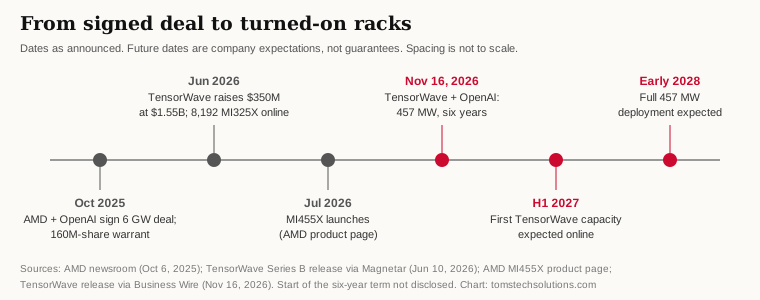
- The deal: six years, 457 MW of IT capacity across multiple U.S. sites, built for AMD's 72-GPU Helios racks with MI455X GPUs. It's dedicated to OpenAI alone. First capacity is expected in the first half of 2027, and all of it by early 2028 (release).
- Where it fits: it's part of the 6 GW AMD–OpenAI deal from October 2025, not on top of it. TensorWave is the first neocloud publicly named as a builder for that deal.
- What it buys (my math): at the 225–245 kW per Helios rack StorageReview reported, 457 MW is at most about 1,900–2,000 racks, or ~134,000–146,000 GPUs. Treat that as a ceiling.
- What's missing: price, sites, take-or-pay terms, who owns the GPUs, and how TensorWave (last valued at $1.55B) pays for a buildout this big.
- The pattern: a small deal announced today by Corvex shows how neoclouds get paid for. The customer prepays, a lender takes the GPUs as collateral, and the neocloud puts in a sliver of equity. I'll walk through it below.
- My take: this is OpenAI building a second supply chain for GPUs, one neocloud at a time. It doesn't hurt Nvidia's quarter tomorrow. It's about who gets the 2027–2028 orders.
Quick jargon decoder
| Term | Plain English |
|---|---|
| Neocloud | A newer company that rents out GPUs as a service (CoreWeave, Nebius, TensorWave, Corvex). Not Amazon, Microsoft or Google. |
| MW of IT capacity | Power available to the computers themselves (chips, memory, networking). The whole building draws more, because cooling and power conversion use extra. |
| Single-tenant | The whole buildout serves one customer. Like leasing an entire apartment building to one company instead of renting units one at a time. |
| Take-or-pay | The customer pays for reserved capacity whether it uses it or not. Like a gym membership you pay for even when you skip the gym. |
| Helios | AMD's rack-scale system: 72 MI455X GPUs wired together to act like one big computer. AMD's answer to Nvidia's NVL72 racks. |
| HBM4 | The newest stacked memory sitting right next to the GPU. More of it lets one GPU hold bigger AI models. |
| Non-recourse debt | A loan where the lender can only seize the equipment it financed, not the borrower's other assets. |
| Warrant | The right to buy shares at a fixed price later. AMD gave OpenAI warrants that only vest as OpenAI buys GPUs. |
What was actually announced
Straight from the release (also covered by Pulse 2.0):
- Six-year agreement for 457 megawatts of IT capacity "across multiple U.S. data center sites, powered by AMD Instinct MI455X GPUs." The headline says "more than 450MW"; the exact figure is 457.
- Purpose-built for Helios, with "high-performance Ethernet scale-out networking across racks."
- Dedicated, single-tenant capacity for OpenAI.
- Timing: capacity "expected to begin coming online in the first half of 2027, with the full deployment expected by early 2028."
- Context: it's "part of OpenAI and AMD's previously announced strategic partnership," and TensorWave is "the first neocloud publicly announced as an infrastructure provider supporting AMD and OpenAI's agreement." It's TensorWave's largest deployment to date.
OpenAI's CTO for Compute, Uday Ruddarraju, said the deal "will help us continue scaling AI to serve more people and organizations around the world." TensorWave co-founder Piotr Tomasik said the company is "helping deliver a meaningful portion of the infrastructure behind OpenAI and AMD's next generation of AI compute."
What was not announced: a dollar value, the site locations, a GPU count, whether the contract is take-or-pay, and who actually buys the GPUs. I'll come back to why that last one matters.
What 457 MW actually buys
A megawatt is a weird unit for a computer, so let's translate.
AMD hasn't published an official power rating for a Helios rack. StorageReview, writing up AMD's launch event, said a full rack "draws 225 to 245kW depending on workload" (StorageReview). Using that:
- Racks (my math): 457,000 kW ÷ 245 kW ≈ 1,865; 457,000 ÷ 225 ≈ 2,031.
- GPUs (my math): × 72 per rack ≈ 134,000 to 146,000 MI455X.
That's a ceiling, not an estimate. Some of the 457 MW will go to storage, network switches and other gear outside the GPU racks. The real GPU count will be lower, and TensorWave didn't give one.
What each GPU brings, per AMD's spec page:
- 432 GB of HBM4 with 23.3 TB/s of memory bandwidth.
- 40.3 PFLOPs of peak MXFP4 (4-bit) compute.
- Built on TSMC 2nm and 3nm, 320 billion transistors, liquid-cooled.
Per rack, AMD says Helios packs 72 GPUs, 31 TB of HBM4 and 18 EPYC "Venice" CPUs (AMD ROCm blog). The memory is the selling point. A chip with more memory can hold a bigger model, or serve more users at once, without splitting the work across as many chips. That's why TensorWave pitches itself as a cloud for "memory-intensive workloads."
For scale: in its June Series B announcement, TensorWave said it had 8,192 AMD MI325X GPUs online (Magnetar). By my ceiling math, this deal is roughly 16x to 18x that GPU count, on a newer chip. It's like a contractor who has built a few dozen houses signing up to build a small city in about 15 months.
Where this fits in OpenAI's chip plan
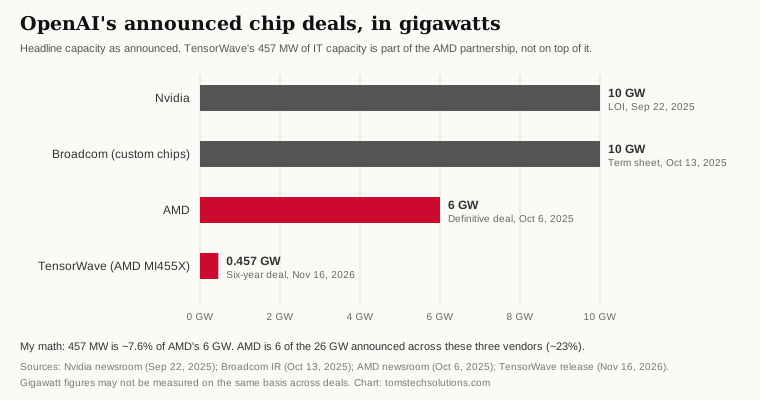
OpenAI has three headline chip deals:
- Nvidia, Sep 2025: a letter of intent for "at least 10 gigawatts," with Nvidia intending to invest up to $100B in OpenAI as each gigawatt is deployed (Nvidia).
- AMD, Oct 2025: a 6 GW definitive agreement, starting with 1 GW of MI450-series GPUs in the second half of 2026 (AMD).
- Broadcom, Oct 2025: 10 GW of OpenAI-designed custom accelerators, deployed from the second half of 2026 through the end of 2029, under a signed term sheet (Broadcom).
(Those are the headline numbers as announced. I'm not assuming the gigawatts are measured the same way across the three deals.)
By my math, AMD is about 23% of the 26 GW announced (6 ÷ 26), and TensorWave's 457 MW is about 7.6% of AMD's 6 GW. So this is one slice of the AMD bucket, not a new bucket.
The detail in AMD's filing that makes TensorWave matter. AMD gave OpenAI a warrant for up to 160 million AMD shares at $0.01. It vests in tranches as OpenAI buys GPUs, "by Warrantholder or its affiliates, or indirectly through third parties ('Authorized Purchasers')" (AMD 8-K). The first tranche vests after the first 1 GW of MI450-series GPUs is delivered. Full vesting needs 6 GW, plus AMD stock-price targets that escalate to $600 for the last tranche.
So the deal was designed from day one for someone else to buy the GPUs on OpenAI's behalf. Neither company said whether TensorWave is one of those "Authorized Purchasers," or whether this capacity counts toward the first gigawatt. If it does, OpenAI moves closer to free AMD stock every time TensorWave racks a Helios. That's a question for AMD's next 10-Q.
The neocloud math: how these deals get paid for
This is the SemiAnalysis-brained part. A neocloud's whole business is a spread. It borrows money to buy GPUs, rents them out under a long contract, and hopes the rent covers the loan, the power bill and the staff with something left over. TensorWave didn't give us its numbers. But Corvex, a smaller neocloud (Nasdaq: MOVE), published a full worked example this morning (Corvex).
Corvex's deal:
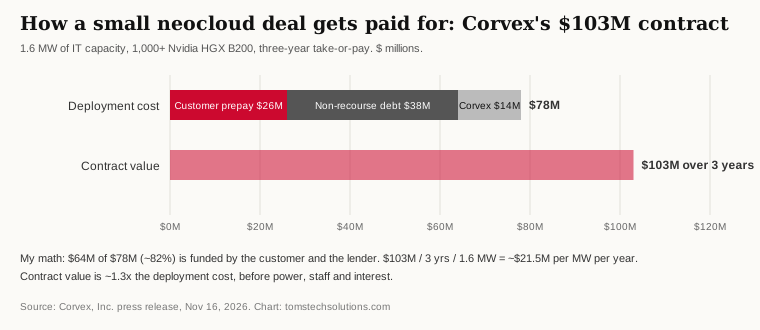
- Three-year, $103M take-or-pay contract with an unnamed "scaled AI inference platform."
- More than 1,000 Nvidia HGX B200 with InfiniBand networking, using 1.6 MW of IT capacity. Corvex says that's about $21M of annual contract revenue per megawatt.
- Cost about $78M, all-in: servers, storage, networking and spares.
- Who pays for it: a $26M customer prepayment plus $38M of three-year asset-backed debt from USD.AI that's non-recourse to Corvex. That's $64M, or more than 80%. Corvex funds the last $14M.
- Revenue starts by the end of Q1 2027.
My math on the unit economics:
- Revenue per MW: $103M ÷ 3 years ÷ 1.6 MW ≈ $21.5M per MW per year (matches Corvex's "approximately $21 million").
- Capex per MW: $78M ÷ 1.6 MW ≈ $48.75M per MW, covering servers, storage, networking and spares.
- Contract vs. cost: $103M ÷ $78M ≈ 1.3x, before power, staff and interest.
- Corvex's own money at risk: $14M of $78M, about 18%.
In plain English: the customer and the lender put up most of the money, the contract pays the loan back over three years, and Corvex's slice is small. The everyday version is a landlord who gets the tenant to pay the first year's rent up front, has the bank finance the rest, and puts down 18%. It works great as long as the tenant pays. If the tenant walks, the bank takes the furniture (the GPUs).
One CPU-side comparison. Not every AI compute deal is GPUs. In September, Akamai announced an $11.6B, seven-year commitment from Anthropic for cloud capacity to support Anthropic's "CPU workload" growth, with about $5.5B of related capex (Akamai). By my math, that's about 2.1x contract value over capex ($11.6B ÷ $5.5B), stretched across seven years instead of three. Akamai also issued Anthropic a warrant for up to about 5% of its stock. Again: the vendor gives the customer equity to win the contract. Same playbook as AMD and OpenAI.
What would TensorWave's deal be worth?
Nobody has said, so here's a sensitivity exercise, clearly labeled. This is not the deal's value.
If TensorWave charged the same ~$21M per MW per year as Corvex: 457 MW × $21M ≈ $9.6B a year, or about $58B over six years (my math). I'd bet the real number is different, for at least three reasons:
- Scale and buyer. A 457 MW single-tenant deal with OpenAI is a very different negotiation from 1.6 MW for an inference startup.
- Who owns the GPUs. If OpenAI or an affiliate buys the GPUs (that "Authorized Purchasers" language) and TensorWave mostly provides buildings, power and operations, TensorWave's revenue per MW would be far lower. It would look more like a data center lease than a GPU rental.
- Different chip, different cost. Helios racks and B200 servers don't cost the same per megawatt.
The point of the exercise is the order of magnitude. If TensorWave is buying the GPUs itself, this is a tens-of-billions-of-dollars buildout. That's against a company that raised $350M at a $1.55B valuation in June (Magnetar). That would mean a debt raise far larger than anything in TensorWave's history, and possibly support from AMD (whose venture arm co-led that round). Either way, the financing is the story I'm waiting for, and it wasn't in today's release.
Why it matters the day before Nvidia reports
Nvidia reports Q3 FY27 tomorrow, Tue, Nov 17, at about 1:20 p.m. PT, with the call at 2 p.m. PT (Nvidia IR). I laid out the setup yesterday, and I'm not going to preview it again here. Three ways today's deal connects:
- It doesn't touch this quarter. TensorWave's capacity starts in the first half of 2027. Nothing here comes out of Nvidia's October-quarter revenue.
- It's about the 2027–2028 order book. Every megawatt OpenAI fills with MI455X is a megawatt it doesn't fill with Rubin. I'd expect analysts to ask about competition, and "OpenAI is now putting AMD into neoclouds" is a fair question to put to management.
- It shows the neocloud model is chip-agnostic. TensorWave runs only AMD. Corvex's new deal is Nvidia Blackwell. Same basic business (borrow, build, rent under long contracts), different chips. If the funding keeps flowing, neoclouds will build whatever the big labs ask for.
What I think
- This is supply-chain insurance, not a breakup. OpenAI still has 10 GW of Nvidia on paper. But a lab that can run on two GPU vendors (three with Broadcom) negotiates better with all of them. Ask any procurement team.
- The real milestone is AMD running at hundreds of megawatts. AMD's hardware specs have looked great on paper for a while. A dedicated 457 MW OpenAI deployment is where reliability and software either hold up at scale or don't. If it goes well, it's the strongest proof AMD has ever had. If it slips, everyone will hear about it.
- The execution risk sits with a startup. Going from ~8,000 GPUs to a 457 MW build by early 2028 is a huge jump. Power, liquid cooling and HBM supply are all tight, and we just watched Cerebras wait on buildings and IREN deal with a Microsoft delay. The "early 2028" date is a company expectation, and I'd treat it that way.
- Watch the money, not the megawatts. Corvex showed this morning what a well-financed neocloud deal looks like: the customer prepays, the lender has no claim beyond the GPUs, and the neocloud's equity is thin. I want to see TensorWave's version. The prepayment size and who's lending will tell me how much OpenAI is really on the hook.
- I could be wrong about the GPU-ownership question. If TensorWave is simply the landlord and operator for GPUs that OpenAI buys from AMD, the financing is much easier and my "tens of billions" framing overstates TensorWave's risk. The release doesn't say either way.
Next up
- Wednesday morning: my breakdown of Nvidia's Q3 FY27 results: revenue against the guide, the Q4 outlook, supply commitments, and whether anyone asks about AMD at OpenAI.
- Thursday: Anthropic's Nasdaq debut. I'll cover how it trades once there's real data.
- Still watching: TensorWave's financing and site locations, and whether AMD's 10-Q says anything about "Authorized Purchasers" and the first OpenAI warrant tranche.
Not investment advice. Company timelines are expectations, and none of the deal terms TensorWave left out are guessable from the outside.