Nvidia's First Report Without Jensen, Decoded: $115.8B, a $20B Rubin Debut and a Pop That Fizzled
Nvidia beat its own guide by $7.8B, Vera Rubin did nearly $20B in its first quarter, and the Q4 guide of $130B topped Wall Street. Here's what the numbers say in plain English, what the margin dip and the extra week really mean, how China and the CEO search fit in, and why the stock still gave back its gains.
Tom Pechulis, , 12 min read
As promised, here's the Nvidia breakdown. Nvidia reported its third quarter of fiscal 2027 (the three months ended Oct. 25) after the bell on Tuesday, Nov. 17 (Nvidia press release). It was the first report since Jensen Huang resigned as CEO last Thursday (Reuters via The Indian Express), with CFO Colette Kress on the call as interim CEO.
Short version: the business didn't notice the drama. The stock did.
TL;DR
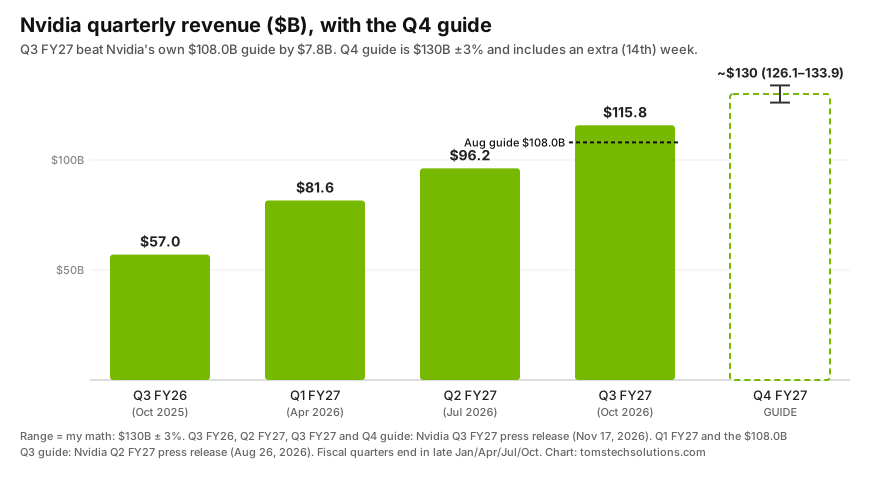
- Revenue: $115.8B, up 103% from a year ago and 20% from last quarter. Nvidia had guided to $108.0B in August, and Wall Street expected $109.1B (LSEG via CNBC). That's a $7.8B beat on its own forecast (my math: 115.8 − 108.0).
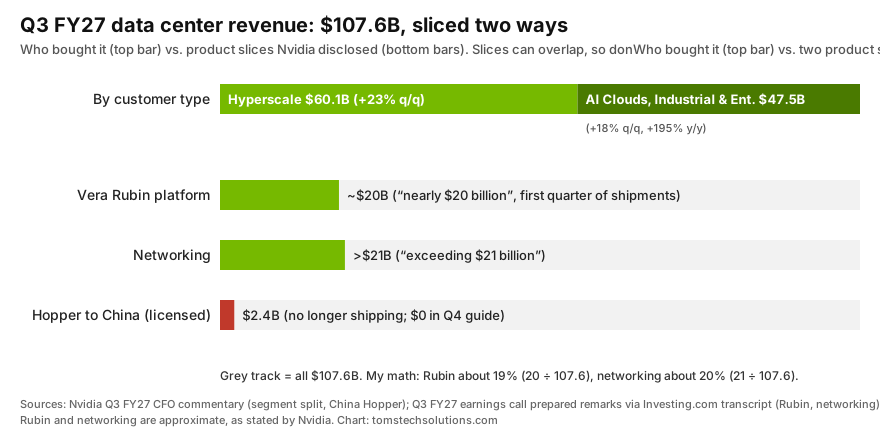
- Data center: $107.6B (+110% y/y). Vera Rubin did "nearly $20 billion" in its first quarter of shipments, and networking topped $21 billion (call transcript, Investing.com).
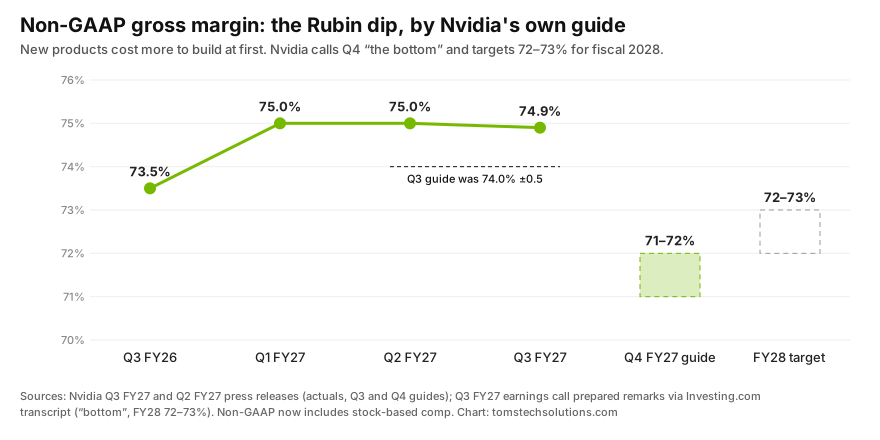
- Gross margin: 74.9% (non-GAAP), above the 74.0% guide. Q4 guide is 71–72%, which Nvidia calls "the bottom" before 72–73% next year.
- Q4 guide: $130B ±3%, vs. about $125B expected (LSEG). Caveat: Q4 has an extra week, and zero China data center compute is assumed.
- Next year: Kress raised the fiscal 2028 growth outlook to about 75%, from 70%.
- The stock: up about 3.5% premarket, then down 0.4% by mid-morning Wednesday (Reuters, CNBC). The numbers are fine. The market is pricing the CEO question, China and how the buildout is financed.
Quick jargon decoder
| Term | Plain English |
|---|---|
| Fiscal 2027 / Q3 FY27 | Nvidia's year ends in late January, so "fiscal 2027" is roughly calendar 2026. Q3 FY27 = August through October 2026. |
| Guide / consensus | The guide is Nvidia's own forecast. Consensus is the average Wall Street estimate. Beating both is a "beat and raise." |
| Gross margin | Of every $100 of sales, what's left after the cost of building the product. 74.9% means about $75 of every $100. |
| GAAP vs. non-GAAP | GAAP is the official accounting. Non-GAAP strips out some one-off items. For Nvidia this quarter they're nearly identical. |
| Hyperscale | The giant clouds: think Microsoft, Google, Amazon, Meta, Oracle. |
| Neocloud | Newer GPU-rental clouds like CoreWeave, Nebius and IREN, often built with borrowed money. |
| DSO (days sales outstanding) | How long, on average, customers take to pay. Higher means more IOUs on the books. |
| Supply commitments | Money Nvidia has promised suppliers for future parts (memory, wafers, packaging), whether or not it ends up needing them. |
The headline numbers
Here's the scorecard, straight from Nvidia's CFO commentary and press release:
| Q3 FY27 | Q2 FY27 | Q3 FY26 | What Wall Street expected | |
|---|---|---|---|---|
| Revenue | $115.8B | $96.2B | $57.0B | $109.1B (LSEG) |
| Data center | $107.6B | $89.0B | $51.2B | $101.87B (StreetAccount) |
| Edge computing | $8.2B | $7.2B | $5.8B | $7.47B (StreetAccount) |
| Gross margin (non-GAAP) | 74.9% | 75.0% | 73.5% | 74% (StreetAccount) |
| EPS (non-GAAP) | $2.68 | $2.22 | $1.27 | $2.48 (LSEG) |
Estimates are from CNBC. Reuters' LSEG numbers are within a cent or two (Reuters via The Indian Express).
To put the beat in perspective: in August Nvidia guided to $108.0B ±2% (Q2 press release). The top of that range was about $110.2B (my math: 108.0 × 1.02). Nvidia blew through the top of its own range by more than $5B. Reuters notes it has now topped Wall Street's revenue estimate for 17 straight quarters (Reuters via The Indian Express).
The company also generated $43.8B of free cash flow in the quarter and returned $28.1B to shareholders through buybacks and dividends, a record. In September, the board added $150B to the buyback authorization, leaving $227.3B to spend, which Nvidia plans to use through fiscal 2028 (CFO commentary).
Inside data center: Rubin's debut and who's buying
Nvidia's tables don't split data center into "compute vs. networking." They split it by who buys:
- Hyperscale: $60.1B, up 23% from last quarter and 71% from a year ago.
- AI Clouds, Industrial & Enterprise ("ACIE"): $47.5B, up 18% from last quarter and 195% from a year ago.
On the call, Kress said ACIE growth came from "Vera Rubin shipments to top leading neocloud customers and the start of our frontier labs building their own data centers" (transcript). Nvidia expects frontier labs (think OpenAI and Anthropic) to be about 15% of data center sales this year (CNBC).
Here's the shift I find most interesting. A year ago, hyperscalers were about 69% of data center revenue. This quarter, about 56% (my math: 35.1 ÷ 51.2 and 60.1 ÷ 107.6). The big clouds are still growing fast. Everyone else is just growing faster. Think of a restaurant whose regulars still come in every night, but the walk-ins tripled.
That's good for Nvidia's bargaining power, since no single buyer gets too big. But the walk-ins are also the customers most likely to need financing help, which comes up below. Customer concentration is still real: Nvidia said in supplemental materials that four direct customers were each 11% to 13% of total revenue over the last three quarters (CNBC).
Two product numbers came from the call, not the tables (transcript):
- Vera Rubin: "nearly $20 billion" in its first quarter of production shipments. Nvidia called it the fastest product ramp in its history. Back in August it said Rubin would be about a fifth of data center revenue this quarter (Reuters). It landed right there: about 19% (my math: 20 ÷ 107.6).
- Networking: "exceeding $21 billion." That's about 20% of data center (my math: 21 ÷ 107.6). The switches and optics that tie GPUs together are on roughly an $84B-a-year pace on their own (my math: 21 × 4).
What about Blackwell? The CFO commentary credits growth to Rubin, standalone Vera CPUs, and "the continued growth of Blackwell Ultra," and says the year-over-year margin improvement came from Blackwell Ultra mix. Kress said hyperscalers brought Vera Rubin into production "in about one month, in half the time required with Grace Blackwell." In plain English: the new racks went from delivery to doing real work about twice as fast as the last generation's.
On the roadmap, Nvidia says Vera Rubin Ultra is on track for next year and Feynman for 2028, and it expects total CPU revenue to more than double in fiscal 2028 (transcript). That CPU line lines up with what I wrote yesterday about Vera CPU racks at SC26.
Gross margin: the dip was scheduled
Gross margin slipped from 75.0% to 74.9%, and Nvidia says the Q4 guide is 71% to 72%. That sounds scary until you read the explanation. The CFO commentary says the sequential dip reflects "the initial Rubin ramp," and Kress said on the call "We expect Q4 to mark the bottom of gross margins before improving to the 72%-73% range in fiscal year 2028."
Why do margins dip on a new product? Early in production, yields are lower and processes aren't tuned yet. Like a bakery's first week with a new oven, more batches get thrown out. Reuters notes the Q4 margin guide was roughly what analysts already expected (71.7% consensus), and Kress said it's "consistent with the outlook we provided last quarter."
The Q4 guide, and the extra week
Nvidia guided Q4 to $130.0B ±3%, or about $126.1B to $133.9B (my math). Consensus was $125.1B per CNBC and $125.25B per Reuters, both from LSEG. So the midpoint is about $5B, or ~4%, above the Street (my math: 130 ÷ 125.25).
The fine print: Nvidia says Q4 "includes an additional week." That's a calendar quirk: most of Nvidia's quarters run 13 weeks, and this one runs 14. Here's a crude adjustment, assuming sales are spread evenly across the weeks (they're not, so treat this as a rough sanity check): $130B × 13/14 ≈ $120.7B. That's about 4% above Q3 instead of the headline ~12% (my math: 120.7 ÷ 115.8 and 130 ÷ 115.8). Underlying growth is still positive, but the extra week is doing a lot of the work in the headline number.
Two more things inside the guide:
- No China data center compute. Nvidia sold $2.4B of licensed Hopper chips to China in Q3, but Kress said "we are no longer shipping licensed Hopper data center products to China" and none is in the guide.
- Operating expenses jump to about $11.0B (GAAP), which Kress said reflects the extra week and "transition-related costs."
The bigger number: Kress raised the fiscal 2028 outlook to about 75% growth, up from 70%, "off what is now a higher fiscal 2027 base." If Q4 lands at the $130B midpoint, fiscal 2027 revenue would be about $424B, and 75% growth would mean roughly $741B next year (my math: $293.7B nine-month revenue from the press release + $130B = $423.7B; × 1.75). That's Nvidia's outlook, not a guarantee. Kress said it "considers data center readiness, the strength and durability of end customer demand, and our customers access to capital" (CNBC).
Supply, power and the balance-sheet tells
In my Sunday preview I said the numbers I cared about most were the supply commitments line and the receivables. Here they are, from the CFO commentary:
| Line | Last quarter | This quarter | Read |
|---|---|---|---|
| Supply commitments | $279B | $390B | Up about $111B (my math), "primarily related to the multi-year procurement of memory supply" |
| Cloud + data center lease commitments | $74B | $102B | Leases up to 20 years, starting between Q4 FY27 and FY33 |
| Inventory | $31.6B | $39.7B | Built up "to support our Rubin product ramp" |
| Accounts receivable | n/a | $81.0B | |
| DSO | 60 days | 64 days | Due to Rubin shipment timing and "extended payment terms on large, multi-quarter agreements with certain investment-grade customers" |
| Guarantees (max exposure) | n/a | $118.0B | Includes $105B of credit support for SB Energy's Ohio campus leased to OpenAI |
My read: the memory lock-up is Nvidia saying it expects to sell a lot more systems for years, and is willing to pay for parts now to prove it. The DSO creep is small, but it's the kind of number I'd watch. A few extra days of IOUs on $81B adds up. Nvidia says it hasn't made any payments on its guarantees to date.
On physical limits, the message is that chips aren't the only bottleneck anymore. "With demand continuing to outpace supply," Kress said, Nvidia is expanding capacity for wafers, substrates and advanced packaging. It announced new deals with Kinsus and Samsung Electro-Mechanics (substrates) and SPIL (packaging) (transcript). The CFO commentary is blunter about buildings: "Securing land, power and shell for data centers has become the next critical phase in the AI infrastructure buildout." In other words, you can have the GPUs and still be waiting on a building with power hookups, which is exactly the problem I wrote about with Cerebras last week.
There's a tone shift too. Kress said Nvidia is "rigorously evaluating future investments, commitments, and guarantees" and will be "disciplined in how we commit capital." Neocloud agreements stand at $32B. Under Huang, Nvidia was a big financier of its own customers. Reuters notes critics call that circular. This sounds like a CFO-run company tapping the brakes, not reversing course.
China and export controls
Two things changed this week. First, the Commerce Department moved on Monday to close a loophole that let Chinese companies rent Nvidia computing power located in other countries (CNBC). Kress addressed it on the call: "New export controls were released by the U.S. Commerce Department this week. However, with demand far exceeding supply, we expect our performance to remain strong."
Second, Nvidia's board created a committee on national security and export controls, its first major governance move since Huang left (Reuters).
The guide already assumes zero China data center compute, so the direct revenue risk to Q4 is small. The open question is indirect: how much Southeast Asian demand was really Chinese demand by another name. CNBC flags a short seller's claim that 20% of fiscal 2026 compute revenue was "driven by China." That's an allegation from a firm that profits if the stock falls, not a finding, and Nvidia has said it has no evidence of chip diversion.
The CEO question
Here's what's confirmed:
- Board chair Harvey Jones opened the call and said the board "unanimously accepted his resignation and does not intend to reinstate Jensen as CEO" (CNBC). Nvidia said it wouldn't take questions on the resignation (Reuters).
- The board hired Heidrick & Struggles to run the search (CNBC). Reuters reports the board is considering internal and external candidates.
- Huang said Tuesday he'd be "honored" to return if the board deemed it best (Reuters).
- Kress's line on the call: it's "business as usual at Nvidia."
Speculation, flagged: Ian Buck, the VP who helped create CUDA, joined the Q&A. CNBC notes some analysts see him as a CEO candidate. That's analysts guessing, not a signal from the board. Reuters also reports, citing two unnamed sources, that U.S. intelligence agencies are looking into Alice Huang's ties to China's Ministry of State Security. That's unconfirmed, and it's about Huang's personal conduct, not Nvidia's numbers. For the backstory, see my Nov 14 post.
The stock: beat, raise, shrug
- Tuesday close: $155.46, down 0.48% (Investing.com). That's down about 25% in November going into the print (Reuters).
- After hours: up nearly 4% (Reuters).
- Wednesday premarket: up 3.5%, with neoclouds Nebius (+7%) and CoreWeave (+5.4%) up even more (Reuters).
- Mid-morning Wednesday: "Nvidia pop fizzles," with the stock down 0.4%. A close lower would be its fifth straight daily drop (CNBC).
Harris Financial Group's Jamie Cox summed up the mood to Reuters: "Any company would kill to have revenue, earnings and a pipeline like this, but the stink on this company hasn't worn off yet." Saxo's Charu Chanana put it more politely: "strong earnings have bought management time" (Reuters).
My take
- Demand: not the problem. A $7.8B beat on its own guide, Rubin at about a fifth of data center in its first quarter, and a raised fiscal 2028 outlook with zero China in it. If the AI buildout were cracking, this is where you'd see it first. You don't.
- The guide is strong, but read the extra week. About $130B looks like +12% quarter over quarter. Per week, it's closer to +4% by my rough math. Still growth, just not a hockey stick.
- The margin dip is the cost of a new generation, not a price war. Nvidia told us in August it was coming, and it says Q4 is the bottom. If fiscal 2028 margins don't recover to 72–73%, that's when I'd worry about pricing power.
- The thing to watch is the financing, not the chips. $390B of supply commitments, $118B of guarantees and a slowly rising DSO mean Nvidia is carrying more of the ecosystem's risk. Kress's "rigorously evaluating" language suggests the new management team knows it.
- I could be wrong about how much the CEO search matters near term. The board gets to set the pace, and products that ship in 2027 and 2028 were designed years ago. But the dealmaking that filled the neocloud pipeline was very Jensen. Who replaces that, and whether anyone does, is the real long-term question.
Next up
- Thursday: Anthropic's Nasdaq debut breakdown, once there's real trading data. It's set to price later Wednesday (Reuters), and sources told CNBC it's likely to come in above its $70–$78 range (CNBC). It's also an Nvidia customer: Kress said on the call that Anthropic's annualized revenue reached $81 billion at the end of October (CNBC).
- Still watching: Nvidia's CEO search, how the new Commerce rules hit Southeast Asian sales, and whether DSO keeps climbing next quarter.
Not investment advice. Forecasts and product timelines are Nvidia's own, and the call quotes come from Investing.com's AI-assisted, editor-reviewed transcript.